
0:28:26
Growing with Django's Open Source Community with Clifford Gama
Published April 8, 2026
Djangonaut Space 2026
This video features Annabelle Wiegart from Djangonaut Space 2026.

In this guest talk for Djangonaut Space Session 7, Annabelle Wiegart shares her journey from newcomer in tech to Django contributor, PyLadies Zurich organizer, and Djangonaut Space captain.
Annabelle explores how finding a supportive community changed her relationship with open source. She discusses her path into contributing to Django, including working on ORM tickets and nullable expressions with mentorship from experienced Django contributors, and reflects on the mindset shift that made participation feel possible.
Automatically transcribed, so expect mistakes in names and technical terms.
Speaker 1: Welcome everyone to the first talk of this session 7 of Django Space. Today we are happy to welcome Annabelle as our guest speaker. Annamili is a software developer at an academic library and an active member of the Python community where she helped organize her pilot this touric. And after taking part of the Dragonut Space Djangout, she's now and she's now back here at session seven as the captain of the Pigware team. So today Annabelle shared with us our her open source journey with us. Thank you for being in. Annabelle, the floor is yours.
Speaker 2: Thank you so much, Garafi, for the introduction. Thank you very much, DjangoNot Space, for having me, and thank you all. for joining. I would like to share the story of my open source journey so far with you. Welcome to my talk from Librarian to DjangoNot. During my studies, I had courses, among other things, like introduction to Python and relational databases. And back then I didn't know that I love coding, but I discovered it there and it was a surprise to me. So after studying, I worked
Speaker 2: as a classical librarian for some years, and during that time I went on studying Python with online courses. And about six years ago I applied for a position as a software developer at the IT department of the library I was working at. Which is Centralbibliothek Zürich, a large academic library in Zurich. Yes, and I got the job and I was able to learn a lot more on the job, and today I develop and maintain smaller Python and Django applications for internal library workflows.
Speaker 2: I had to find my community. In the beginning I didn't have any um like coder or python community. So two years ago I went to my first Python conference, which was the Swiss Python Summit in Rapperswil by the Zurich Lake. And it was my first tech conference in general. So I went there, I was really excited, and I knew that there were not gonna be a ton of women in the room. But when I entered the space, I was still a bit shocked. There were maximum maybe 10% women and folks from gender minorities in the audience
Speaker 2: and only one in sixteen speakers was not a cisgender man. And I was surprised how almost physically I could feel or I got this feeling that this space was not for me. And that I was never get gonna get up on that conference stage. And I I realized I I needed uh some form of um friendlier Entry point to the Python community. So I had been listening to some Python podcasts and I had heard about the PyLadies organization.
Speaker 2: So PyLadies, I suppose most of you know it, but I'll uh um summarize it anyway. PyLadies is uh an international mentorship group for underrepresented genders in the Python community, and it uh in it promotes a diverse Python community through education, events, social gatherings, etc. So I was trying to find the Pie Ladies chapter near me. I checked the map and then surprisingly there was not a single chapter in Switzerland. And I thought that needed to be changed. So with my colleague Sarah and her friend Janine, we founded Pilates Zurich. And we tried
Speaker 2: to create an empowering and inclusive space where people can learn and grow together. In the last one and a half years we've hosted a series of meetups where people could share some project of theirs, whether it was from work or a personal project. and we really love to see the connections that form at PyLady Zurich and we have seen several regular attendees become speakers at our events which is really nice. And we've for example we've had someone present a personal project which is a book recommendation app called Narrowoon
Speaker 2: and we've had another person um who is a designer present on her work in creative coding. Community organizing is one form of open source contribution But I also had this dream of becoming an open source code contributor. I really love open source software. Obviously I use Python and I use Django, but I also use A lot of other open source apps such as Joplin for note-taking, Blender for 3D modeling, and Tusky for connecting with folks on the Mastodon social network. I really love this idea of software being driven by communities and not commercial interests.
Speaker 2: It's also very appealing to be part of a friendly community, to meet nice people with a shared interest. And what is also very valuable to me is like to learn how to collaborate with a lot of other contributors on a large code base. which is something I don't get to do so much at work. And Django was my first choice for open source code contribution. I started to learn Django about seven years ago and I've used it on a lot of um learning projects. On the left you see, for example, a project that I I tried to
Speaker 2: start an ecology data visualization blog, which unfortunately got only one post. because I was trying to teach myself too many things at the same time, like data visualization, web development, and also writing and Yeah, analysis of ecological data, which I'm not an expert in. So I did those learning projects and at work I also developed an app for map for an acquisitions workflow. which I call the bibliography service API. Yes, it has a RESTful API that interacts with other programs. And after a few years of using Django, I thought, yes, maybe I could try contributing
Speaker 2: And I re repeatedly looked at those tickets in track and I I couldn't understand anything and yeah every time I looked I thought wow this is Maybe I'm not ready yet and somehow I had this idea in my head that um all these people who worked on Django Like they knew it all. They they look at these tickets and they instantly know what to do and they don't need any help and they do everything alone and if I'm not there I can probably not contribute But then I found DjangoNot Space and I applied for session five and I was accepted. I was very happy about that and I was able to work on Team Neptune with my lovely
Speaker 2: fellow Django Nauts Hua Yong and Anthony. We worked on Django Core and it was an amazing experience to me. I felt really empowered through the through the program I learned to overcome my fear of asking questions, so I asked a lot of questions, I learned a lot, and I really got the feeling of appreciation that my contribution matters and I also became part of this fantastic community, which I'm very happy about. And now I'm trying to pass some of that on as a captain. Since the beginning of my Django Not journey, I was interested in the ORM
Speaker 2: Django's database layer. So how do you enter the ORM? You have to find some approachable ticket in the beginning to work on somewhere. My first ORM ticket was during the session five of DjangoNot Space. It was a documentation ticket, but it was still quite tricky. But in the end I was able to document an a rather unexpected behavior of the query set filter and the exclude methods when it comes to traversing many-to-many relationships. So it's great to be mentored through your first or
Speaker 2: M ticket, but then you have to find a second one. And uh so Django session five finished. Um and I still wanted to work on the ORM, but all the other ORM tickets still looked super complicated to me. And that's when Jacob Wals um approached me and suggested a second or M ticket by marking it as approachable and I was really grateful for that because I would not have uh thought I could solve that ticket on my own but since he said okay I think this ticket is approachable I gave it a try
Speaker 2: and with some help I was able to fix the bug described in the ticket And I also learned a lot during the review process. And currently I'm trying to dive even deeper into the ORM and I am starting to work on the handling of nullable expressions in the ORM. I'm also getting a lot of mentorship by Jacob and also by Simon Charrette, a very experienced um Django ORM contributor. So right now I'm working on this PR, which is about a bug in lookups when it comes to null values.
Speaker 2: So for my Django contribution and ORM journey, an in-person sprint turned out to be a real game changer. In September this year, I joined Django on the Med, a three-day Django development sprint in Pescara, Italy. We were about 20 or so Django contributors who came together, worked three mornings on Django and in the afternoon did lovely things like biked Tours and excursions in medieval cities and uh yeah, uh swimming uh in the ocean and um Yes, so
Speaker 2: the one of the greatest things about it was that it was the first time that I met um Django. people from the Django community in person. So in the left picture you uh you see all the people from Djangonaut Space that I met in person. Let's see if you recognize some familiar faces And in the right picture you see me sitting next to Jacob. And Jacob uh that was the first um Sprint day and he was onboarding me on uh this topic of nullable expressions in the ORM. For the rest of the sprint, I would um Get a lot of mentorship by Simon, whom I have mentioned before, and
Speaker 2: that was just invaluable to me. He would sit next to me and walk me through the code and um explained some important um or am concepts to me. He did this in a really nice way. He also gave me some tasks like to understand things better. And one thing I really liked was that also at one point he said, yeah, with time, I would like you to understand things and also to form your own opinion about it. And that really made me feel like a peer, although I needed a lot of help at that moment. So this really motivated me to go on.
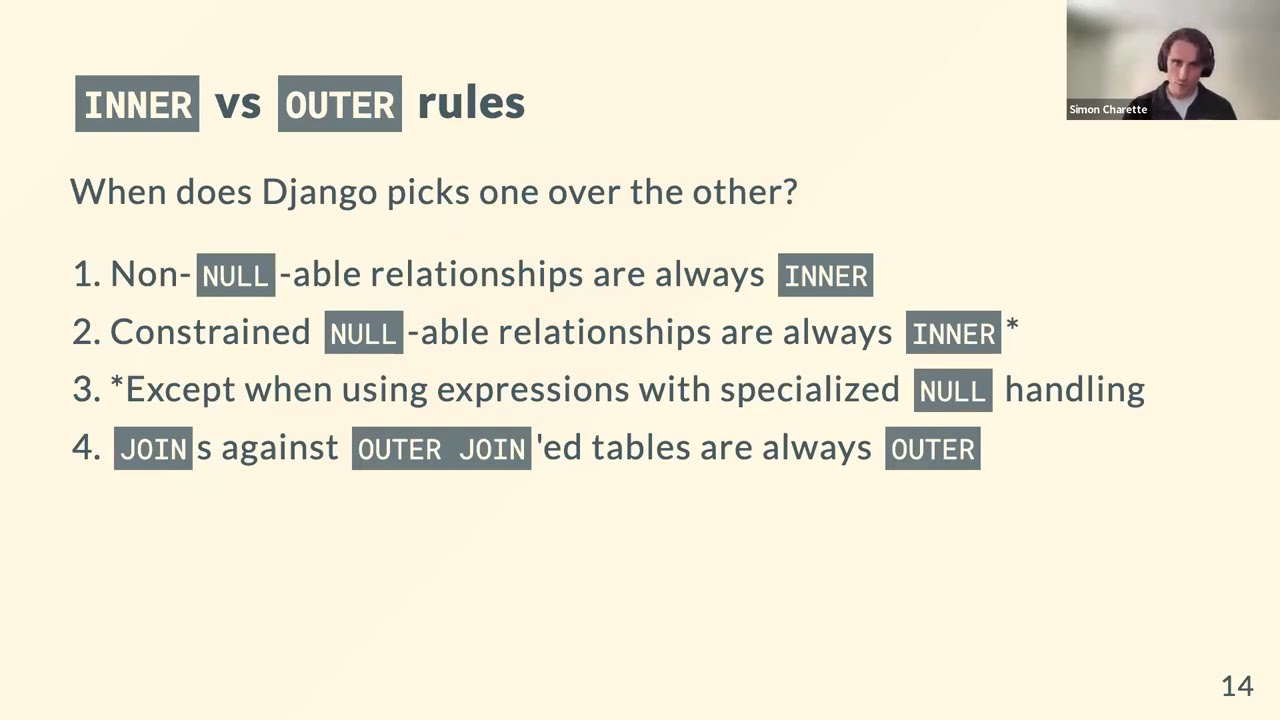
Speaker 2: By the way, if you haven't watched it yet, I I highly recommend um Simon's uh talks That were also in this series of talks. One of them is called Demystifying the ORM and there he explains how the Django ORM translates query sets to SQL lookups um and back into Python like Django um model instances. So all of these learning experiences really start to shift my mindset. When I started working as a developer, I really felt the need to To prove my competence all the time, like to hide my lack of knowledge and pretend I know everything
Speaker 2: Maybe I felt some pressure because I was given a chance to learn on the job and I I felt I had to have to prove that I'm getting there. I'm not sure why. But um These days I'm thinking a lot about how we can create environments that that enable people to learn and grow together. Yes, and it's really I think we should um stop seeing the net lack of knowledge as a weakness. It's if we if we treat questions a as something valuable and shift to this mindset that we can Solve problems together, then we can all
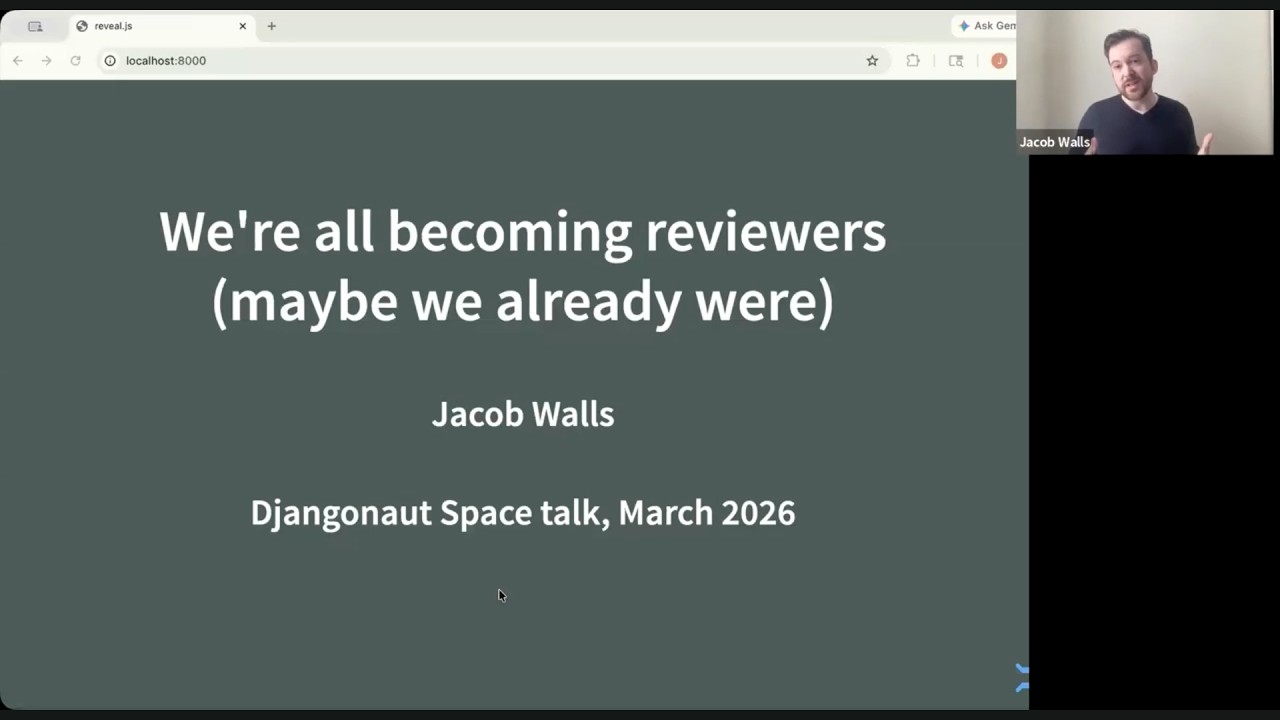
Speaker 2: learn and grow so much more I would also like to thank Lillian and Juliana for our inspiring discussions at Django on the Mad. which really made uh me realize some things and and see things more clearly in this in this area. Also in um in Jacob 's talk uh in session six uh about Sorry, I forgot the title. It was about reviewing PRs. We we can all become reviewers or something along those lines. Um he said something that also made a difference for me, which was the main work happens in the review process, the
Speaker 2: like the main view um work on a PR. And that really shifted my mindset because before I thought okay I have to make this perfect PR and if I'm lucky it gets merged right away But then I realized no, like I can't come up with this brilliant PR on my own. I really need the review dialogue. That's where the magic happens basically. Yeah, some realizations that I had along the way is for example that you can you can go step by step. It's it's okay, you don't have to learn everything at once or like uh spend your your whole weekend on a
Speaker 2: on a PR, small contributions are valuable and if you um if you contribute consistently then Yes, the the worth of this will prove over time. Also, it's not all about technical skills. Communication skills are actually pretty important. Um and make the whole process a lot uh smoother And I feel that in general we can't emphasize enough that success always depends on help by others. Nobody comes up with brilliant Solutions on their own.
Speaker 2: We always need some help by others. This is true in general, but it's also true for open source. And we, if we want to make um communities and also the contributor communities thrive, we really need um inclusive spaces. Yeah, I feel like Django North Space is doing such a great job in creating such inclusive spaces, and I'm also trying to understand how this works? Why do I feel like really ignorant and you know like not valuable and and stuff in in in one place and in the other place I feel like Wow, I can really participate in the conversation.
Speaker 2: I have something to say, I have something to give. And yeah, I'm trying to understand how that works. I think one of The important aspect is to make people feel safe. Yeah, at Palladi Zurich, for example, that also means stating very explicitly that trans folks are um welcome at our events. Inclusive spaces are also about inviting everyone into the conversation. If you have a really quiet person in the in the group You probably just haven't figured out the right question to ask them yet. Everybody has something interesting to
Speaker 2: share. And just being interested and supportive is really important for creating an empowering space So looking back on my journey so far in open source, I feel a lot of gratitude. So looking back on those, uh on that first Python conference two years ago when I thought I was never going to get up. on a conference stage. In the picture you see me last week announcing the Pie Ladies lunch and and talking about Pie Lady Zurich, inviting new people to become members.
Speaker 2: And uh yeah, look at me now. I'm speaking here, which also took a lot of courage, and I am also thinking about um submitting a proposal for DjangoCon Europe next year. A friend of mine who spoke at Swiss Python Summit this year told me that my encouragement really helped her submit that proposal, which also made me very happy. And I was able to host my first Django contribution workshop with PyLady Zurich, which feels like a big achievement So that was my story. Thank you very much for listening to it
Speaker 2: and I would be happy to chat and hear your reactions, maybe what parts of my story you can relate to if there's some things that resonate with you.
Speaker 1: Thanks so much Annabelle. Let's see if we have some questions. Feel free to To raise your hand for it, put some question in in the in the chat, whatever you want. Meanwhile I have a question for you, Annabelle. I want to ask you when you started with with the new chapter in uh in Switzerland. How do you approach, for example, having new people? How do you for example creating a community? Where do you find people to join?
Speaker 2: So I think we're still in the process. We have in in our past meetups we had around maximum 20 people join. It's a small community so far. But one approach is to just so we have an account on meetup. com and I think the algorithm does the job to make people you know, find us. Um we also post um on LinkedIn and on Mastodon. And we also approach um companies to ask them whether they want to sponsor us or host events. So that's also a way to make us known and also So far we've only been at
Speaker 2: Swiss Python Summit, but another approach is to join different conferences and talk about the community there.
Speaker 1: Yes.
Speaker 3: That was a great talk, Annabelle. Um I have two questions. Uh the first one I think is yes no. Is is all the the artwork in your talk hand-drawn from you?
Speaker 2: No, it's um hand-drawn from my partner. And I didn't use any any thought to to create the slides also. I used LibreOffice Impress actually
Speaker 3: Very cool. I like it. It's I like that touch to it. Um my other question is uh was there something specific that helped you get over your fear of asking questions? Because I think A lot of people have that and I'd just be curious what what got you over the hump?
Speaker 2: I think Django Not Space played a big role in that. I think that when you see more experienced people being really humble and approachable and just normalize, you know, like people not knowing things, um seeing other people ask questions Yeah, see seeing seeing other people like um showing that they're not perfect, that I think that really helped me. And also the reaction. So when you start to open up and people
Speaker 2: are really interested in you, like Yeah, I sometimes it's hard to put it in words. It's more of a feeling, but like When people are show interest and and are supportive, I think it's really it's really the environment that makes the difference. It's not inside of me. It's the people around me that make me feel safe and comfortable and will empower me that and then I can ask questions and show vulnerable I think.
Speaker 3: That's fair. That's totally reasonable. But I also do want to acknowledge like it does require you to be like brave and courageous to It doesn't matter what the environment, it's still a little challenging. So they um yeah, don't lose sight of that. That's cool. Thank you.
Speaker 1: 100%. I can relate with what you said, Annabelle, that you uh that the environment really helps you to thrive I I have another question. Um what now that you are uh in a in a mentorship position um how do what could be your suggestion your uh um for other people that want to approach uh your your SIMPAT uh how do you find the um some some ideas or something that could uh that have helped you during your your path to become a mentor
Speaker 2: So I think it's for me it was really important to connect with other people. online or even at like I I would also really recommend if possible to go to in-person events, go to conferences, go to sprints I think in in every Django Con um there is also a development sprint, so that could also be a very nice place to to deepen your um connections with other people and also your uh dive into Django and and learn Like help yeah. I think that's the most important thing.
Speaker 2: Talk to other people, um hear their stories, tell you tell your story.
Speaker 1: Yeah, the connection, the community, it's something that I I do I do really appreciate uh doing your talk. So thanks so much, Annabelle. Thanks so much for sharing your very inspiring path during the open source journey with us. It was great. Thank you so much.
Speaker 2: Thank you. Thank you so much for having me
Note: We understand that names change, people change, and bodies change. We respect each individual's journey and privacy. If you have any concerns about a video or need us to remove content, please don't hesitate to contact us. We will handle your request with care and promptly address any issues.
Published April 8, 2026
Published March 24, 2026

Published December 12, 2025

Published November 12, 2025

Published November 11, 2025
Published October 23, 2025