
0:11:18
Video Tour of Wagtail 8.0
Published August 26, 2026
Wagtail CMS 2026
This video is from Wagtail CMS 2023.
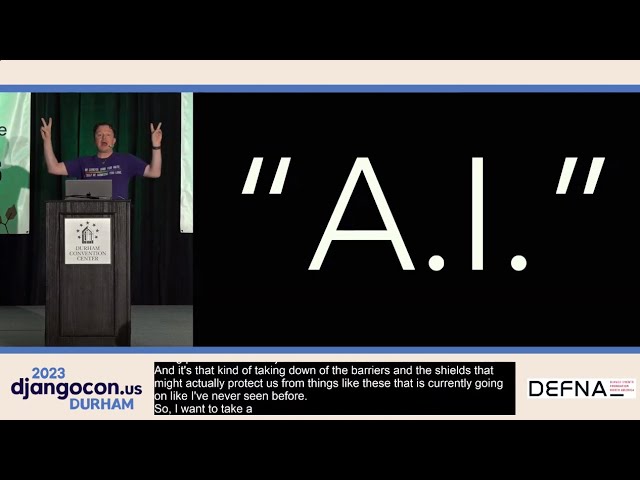
In my 2023 talk at DjangoCon US, I implore y'all not to buy into the "A.I." hype.
“Those who cannot remember the past are condemned to repeat it.”
– George Santayana, The Life of Reason, 1905.
Congratulations, technologists! We have reached a new record for the height of the peak of inflated expectations with the hype surrounding “A.I.” If you believe the recent press, “A.I.” is going to be capable of everything, with some even talking of immortality.
It is wonderful to be excited about new technology available to us, but this is at a level I have never seen in my career. There have been numerous lessons from the past that illustrate why we should avoid these levels of hype.
Is “A.I.” going to change everything? I don’t buy it, and in this talk, I’ll explain why.
The speaker argues that today’s “AI” is mostly machine-learning models, not intelligence, and that describing them with human terms such as “hallucination” obscures the responsibility of programmers and companies for their errors. He compares the current excitement with earlier hype cycles around Second Life, blockchain, crypto, and other technologies, which eventually found useful niches but failed to transform everything as promised. He warns that unreliable generated information, environmental costs, commercial pressure, and the use of these systems in education and elections could further damage shared standards of truth. He calls on technologists to speak up, explain the risks to their communities, and help separate genuinely useful applications from hype driven by profit and competition.
Summarised automatically from the transcript.
Automatically transcribed, so expect mistakes in names and technical terms.
Speaker 1: And his talk, Don't Buy the AI Hype. And as long as there's time, Tim would be happy to answer some questions afterwards. So here we go. Thank you very much, Tim.
Speaker 2: Thanks everybody Good afternoon. It's awesome to be here. Great to be back at DjangoCon US. Durham is my second hometown. So my partner lives here. And you know, just seeing Dawn's talk and all the talk about Django Girls and how Dawn got her start at Django Girls 2016, well on Sunday, my partner's child. They did Django Girls for the first time with Dawn leading the effort. So it shows the beautiful cycle of the community we got here that uh my partner's 11-year-old child did Django Girls and got all the way through models and getting it into the admin And then they got distracted by writing some blog posts about Pokemon. But I'll take it as a win if you can get an 11-year-old all the way into the admin and have it working. So that was awesome. And it's it's lovely to see a community here that I care about so deeply, you know, congregating here in Durham.
Speaker 2: And uh this is my the second year my Philadelphia Phillies have been in the playoffs during DjangoCon US We hope for a slightly different ending to the script this year. But it's also my second year giving a last minute talk, so I guess I'm the pinch hitter coming off the bench. So uh hopefully I I can hit a metaphorical home run here. I also wanted to give a big thank you to Jeff to DEFNA and all the DjangoCon organizers. The amount of effort that goes into planning something like this is immense and I really appreciate it. So let's take a minute to thank all the organizers. And especially the ones from here in Durham. I helped host DjangoCon 2016 in Philadelphia and the amount of effort and blood, sweat, and tears and love that goes in from the local organizers to really show off their town It's a huge amount of effort. So a huge thank you to all the organizers from Durham and the city of Durham, which has just been so welcoming.
Speaker 2: So thank you so much. And most importantly, thank you to all the attendees for coming. DjangoCon US would be incredibly boring without all of us. So this community is fantastic. So let's dive in. Who I am? I'm a principal engineer at Wharton Research Data Services at the Wharton School. I'm a Python Software Foundation member and a Django Software Foundation member. I'm a member of the Wagtail Core team and an occasional on-and-off DjangoCon US organizer. I've been writing code since 1980, when the Phillies won the World Series, oddly enough. I was six years old, and uh I live and breathe technology, and I have my entire life. Over those years, I've seen a lot of tech trends. I've been closely involved with a few of these overhyped trends over the years, and I've contributed to the hype myself in the past.
Speaker 2: So I'm hoping I can share some of the mistakes that I've made in the past so we can all learn and avoid some potentially dangerous pitfalls. Who I am not is an AI expert, a Chat GPT zealot, or a meta -lama herder But I've immersed myself in technology my whole life, and at the risk of sounding like the metaphorical old man yelling at the kids to get off my lawn, I've seen these patterns repeat themselves. The first primitive AI programs I used were in the late 1980s, and they were based off the ELISA program, which was developed at MIT in the 1960s. ELISA was the first program where you could type in some text to a computer. It would analyze the sentence and pick out the most important word from the sentence, the most important token, and spit it back to you like a therapist.
Speaker 2: And this was the first time that people would ever interact with computers for the next 20 years in programs like these and wonder if they were talking to a human or not. And a a term was coined out of this called the Eliza effect. The Eliza effect is a tendency to project human traits, such as experience, semantic comprehension, or empathy, into computer programs that have a textual interface. The effect is a category mistake that arises when the program's symbolic computations are described through terms such as think, know, or understand. And that's the Wikipedia definition. And did that sound familiar to anything we're hearing lately? Because it does to me. So I think it's important that we take a little bit of a step back in time and know thy history.
Speaker 2: The Santayana quote, those who cannot remember the past are condemned to repeat it, seems particularly apt at this time. So in July 2023, a report from the professional services firm KPMG found that 97 % of the 200 senior U. S. business leaders it polled anticipate that generative AI will have a huge impact on their organizations in the short term. 93 % believe that it will provide value to their business, and 80% believe it will disrupt their industry. And I'm not here to say that that's wrong, but it's that kind of thinking that allows tech bros You know the folks who were really into blockchain about 18 months ago and are now suddenly all into AI? To dominate the media cycle.
Speaker 2: We've got to stop falling for it because this level of hype blocks us from improving the human condition with technology It makes it impossible to find the true utility of new technologies by blinding the world with both hype and fear. So I believe there are definitely useful technologies and teaks and techniques behind this curtain that's currently being called AI. But the race to the bottom here is dangerous and it is a race to the bottom. For example, Google was not going to release its AI programs because they thought it needed more study and was more dangerous. but only did after being pushed forward by Chat GPT because it became an arms race. And it's that kind of taking down of the barriers and the shields that might actually protect us from things like these
Speaker 2: that is currently going on like I've never seen before. So I want to take a moment here and talk about AI. And I keep putting AI in quotation marks because let me be very clear about this, it is not artificial intelligence. The accurate term for what the hypsters are currently calling AI is machine learning models. It is only one subset of what may one day be called artificial intelligence. These models are advanced and have parameter accounts in the billions, but let me be clear, they are not artificial and they are not intelligent. This is a chart from a 2010 paper 13 years ago outlining the different fields which may someday come to make AI.
Speaker 2: As you can see, there are many fields which must coalesce to achieve the dream of artificial intelligence, and even then, it is likely a misnomer. If you take a look, what we're largely talking about now is just one-sixth of the pie wedges of this puzzle, the machine learning wedge up there in the upper left. And we have to stop giving these human attributes to machine learning models. It's dangerous. Here's one example. Right now, a lot of AI folks like to say that models hallucinate. This removes responsibility for algorithm coders and model trainers. These models do not hallucinate. They make stuff up because a programmer using a random generation function decided they should.
Speaker 2: Their responses are frequently inaccurate, laughably so, but it isn't really funny. We are already seeing real-world consequences of this, driving us even further away from a collective shared truth than we already are. By saying they hallucinate, we are removing the responsibility of the programmer and the model trainer to be ethical. This is the Gardner Hype Cycle for Emerging Technologies Chart for 2023. And if you're not familiar with the Gartner Hype Cycle, it's something I've come to know over the many years as I've watched technical trends. And again, this is really about machine learning models. You can see right now it's at the peak of inflated expectations
Speaker 2: called generative AI. The peak of expect of inflated expectations, or as I like to call it, mount hype, is higher than any I've seen in my 40 years of technology. The curve of the Gardner-Hype cycle chart is incredibly similar to another curve chart. This is the curve of the Dunnen-Kruger effect. These two charts being close to identical is not a coincidence. The Dunnen-Kruger effect has shown that people with limited competence overestimate their abilities. While high performers tend to underestimate their skill. We're at a crisis point in the United States. Our education system has left a sizable portion of our population behind.
Speaker 2: And the unfortunate truth is this portion of the population is easily misled. We saw this in the 2016 election, with the effect that foreign actors using troll farms had in seeding divisive content within American social media networks. This was before the recent AI explosion, and I truly fear what might be coming our way in the 2024 election. And regardless of your political persuasion, I think we can all agree as Americans, we don't want Putin and Xi to regularly have their thumb on the scale of our elections. And if you're one of our friends who are here internationally, you know just how much the effect of an American election in which you do not get a vote affects your life. It's substantial. We've made ourselves easy targets for our adversaries to divide and conquer, the oldest rule of attack in the book, and have yet to develop against uh a defense against this new weapon we've developed and just released into the wild.
Speaker 2: So let's take a bo a little bit of a history lesson here and look at some technology trends through the past 25 years or so. So if we go back to the early 90s, What I like to call virtual reality and the metaverse part one was soon after the movie Lawnmower Man came out, and everybody was convinced virtual reality and the metaverse were going to change everything. Snow Crash had just come out as a book and yeah that was where things were gonna go. VRML was a hot technology back then and then it faded and then in the late nineteen nineties we had dot-com insanity investments in all kinds of crazy companies. If you've never seen Startup by comm it's a hilarious watch. And portals were a big thing. Yahoo and portals were gonna be the next big thing. In the early 2000s, we moved into Web 2. 0 or JavaScript actually kinda sort of works part one.
Speaker 2: There were like eight parts to that movie In the mid-2000s, we moved back into VR part two with Second Life and the amazing wave that Second Life got in 2005, 2006, 2007. Everybody was gonna move to Second Life. Email was gonna be defunct All our meetings were gonna happen in Second Life and Virtual Reality. And I got caught up in this hype wave. A little more on that later. But there was also Google Wave. Remember the three glorious weeks of Google Wave before it got shut down? That was gonna change everything. Then in the late 2000s we had big data. And remember 3D TVs and movies? Like every TV you got was a 3D TV for like five years and now nothing is a three D TV? I don't know what happened to them, but I guess Avatar came and went and that was a quick fad. In the early two thousand and tens
Speaker 2: we had the Internet of Things and Siri and Alexa and even Apple employees now. There's not a week that goes by that I don't see a secret leak about Apple employees secretly hating Siri. And in the mid-2010s, wearable UIs, remember we were all gonna have clothing that were like screens and could broadcast our feelings and stuff, and 3D printing was gonna take over everything. Then in the late 2010s, very recently, we had blockchain and web3 and crypto, which were gonna change everything. And just recently, we had virtual reality in the metaverse, and Mark Zuckerberg decided to rebrand Facebook as Meta. And then destroyed that for everybody because anything Zuck changes can no longer be cool. And this list is just a microcosm of the over overhyped tech trends throughout the years. I won't even go into Justin Bieber dropping a million dollars on an NFT
Speaker 2: How's that investment feeling these days, Justin? Pretty good? All of these eventually became useful tools in the technology toolbox, but didn't live up to the hype. We see this pattern over and over again, yet we let it happen over and over again. And who does it benefit? The media get clickbait by hyping up a technology to the peat of inflated expectations, mount hype, and then by tearing the technology apart during its descent into the trough of disillusionment. Tech Bros dreaming of get getting rich quick, pump it up to get investors to be done with their money. That's who benefits And, you know, I've been around for a long time and seen many hype cycles, but this AI hype cycle is next level. It's unlike anything I've ever seen in my lifetime. So let's take a look at a little bit of history.
Speaker 2: Second Life is a continuous virtual world that has been available to the public since 2003. I was one of the first users. It is the closest thing anyone has come to creating the metaverse described by Neil Stevenson in the Snow Crash, and the amount of hype it got in the mid-2000s Was truly amazing. When I first started as a Second Life user, I was like one of the first hundred users. It's made up of simulators, and each simulator is a 256 by 256 meter virtual region And there were maybe 40 or 50 of these at the time. They're now tens of thousands. And believe it or not, Second Life is actually one that survived this. It still exists today. and is a profitable company and has more active monthly users than have ever done a single transaction on blockchain.
Speaker 2: It was featured on the cover of Business Week. With an article inside featuring Years Truly, my fifteen minutes of fame, Reuters had a bureau in Second Life with a full-time dedicated reporter. And IBM was all over it. So I accidentally started a company on a dare called SL Boutique. When somebody said they didn't think I could pull this off technically, I took some time and I created a portal where anybody who created content within Second Life could sell it through this common web portal. So you could do a primitive search, find what items you wanted, and in real time through an XML RPC call, it would deliver the item to the person buying it within the virtual world and make a payment to the person selling, and I would take a small percentage cut.
Speaker 2: It was uh it was actually pretty cool. And after a year it had grown so explosively that either I knew I would have to quit my full-time job Or find somebody to take it over. And I found a company called the Electric Sheep Company, named after, of course, the Philip K. Dick novel. Um and they wanted to buy it from me after a year for a kind of ridiculous sum of money for something I had done as sort of a a a joke, a side project. And uh they had just received over seven million dollars in angel investment funds from CBS, like the broadcasting company, not an angel investor, from the actual TV channel CBS Viacom. And uh you know the hype level at this time was insane. Uh the CEO of electric sheep company, Sibyl
Speaker 2: Verbeck, was appearing on stage with Les Mumvez, the CEO of CBS, like talking about the future of the metaverse and how everything was gonna happen there. It was absolute insanity. And at the same time, while running SLBT, I became the first person to sell real-world items for a virtual currency. This was long before Bitcoin. We sold computer monitors and NVIDIA video cards for Linden dollars, the currency in Second Life. The Guardian, formerly the Manchester Guardian, and MTV both covered this. The hype level was absolutely insane. The electric sheep company did an episode of CSI New York in Second Life that won an Emmy where Gary Sinise had to come into Second Life to track down the murderer.
Speaker 2: It was absolutely insane. And Jay-Z did a performance on Jimmy Kimmel's late-night talk show In a virtual arena, and the colorful 3D landscape of Second Life was talked up as the future of commerce, advertising, job recruiting, and even dating. Then the hype died down, the media turned on it, and Second Life went from being the media darling to its absolute whipping boy, and the media completely turned on it. And most people haven't thought about Second Life for fifteen years since it had its eighteenth. Months in the sun. So it did not change everything. But let's look at a more recent example. Fresh in our memories. So here's a simple three-step process. Find the social media account of somebody overhyping AI.
Speaker 2: Scroll back 18 months. And look at all their tweets over hiding over hyping blockchain and crypto. It's a really easy experiment. So Bitcoin was started in 2009. And the first Bitcoin transaction for a tangible asset happened five years after I'd done it with the Linden dollar. On May 22nd, 2010, two Papa John 's pizzas were delivered for 10,000 Bitcoin. At the height of Bitcoin's value, that is $680 million, or $340 million per pizza. But the hype didn't really start up until a few years later. In 2017, companies started putting blockchain or bitcoin into their names just to increase their stock value. And this company, Tulip Biomed, changed their company name to Bitcoin Services, and its stock increased 42,500%.
Speaker 2: From being a penny stock until a 42 cent stock, and is now back down to being worth just over two cents per share But by changing their name and doing this pump and dump scam, some people got very rich over a company that had nothing to do with blockchain or bitcoin. They just changed their name. And many companies were doing this. During the 2022 Super Bowl, crypto and blockchain reached a feature a fever pitch with Coinbase, Crypto. com, and FTX buying spots, including the infamous QR code ADSPOT Coinbase's stock has since plunged 90%. Crypto had Matt Damon encouraging people to buy and calling you a wuss if you did not buy crypto. And those who did lost an average of 50%
Speaker 2: of their investment since that day. And then there's FTX. How's that going? FTX collapsed nine months after the Super Bowl ad in November 2022 after solvency concerns involving their trading firm arose. This shook the already volatile crypto market, causing losses in the billions. This caused a liquidity crisis and a desperate search for bailout funds. And the rival exchange Binance considered buying portions of the company, but quickly backed out. And within a few days, FTX's CEO, Sam Bankmanfried. Bailed out, and the company filed for bankruptcy. Within a few hours of the bankruptcy being announced, FTX was hacked and hundreds of millions worth of tokens were stolen
Speaker 2: Bankman Fried was arrested in the Bahamas and extra extradited to the United States in late December. Mining crypto took so much energy that the only place to make a profit pretty quickly was in Iceland because geothermal energy makes electricity basically free. And we as a society started to talk about the environmental cost of crypto, but that environmental cost is dwarfed by training these machine learning models, AI. Microsoft's latest sustainability report showed a 30% year-over-year increase in water usage. That's $1. 7 billion with a B more gallons used in just one year.
Speaker 2: There's an open AI data center owned by Microsoft and Des Moines, Iowa. Due to the mammoth increase in water usage, the local water utility, West Des Moines Waterworks, will no longer consider future data center construction in the area despite the boon for employment it would be, unless they can significantly decrease their water use. usage as it is already affecting the local drinking water availability. At some point we're really gonna have to ask ourselves, you know, is this worth it? Is this worth it? With the current hype around AI, we face a far more dangerous problem than with Second Life Crypto, blockchain, or any of the other tech bro -driven trends of the past several decades. We already face a large problem with a shared collective truth that is driving humanity farther to extremes.
Speaker 2: In 2016, I witnessed an election in the United States decided by less than 80,000 votes across three states. I'm convinced at least 80,000 votes were swayed by troll farms created by bad foreign actors, increasing the amount of outrage about what were really non-issues with lies and deceit. We're coming up on another election in 2024, and I believe we are wholly unprepared for the onslaught of these LLMs on an election cycle. The social media and traditional media companies continue to be complicit, as outrage is good for their bottom line. More clicks for ads, more money for them. Thinking about these LLMs, AI, as knowledgeable or meaningful is actively dangerous
Speaker 2: They have been trained on vast swathes of misinformation available on the internet. This will further push us away from any kind of collective truth. Tech companies are proposing and already implementing using LLMs to give answers to people seeking knowledge online. We know these LLMs frequently give the exact opposite of the truth. And now some are suggesting we use these in our schools as teaching aids? Are you kidding me? We are not ready for this. When AI released the most recent version of Chat GPT In the release notes, one of the bullet points was less likely to make up facts. Pause and think about that sentence. Less likely to make up facts.
Speaker 2: You cannot make up a fact. A fact is the truth. A fact is. You do not make up a fact. That sentence is an impossibility and shows the irresponsibility going on right now that they actually let that get out in their release notes. Less likely to make up facts. This risks these falsehoods becoming part of the permanent record, blocking the path between humanity and more legitimate, testable sources of information. We risk the line of truth becoming so blurred it isn't visible. I don't have any easy answers. But I know as technologists, we should also be responsible stewards, and we must do better. Thank you very much.
Speaker 1: Thank you very much.
Speaker 2: That's my cat Sylvie who likes to help me code.
Speaker 1: Thank you very much, Tim. I think we might have time for one question.
Speaker 2: Sure. But like I said at the beginning, I don't have any answers.
Speaker 3: within our social media platforms. Like I'm trying to understand how to sort of create more community awareness about of it, especially within my local community. Like what would you suggest, like talking to local politicians or just sort of like raising awareness within the community through like signs or like having a table set up and like just having convers
Speaker 2: Yeah, set up the table with the little sign saying AI is evil, convince me otherwise. Is that what you're thinking? Uh oh yeah, I'll set up the meme right here. No, it's an excellent question. And you know, I didn't really have any answers, which is why I decided to give this talk instead of another talk I was thinking of. of. I just think getting the word out, you know, I had been struggling to put my feelings into words and this talk has helped me do it. And I'm hoping in doing so that inspires some other people to speak up. Because a lot of people do look if you're in this room, there are people in your life who look up to you to talk to them about technology. Uh I mean who here gets the call? Will you help me with my computer? Anyone in this room ever taken that call? Mom, dad, or your mom volunteering you for their church, their local community organization? Yeah, I get that all the time. These are people that we can talk to about these dangers and what's going on.
Speaker 2: Um so I think just getting out there and communicating and not being afraid to raise your voice, if there's something in the back of your head that is saying this does not feel right, there's something not right here. It's okay to open your mouth and say something about it because right now there's an avalanche. There's a tsunami of, you know, people are getting overwhelmed by how cool it is. And it is cool! That's the thing. There is a there there. There is something there that's tangible and gonna be valuable. But the signal to noise ratio is currently drowning out our ability to f separate the wheat from the chaff and find out what is actually useful with this technology. And it's being done for all the wrong reasons. It's being done for profit over morals. It's being done because a couple companies want to win this arms race and aren't thinking about the long term
Speaker 2: good of humanity. So it's up to the rest of us. When politicians fail, which is very frequently, it's up to the rest of us to pick up the slack, step in, and especially as technologists in this realm who people look up to to have knowledge about this thing I feel we all have a little bit of responsibility to say, hey, stop, think. So excellent question. Thank you so much. And thanks everybody for coming and allowing me to uh go on a little bit of a rant today.
The speaker says most of today’s so-called AI is machine-learning models, only one subset of the broader field that might eventually constitute artificial intelligence. He argues that these systems are neither genuinely artificial nor intelligent in the human sense.
Discussed at 5:45The speaker argues that models do not hallucinate; they generate inaccurate or fabricated responses because of how they were programmed and trained. Using humanizing language can obscure the responsibility of programmers and model trainers for those errors.
Discussed at 6:34According to the speaker, media companies benefit from clicks, while technology promoters and investors can hype products to attract money or inflate valuations. The underlying technologies may become useful, but usually do not deliver the sweeping changes promised at the peak of the hype cycle.
Discussed at 12:13The speaker says training machine-learning models consumes substantially more resources than crypto mining, including enormous amounts of water. He cites Microsoft’s reported 30% year-over-year increase in water use—about 1.7 billion additional gallons—and concerns that data centers are affecting local drinking-water availability.
Discussed at 19:15The speaker says large language models can amplify misinformation and further undermine a shared understanding of truth, especially during elections. Treating them as knowledgeable or meaningful when they can confidently give false answers risks making those falsehoods part of the permanent record.
Discussed at 20:52The speaker recommends talking directly with people in local communities who look to technologists for guidance, and not being afraid to speak up when something feels wrong. He says technologists should help people distinguish genuinely useful applications from hype and demand that long-term human welfare take priority over profit.
Discussed at 24:07Note: We understand that names change, people change, and bodies change. We respect each individual's journey and privacy. If you have any concerns about a video or need us to remove content, please don't hesitate to contact us. We will handle your request with care and promptly address any issues.
Published August 26, 2026
Published July 9, 2026
Published May 20, 2026
Published April 16, 2026

Published March 12, 2026

Published March 10, 2026