0:35:08
Djangonaut Showcase Session 6
Published April 27, 2026
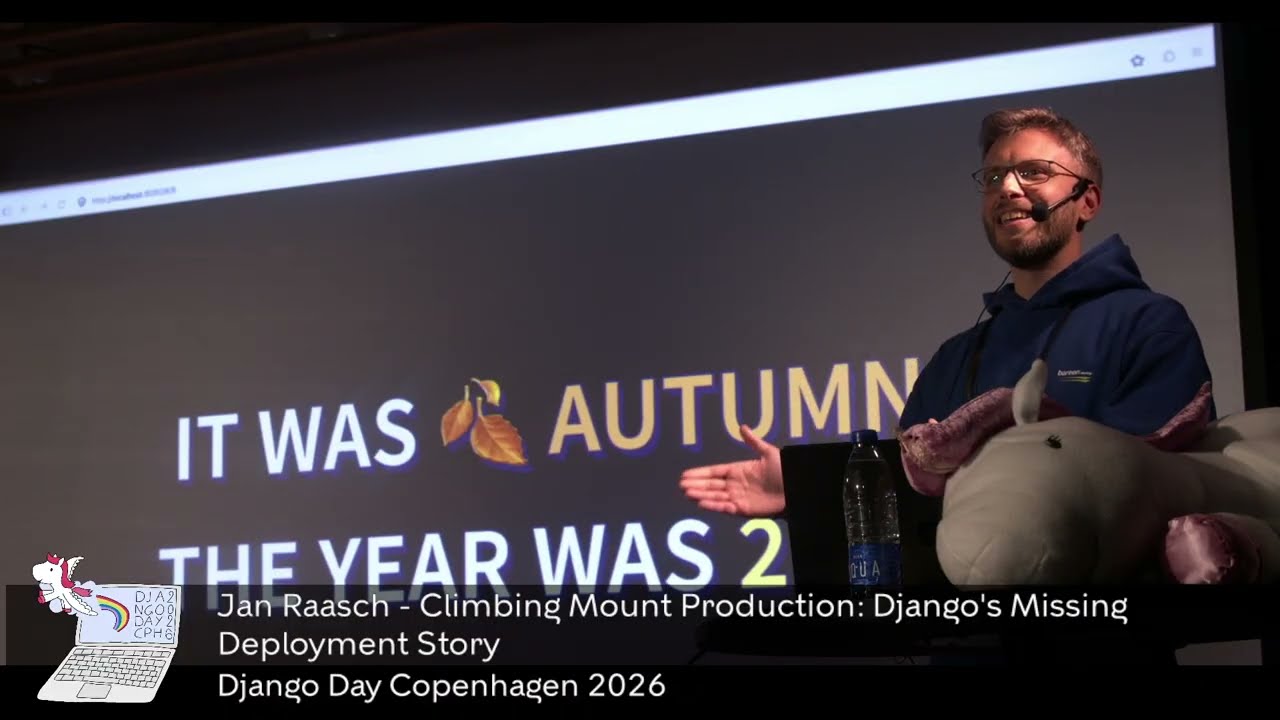
This video features Jan Raasch at Django Day Copenhagen 2026 in Copenhagen, Denmark.
Django Day Copenhagen 2026 talk descriptions: https://2026.djangoday.dk/
Automatically transcribed, so expect mistakes in names and technical terms.
Speaker 1: Chip chip
Speaker 2: How many uh lightning talks are on the poster down there? Just
Speaker 1: Seven? Seven.
Speaker 2: All right.
Speaker 1: Thirty-five minutes.
Speaker 2: Yes.
Speaker 1: That's not nearly enough.
Speaker 2: More lightning talks. And uh another big theme in life.
Speaker 3: Wow. Yeah.
Speaker 2: Thank you Jan for coming and we look very much forward to to your talk. Oh I made a mistake earlier. I said that this repository was called um Django features. It's called new features.
Speaker 3: The other one is for the old features. Yeah, yeah. Okay. All right.
Speaker 2: Yes. Welcome on stage, Jan.
Speaker 3: Thanks. Um yeah, so Wow. Nice. Thanks um so um yeah I always like to start with um a video game background. Does anyone in the room recognize the video game by any chance? Ah yeah. I was gonna say if you're on the internet just all caps it. Yeah, it's Celeste. Quite fun if you're into uh platforming. Um and uh has a nice backstory also, which is Not often the case for platformers, but maybe enough about video games for now. So um what this actually is about, it's about Django
Speaker 3: 's missing deployment story And um well you might say um I have a deployed Django app, I have multiple deployed Django apps, what are you talking about? So um what we will be talking about is uh my personal story to Django um and then um kind of how I uh um discovered this um this missing piece here and um how I dealt with it. I'm gonna show you a demo. And at the end we're gonna take of course what you do at the end of a nice climb, you take a view from the top And we're gonna look at actually the new features repository and see uh what is out there in terms of deployment.
Speaker 3: So just um really uh briefly about me I'm a full stack software developer. The red part here is self, because I'm no longer self-employed. The people at About Source managed to full-time hire me permanently. So this is still something I I'm adjusting to. And this is just shown on this slide. My pronouns, uh my emojis. I do a bunch of yoga. I like to go bouldering, I like video games, love my wife, we have a dog. Every married dog owner knows that in reverse order
Speaker 3: this is correct and will not cause any marital issues because you both know that the dog comes first. Now um I gave a talk about this, well, some part of this at DjangoCon Europe in the beginning of the year. And I see some familiar faces. And when I did this there, I said, let's talk about Django's deployment story. But we only have five minutes because it was a lightning talk. Got a big laugh. Now we have a lot of time. Let's start at the beginning. It was autumn, the year was 2003.
Speaker 3: I was not around back then. This was when Jang was built of course. For me, I started in Django quite a bit later, actually not that long ago. I wanna take a little survey If you are in this point in the year where you think I should look at a new framework, at another framework, I should pick up a new programming language, maybe just do a quick survey. Is that Put up your hands if it's for you this is in the beginning of the year, say spring or summer. Uh the the time you like to pick up a new framework and a new programming language?
Speaker 3: January, beginning of the year? Or winter maybe, it's still winter. at least here. Time zone issues of course. And um w who would say maybe it's a little it's a little bit later, maybe towards the end of the year or s um autumn, winter, show of hands. Okay, some people there. That's definitely my camp as well. So it was the winter. The year was 2025. And for me, that's the annual route kind of to do a new rewrite of the Secret Center app we use in the family. So that year I kind of felt at odds with the framework I was using before, which is
Speaker 3: um Oh actually I haven't mentioned it. So I have a background in Rails development a lot. So I I did a lot of Rails applications also lately the Next. js and React, some of that, but mostly Rails I would say. And so that year I thought no, I'm not gonna pick up the next Rails version for this. Let me look into Django. So I want to show you just quickly what I built. This is really it doesn't really have anything to do with this, but I want to show you anyway So just so you know what my family has to deal with
Speaker 3: , this is the kind of make-a-wish app I built. And um it's German, don't worry about it. But it's a wish list. It's just a simple form. It's kind of the perfect project if you wanna pick up a new framework or a new language because it's just complicated enough. It has you know user login it has session management it has some private data and then some data flipping around like who gets to um present whom with uh their presence So so I built this uh and uh was quite quite nice experience.
Speaker 3: Um and then I thought oh that's great Christmas is saved But wait, I need to show my slides again. But wait What's this? So so I so I finished the tutorial. I have this nice app you've just seen. I already put in my wish list of course. And then I see this in the settings. And I was like, okay, that's interesting. At least they warn me. That's good. But I saw I also saw this. Another warning.
Speaker 3: Here there is a link as well. Now to be honest, in settings py there's also a link if you scroll up Um but you know, if you are just starting to look at it And um you look at this, it's it it is a lot. I mean um especially if you're coming from uh Rails or I think uh even some of the other popular Python frameworks. The deployment stories often, you know, at least there's a default deployment story you can access with a git push. Maybe there is included a GitHub Actions. workflow already or there's a command that you can run um to get your application up and running and um
Speaker 3: and here uh I was I was like Uh wh whisky ASCII? I don't know. So uh just to make the case, it's not that simple, at least if you just get started. And um so what I then discovered being new to Django and uh Python ecosystem overall is what's really good is if you get kind of uh into the community And um so what I did is um I went on the Discord and I listened to a bunch of podcasts. And I found um this episode of Django Chat
Speaker 3: with Eric Mathies, where they actually talked about uh Django's deployment story. And Eric um presented Um a package he wrote, which is Django Simple Deploy. And um For me at the time, this is really exactly what I was looking for. So all I needed to do to get the app I already built running on in my case Fly. io because I was uh familiar with that. um is I pip installed a package, I added it to installed apps, and then I had my manage PY deploy command
Speaker 3: even with an automatic all option and just needed to run this and had my app up and running on Fly. io So at that point, Christmas was saved once again through open source. And um I'm not sure actually how many people know about Django Simple Deploy. So let me just quickly give you an overview. There are actually quite a lot of plugins that you can use. So there is a Fly. io plugin which I used. There's Platform SH, there's Skalingo, there's Render. There are a bunch of plugins for a bunch of platforms.
Speaker 3: And of course, you can build your own. And um what I was actually looking for for this uh side project is um to not use one of the big providers. I think that's also maybe something a lot of people um try to get away from, especially from the uh from from these bigger uh companies like Heroku um just because um these platforms can be quite expensive. And you just don't have that much control over it, right? And there's a big movement of just going back to running stuff on your own virtual private server or maybe even your your actual server So um what's something that I knew from the Rails
Speaker 3: world is um Kamal, which is a command line utility. Which uh makes it very simple, kind of like we just saw with Fly. io, to not deploy to one of those servers uh one of those services, but to just deploy to any uh any plain virtual private server or server, you know, for that matter, anything which you have an IP address to and which you can access over SSH Um so so of course I build a plugin, right? Like every good developer, I build what I need. And um so I build a plugin, it gets your Django app online, it gets you Let's
Speaker 3: Encrypt, um, so it gets you HTTPS. You get zero downtime deployments and it all works in under two minutes, I swear, let's hope And of course, I didn't really do any work here. I just put together the pieces, right? I already knew Camal and there's Django SimpleDeploy and I just put together the pieces in a plugin. But anyway, for me at least this was quite useful. And I want to show you how it actually looks. So for that, I think I'm actually gonna mirror the screen. Let's see if I can do that
Speaker 3: Yeah, that's good. So um so I have a little Django project here. I'm gonna run it in a second, but just to show you it's just a really small project. Um nothing uh nothing special about it at this point. Um What I did do already is I uh added the DSD VPS command. So DSD is just a prefix for Django Simple Deploy uh plugin. I added this
Speaker 3: to the requirements and added it to the installed apps and ran install. So I did that already. So at this point we should have a deploy command. And um this is what it looks like. So as we've seen before There's an automate all option, but maybe what's more interesting is the last part of options for this particular plugin. As I said, you can Or you have to supply an IP address of the server you want to deploy to. You can supply a host name, like
Speaker 3: a subdomain or a domain. That's actually needed of course if you want to have HTTPS. And the default would be to run everything on Postgres, but you could do it also with SQLite. uh which I'm of course using uh the package that's out there for that. So um before we deploy this, what is it? Uh, let's run the application somewhere locally Uh that's the app
Speaker 3: uh we're gonna deploy. It's called emoji vote. Of course, yeah, this is a very important application. You wanna vote for your favorite emoji? We gotta get it out there quickly. So Let's hope this all works. Um what we're gonna do is um run the deploy command, but before that of course We do need um a server. I set up one before. Uh it's an empty Ubuntu server. We could also do one again, maybe if we have time. But um
Speaker 3: So we do need that. And I also like to have a nice host name. So let me just add an A record To this IP address. Ah, I already did that before. Okay. So it's gonna be available at emotivode. janraj. com Now going back to the console Let's see if I have already prepared it a little bit. So this is not the correct host.
Speaker 3: This is the correct host and I need to get the IP address right. From here. Okay. And uh I gave it the name emoji vote, otherwise it's just gonna be the default Django emoji vote, which is the name of the directory. But this is just a nice shorter name. Okay. Let's run this. It tells me what it's gonna do and asks me if I want to move forward with this. So um I feel adventurous.
Speaker 3: And um so while this is going on I can tell you a little bit about what Kamal is doing. So as you can see, it's gonna log into the machine via SSH and then it's gonna check if there is Docker installed already. If not, it's gonna install Docker And then it's gonna put up, you know, some machinery, what it needs to get, for example, zero downtime deployments going, is it sets up a proxy. If you define a database, it's gonna set up the database. And then of course it's gonna build the Docker image. In this case locally on my machine, could be anywhere else Um
Speaker 3: and then it's gonna deploy the application. Um and um what's really What else might I tell you at this point? Maybe what we could do is uh while this is going on We could uh look at the code a little bit more. So see what It's it hasn't committed any files yet. Let's just wait a little bit.
Speaker 3: The container is starting up. Oh, okay. So under two minutes, maybe, right? Um And now it's there. And um oh okay, there are already people voting. That's good. Uh there's no live uh reload or anything. Oh okay, okay, nice. Very good. Um yeah, great. Um so uh Okay, now I get it. Um it did uh already uh commit the changes.
Speaker 3: for configuring um the deployment. So I think maybe just take a quick look so you get an idea what's happening. So really, all the magic happens in this deploy YAML. This is all the configuration for Camal. Um wh what I haven't touched really is um that is um a health checkpoint. Um of course if you want to do zero downtime you gotta check. uh when the new service is up and then you can define accessories and uh we define Postgres here. Um
Speaker 3: And um how does this connect uh with the Django app? Um Of course with Django there are multiple ways you can do things but there probably is a settings PY So one thing you can do is just append a bunch of stuff that you really want to get into production. And that's what we do here. And we just check for this little kind of on-off switch And as long as on VPS is true, this is where we do all the configuration that we want for the database and everything. So uh maybe that's enough for now um how this works. Hmm and um
Speaker 3: Let's go back to the presentation here. Gonna switch back And to extend the display mode. Yep, okay, nice And uh let me get the slides here back up. Okay, great. So uh VPS works. Oh wait, there's more. So uh there's actually a lot of stuff going on in this uh deployment space kind of in Django One thing that I already included in my plugin is a project called Django Prod
Speaker 3: Server. And this one tries to solve a different but very related issue, which is that uh you have this run server command which um pulls up a dev server. But uh what do you do if you want to go to production? And so um this is why um Andy who built this um thought about um having a Django prod server command Now actually recently he changed this into server and so the idea is to maybe in the future have a general server command and then via environment variables Like you might be again used to from other frameworks, you switch between having uh an a dev server or a prod server and
Speaker 3: um Uh the definition happens uh through um um uh constant in settings py Also related, and this is one of these new features on the Django new features repository. And this is uh this has been worked on in uh this year's Google Summer of Code. It's to have experimental APIs um in Core Django. So one of the issues with uh this deploy command or this server command is it's all very nice, um but you don't get actual feedback from the people who might want to use it.
Speaker 3: Um and uh I I think or I don't know but um my hunch is that The people who would need these tools, they don't know about them. And the people, you know, who already have a Django app running, they really don't need these tools that much. They know how to do it So I think if it's if it's placed closer to core, closer in front of people who might just pick up the framework and have a first look at it. Just the more uh actual users you get and the more uh feedback you get on these things. So I think this is uh great um new feature. Again very much related and it came up earlier in FS
Speaker 3: Talk is um As you saw, the way I do it currently in settings py, add just a bunch of stuff to the end of the configuration. It's kinda hacky. But of course uh there are so many different ways of doing things that uh you cannot rely on anything if you build a general plugin. So If instead you have something like Environ go into core and you can rely on people using it, this is something that you can of course use and then have a much cleaner implementation. of um a server or a deploy command. And then just um just to kind of uh again
Speaker 3: make the point that this is really something that's kind of in the zeitgeist currently. Like there's this book out by um the Talk Python um uh podcast. Uh um people uh which is also called talk python in production and uh this is basically um this is basically the same as what um the vps uh plugin does but put into a book And uh if you follow along with that, you just you get your VPS set up um just as good. Um and then just recently also um bringing it all back to the Django Chat podcast, Will Vincent published um a talk or he gave a talk and also published this um as um a blog post
Speaker 3: on his blog uh talking about modern Django deployments in 2026. That that's much more technically kind of giving you an overview of what's happening in a deployment. But uh yeah, that's also out there. And then uh just in August now, um uh Paolo um posted uh this message on uh Fossodon, which I thought was great And he texted Eric and said, hey, I just had a talk at uh DjangoCon US and you know maybe we should have a deploy command in Django Core. So I kind of feel like uh the streams align, the everything comes together. Um and uh yeah, I think that would be really cool.
Speaker 3: Um I think um One idea um that I would have like even if we cannot get it into core that quickly, I think it would already help if you have uh one place where people come and find the this kind of knowledge. So maybe have uh um DjangoDeployment. com uh website um that's maintained by uh a working group. and um you know have different entry points for people who are just getting started maybe with programming, maybe with Django, uh maybe they already, you know, very um uh senior developers but they want to switch or they might switch And uh yeah, just uh have a common entry point. So uh
Speaker 3: of course uh this is about open source, so maybe in uh 2026 to save uh Christmas again Maybe some of you can also partake. I think you know if if you haven't gotten that much experience, then you can at least try these tools out give some feedback and if you have a lot of experience then these tools are also really great for packaging up all that knowledge into a plugin of sorts and getting it out there So uh thank you. Um of course uh talk to me about uh deployment or anything else. Um Reach out and uh I I hope we have uh some time for questions as well.
Speaker 3: Thanks.
Speaker 2: We do There's a question right behind me.
Speaker 4: You mentioned that people that already know how to do the deployment don't really need it and th those who don't need it don't know that it exists. So that would also obviously be solved if it's in Django or something very related. How do you think about the fact that the people that then using that and don't really know what they are actually doing Potentially you navigating themselves into dangerous situations they don't even realize that they are maybe taking weird turns
Speaker 3: there. Mm-hmm. Yeah. Right, because otherwise, I mean you could ask this question about any API that's out there and can be used by anybody who doesn't um know the details. of the internals. So so I think to some extent a it's an unfair question to the topic um because it does hold for everything that's out there. But you are right, um we are putting stuff supposedly on the internet. Um I personally uh I don't um like Maybe it's just because I'm I'm used to having this available um
Speaker 3: much more easily. I don't see an a big issue there if you have sane defaults that are safe. I I think you could even make the case that having uh a security warning uh is much less
October 2, 2026
Copenhagen, Denmark
Note: We understand that names change, people change, and bodies change. We respect each individual's journey and privacy. If you have any concerns about a video or need us to remove content, please don't hesitate to contact us. We will handle your request with care and promptly address any issues.

Published October 13, 2026
Published October 13, 2026
Published October 13, 2026
Published October 13, 2026

Published October 13, 2026
Published October 13, 2026