
0:35:39
Unlocking the Django Job Market: Strategies for Developers and Employers
Published October 8, 2023
This episode of DjangoChat features Jon Gould.
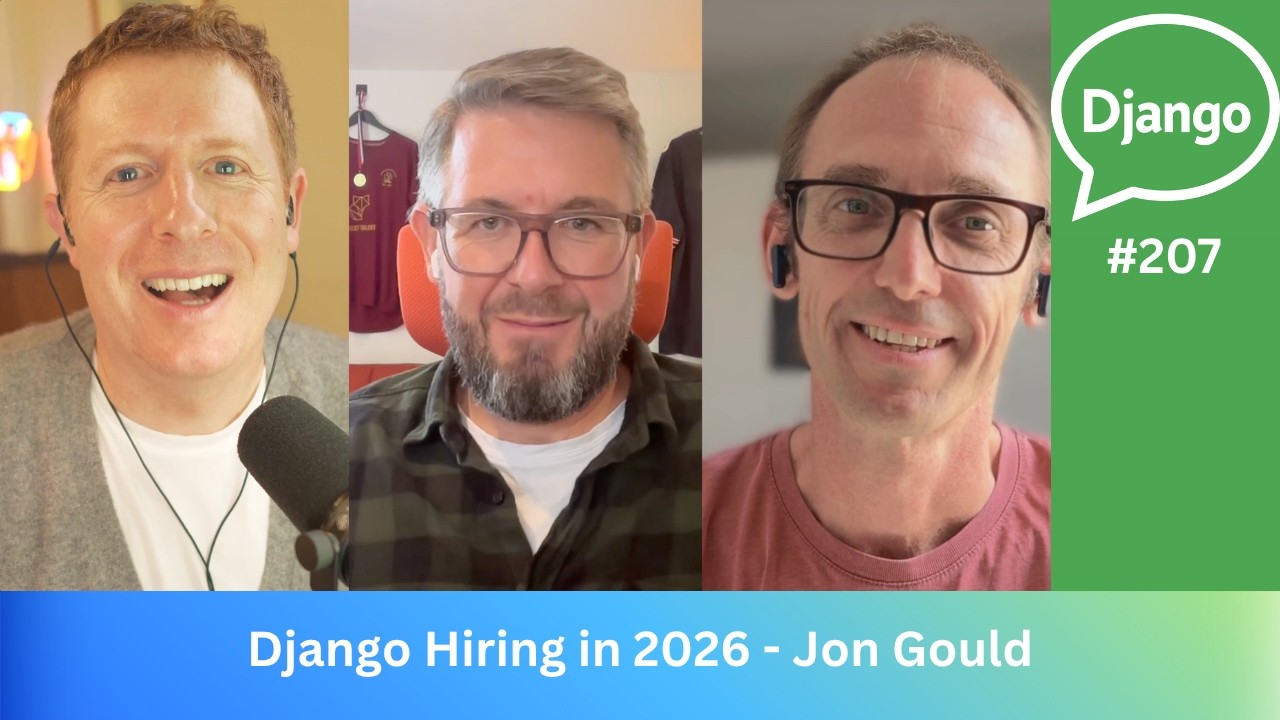
Jon Gould is the founder of Foxley Talent, a recruiting agency focused on Python and Django developers. We discuss what he's seeing in the market these days, the benefits of attending Python & Django conferences, and why humans matter more than ever in our new AI age.
🔗 Links
📚 Books
📦 Projects
🎥 YouTube
Automatically transcribed, so expect mistakes in names and technical terms.
Speaker 1: Hi, welcome to another episode of Django Chat. I'm Will Vincent with Carlton Gibson. Hey Carlton. Hello, Will. And we're very pleased to have John Gould from Foxy Talent back on after three years. Welcome, John.
Speaker 2: Yeah, thanks very much guys. Nice to nice to be back on on with you.
Speaker 1: So you and I have seen a bunch of each other this year because at the various conferences. Maybe I'll start with the softball. Uh where have you traveled this year? Because you've been everywhere.
Speaker 2: Yeah, I've been to the two sort of big Django conferences, so DjangoCon Europe in Athens, Greece, and then uh in DjangoCon US in Chicago uh earlier in in August, and then I went to uh PyCon US over uh Long Beach as well. Those were my sort of three three big events and yeah, seeing one or either of you uh at every single one of them.
Speaker 1: That's right. That's right. Yeah. Two for me, one for Carlton.
Speaker 2: Yeah.
Speaker 1: Um Well, so maybe and sorry, for introduction, for those who don't know, you're at Foxy Talent, like the preeminent Django recruiting agency. Um What should I add? What's the pitch these days?
Speaker 2: Yeah, I suppose I yeah, I've I've Foxy Tongue has just turned five years old. Um I've Yeah, I've recruited Python, Django Space and developers since 2008. So all you know coming up to 20 years doing that and Um yeah, as a I suppose as a career recruiter, I'm also an individual member of the Django Software Foundation and Foxy Talent is one of the corporate sponsors. So in the five years I've been going and I've donated over twenty thousand dollars to towards that. Um I'm a regular at the conferences. Um yeah, w all that everywhere. If you go on LinkedIn you won't be able to yeah, spend it scroll for a couple of minutes without seeing me somewhere on the talk.
Speaker 1: I was just gonna say so the conferences so as a as a programmer, right, people go there to give talks, to network, to maybe look for jobs, to find out what's happening in the industry. What are you know, as a recruiter, what are you looking for? Is it similar? Are there differences? Like what do you pick up when you go to these events?
Speaker 3: Yeah, I suppose the
Speaker 2: probably uh DjangoCon
Speaker 3: US is very much for me it's the uh the
Speaker 2: Being in the States is where most of my business now is. I I probably in the last twelve months I've been seventy percent of my placement and revenue has come from within the the United States. So being there, it's being in the room with all the right people.
Speaker 3: Um
Speaker 2: whether yeah, whether there 's there's talks happening, but
Speaker 3: yeah
Speaker 2: For for me it's it it always started out being I just want to be around the the people who have given up their own time, the best you know, who I would see as like the best people in the room. Now it's changed a little bit with
Speaker 3: like
Speaker 2: fake candidates and all this. It's I'm now in a room of just real Django people. Um
Speaker 1: if they're at the conference they must exist.
Speaker 2: Exact yeah, yeah. There is proof of life. Um that every everyone's real and it's not an AI filter. Um but I it's and also like these events are so important for the community. If you can help out by sponsoring and you know for me having a stand where people come talk to me as well is a byproduct of that, it it's worth Yeah, it's worth doing and yeah, it's uh yeah, I I like like to have where I can. Like Django Day Copenhagen was a week ago, we go, ten days ago. And yeah, I couldn't go but uh somebody I met at JaguarCon Europe really wanted to go, they had helped me out with some stuff from my website, so I bought them a ticket and did like the supporter bit on top to to help the guys run that conference.
Speaker 2: So yeah, just trying to help those little community events happen where they do.
Speaker 1: Yeah, and I I should just I'll say one more thing, Carlton, and then you can go. I was just gonna say um I remember having this conversation with multiple people at Django Kong US saying, Oh, do you know John? If you don't, you should go talk to him because no matter how happy you are with your job, like you should know what's out there, right? Like you You need to get information about what the market's saying, how your employer 's doing. And then I know for you, like you have these long term relationships. So even if someone's happy now, you build you know, you get the contacts, you understand their situation, and then two, three, four years. you know, oh, this this position came up and this person I've met and talked to at conferences would be a good fit. So people shouldn't be shy about talking to you. Um, which most people aren't, but a couple of times they need the nudge of like, no, it's like You should talk to John.
Speaker 1: Yeah. I think
Speaker 2: I I think yeah, that's that again is another, yeah, key key reason I'd go is like to meet people I I mostly speak to people in my day job when they need something, when it's a transaction, when it's I'm looking for a role or you've got a job that I want to find out more about. It's it's a transaction a lot of the time. But by going to conferences, you meet people when just no it's not organic because you're at a conference, but it's you you meet people and you can have a a conversation and build a relationship and get get to know somebody when there is nothing on the table, it's just yeah, it's nice. And then I find When if I f yeah, a job comes in two years later
Speaker 3: that they said,
Speaker 2: Oh, I'd love to work in X industry.
Speaker 3: I'd
Speaker 2: We'll come back to them and go, Hey look, I know you may not be looking, but we spoke two years ago at this conference, I've got something that might interest you. Like it's a lot easier like that. And it's yeah, it it it it's the the enjoyable part of the job. I much prefer to speak to people when then they are happy in working, not looking than yeah, I've been laid off and I need to get something b before the money runs out.
Speaker 4: Yeah, no, because then it's desperate, right? It's like
Speaker 2: Yeah. Yeah. And I I mean over the course of a year I'll probably make between fifteen and twenty placements. So I'm having fifteen, twenty calls a week with people. It's such a small proportion I end up actually
Speaker 3: putting into a job
Speaker 2: because that's where
Speaker 3: the
Speaker 2: yeah, the the the nature of it.
Speaker 4: Yeah. I think when we chatted before the the the business was changing a bit, but uh it must have changed quite a lot over the last two, three years.
Speaker 2: Uh yeah, well the I built Foxley to you know I'd hide a couple of guys and we were there's uh at one point there was four of us working in a in an office in the in the town near near where we are and it just It it was through it grew through like a desire to and maybe old habits of building something and diversifying and creating additional um revenue streams and that sort of thing, but the the number at the top never really changed. So whether it was me on my own or me and two or three others, the the the m the placement's never really changed. So it I had to make difficult difficult decisions to scale back and I've for the last well
Speaker 2: over twelve months now I've been on my own again and it's been probably my most fulfilling year. I've been close to everything. I've I've been able to lead like lead my own projects as well and and like I actually quite enjoy travelling on my own to these things as well. Go for an airport with no stress, don't have to worry about anyone air looks like I can get there. It's those of things where it's
Speaker 4: so you haven't got the kids in tow.
Speaker 2: No no kids, no wife, no colleagues. It's it's perfect.
Speaker 4: Right, okay, fair enough. So you've started a new podcast, Sean. That's why we really wanted to get you on, 'cause, you know, tell us tell us about the new the new thing. What's it
Speaker 2: give us around? So I've started a podcast called People or Code. Um I've There's now three three episodes which includes like my sort of story to start it off, which are out and I've got another three recorded which are going out over the next couple of Mondays. Um and it's it's basically it's a conversation around the point in a engineer's career where y the decision is to to go further in the career into people management or into code and I suppose from the five conversations I've had, also now like what impact is AI agents and what what impact is that gonna have on the path that people choose and So the the sort of the goal behind this is to start that conversation
Speaker 2: something that people who have stood at the fork in the road, the crossroads have some way to go for a bit of guidance and advice, um, but also to help the people who are building teams in twenty twenty-six, twenty seven onwards. learn and sort of make those good decisions as well about how they should shape a team.
Speaker 4: Okay. I mean t for me that's the classic um Crux point because you know, when I was coming up I never wanted to be a manager, I wanted to be a coder forever. But if I was no, you gotta move into management, you've got to move into management, you've got to move into management. And I remember seeing some article about how, you know, yeah Uh i but get out of coding before you're forty. And I'd just turned forty and I was like, well, a bit late now.
Speaker 2: Yeah. Yeah, it was but it was it was the same in the recruitment world. I was Um yeah, I I was enjoyed doing the job of a recruiter and I got to a point where I'd had a couple of people around me and I was then moved in I I had opportunities to move up and everybody was like, Oh, move up, get off the tools, like get a you know, get a get a job before your uh you know, your your your hair goes grey and you're knocking on you know you're having to go to conferences and stuff and Um it was yeah, it it was it was for not forced upon me. I enjoyed it. I enjoyed every minute of building a team out and like the camaraderie that came with that and some of the guys who were in my team are still really good mates. Like we came over to the UK, we played golf with one of the guys who used to work for me who's running his own recruitment business as well.
Speaker 2: Um It's yeah, it was it was brilliant, but I always missed the the job, the job that I loved, which was recruiting and Even when I started the business again on my own at Foxley, I went old habits of building a team fell back and I got further away from doing the job that I love. So I'm now yeah facilitating that conversation for engineers and like yeah, because it's there is no right answer and I think that the the The good thing about you know the length of a career is you can always go back and unpicking it and you can go back to that um point with experience under your belt and tried either route at any time. Um and some of the guests I've had on have done both
Speaker 2: and moved um yeah, moved to eat done either route and uh loving it or have done one root and changed. So yeah, some great stories that are coming out. Um so shame spot anyone 's Yeah, if anyone anyone's done that and wants to come on and talk about their story, then yeah, we're pleased to get in touch.
Speaker 1: Yeah, I mean
Speaker 4: it's a great topic.
Speaker 1: No, it's it's it's it's sort of the topic. I mean, Carlton, I wonder, not to psychoanalyze you, but you know, you you did your PhD in philosophy, like most people Most people like if they start coding, you know, in their early mid twenties, they join a reasonably sized company, you get a lot of pressure four or five years in. Like if you're not managing Like there's not a role for you. I wonder, like I mean, you know yourself well, but also you were consulting and stuff, right? Because it's pretty hard to avoid that in a big company, like you know, after four or five years because the company wants to scale up, right? And so you're more you're you're more valuable as a manager.
Speaker 4: Yeah, no, I mean and I I um uh when I started two two oh six or after the dot com bubble and I'd been in I'd been in the kind of nice shelter of academia with a you know a nice grant to to fund me during the the the bust after the dot com bubble. So I'd seen it I'd seen it happening. I was like, oh that doesn't look good. And I I always had this idea about um the one the one man business model. Keep it small, keep it just me, keep because as soon as you've got As soon as you've got staff, then you've got a commitment because th those people's livelihood depend upon you making um payroll every month. And I remember when I was beginning I worked did some freelance work for an agency that um were winning all the prizes. They were a um iOS agency and they they built Facebook's app and whatnot and they had uh big offices in Barcelona, fifty people, they were winning awards left, right and centre, with
Speaker 4: and within about thr two or three months they just disappeared because for for whatever reason the pipe the sales pipeline dried up and then they had this massive payroll which they couldn't afford. So everybody got um laid off and the the the sort of core team got aqua high by Facebook and they went and built the the app in Hamas and it was like, no, that's why you don't build a massive um business with a massive payroll, w which you can't, you know, see m see the the pathway clear. I d uh there there was this Bill Gates line about alwa um he w always wanted Microsoft to have enough cash on hand to go a year without making a single sale. And I kinda took that very much to ha to heart, but like at my scale, it's like you must have enough reserve so that, you know, if push comes to shove, there's a window where you can find a job without being in the panic situation that you were talking about before, John
Speaker 4: Um but yeah, everything you're talking about here and maintaining the position of an individual contributor, that speaks right to my heart because it's what I've tried to do my entire career. I'm not interested in being a manager, which will you know, we'll come to a different topic.
Speaker 1: But I I would say you gotta be pretty good to get away with an IC career. Um, you know, I mean if you're I mean, no one self-assesses as a mediocre programmer, but you know, it is true that some people are great managers. And maybe mediocre programmers. I mean that's right. Not to turn this into one of your episodes, John, but like their their different skills is sort of the core thing, and yet they're thrust upon you.
Speaker 3: Um yeah. So Yeah, and I think as as well, like with within open source, obviously Carlton
Speaker 2: 's working as a as a fellow as an individual contributor, like that is a role I know not off open to many, but it is a in software and especially in open source
Speaker 3: like
Speaker 2: giving back and using your skills in that way is also a um is an is an option as a rig or as a goal that people may have is like It's not managing people, but it is it's it's doing more than just
Speaker 3: yeah,
Speaker 1: I mean it's worse. Topic. I mean I would just say my l my little plug is is like I I've managed people and I think for most people I think it's good to do it and try it but recognize It doesn't have to be forever. Because so for me now, like I'm managed by thirty somethings, right? Thirty somethings run the world in tech, right? And so When there's things I disagree with, like I have a lot more empathy for the situation they're in because I was in some version of it before, right? Whereas if I don't if I'd never been in those shoes, I might be a little more like You know, lacking an understanding for the situation. Um so anyways, yeah, people should listen to the podcast and it's a perennial topic.
Speaker 2: Yeah, forgive the the rustic nature of it, I'm still figuring a lap out, but
Speaker 4: Oh no.
Speaker 1: Well, I wanted to ask you about so we mentioned so Carlton that you said the the aquahire of the agency. I think this came up, John John, in um in the US like I won't name names, but there's a number of high profile Django people who are now at Frontier labs or doing, you know, AI stuff. Do you see How much do you see that happening, right? Because AI salaries are a bit better than slinging Django code. Is that is that true? Or what are you seeing out there in the market?
Speaker 2: I think there's yeah, the the if you look at where uh the um uh investment funds are putting their money, it's anything which is AI heavy at the moment and therefore they are gonna have more more carrot they might have yeah they they they are throwing money at the at their staff because they've got to they want to try and attract the best. They're in a a bit of an arms race for people and Yeah, to get their product out out first. But then you've you've also that there's a lot of fatigue in the job market where people
Speaker 3: have been hired by a start up or a scale up and
Speaker 2: have been let go a year, 18 months later. So I think there's although yeah, that you can chase something shiny and take a a a role With an AI calculator, I think there's a little bit of trepidation around it because you don't want to be, yeah, what if staying put in your Django slinging Django code role is actually the the safer long-term play. But
Speaker 4: it might might still be there in a year or two.
Speaker 2: Yeah, yeah. Django 's Django's twenty one years old. Like that there's a whole ecosystem around it and AI is it I don't know, it's it it it's uh in in the job s job sector at hiring i people who use it is changing the way people are writing code and uh are evaluating engineers. It's having a knock on to junior roles Definitely, but I think there's still yeah, still a a good job market for for Python Django engineers. So
Speaker 4: i d just nip into that junior question at the moment. I mean it looks like a serious crisis sustainability crisis in that if we're if n if we're not hiring juniors and we're not training them up, we're not going to have seniors in half a dozen years' time. Um Does how how does that look from your end? Is that a real concern? Is it are folks still training folks?
Speaker 2: I d I uh yeah, there are there are juniors coming to the market. I think grads coming through with from like universities and colleges who've got links into employment, they're still grad paths into bigger organizations. Um It's it it's more like those yeah boot camp and reskillers who are or career switchers who are probably not getting much op as as much anywhere near as much opportunity as before. Um I don't I don't know of uh anywhere near as many companies who are h actively hiring juniors. There's a there's a handful that you you sort of see every now and then, but they'll have their
Speaker 2: A word cut out identifying which person's going to be the right one or two to bring in, but also, you know, they're they they've probably got their their formula, like they might have a link to a a college, university locally who are doing it and I think partly this is because of the the AI tools being the junior developer. But also
Speaker 3: um
Speaker 2: remote work. I think remote work is possibly detrimental to juniors integrating and learning like the nuance of sitting in a row of desks where somebody's working on on something and they can just lean over and ask, hey, can you look at this? Can you explain how this works? Yeah, if you look at the the sprints and things at Django Coins or yeah, there are people of every level learning from each other just by osmosis of being in the same room. And I think for remote working that has had a a real impact on the and juniors will can learn and can progress by doing it that way, but I think it's just a um Yeah, a a negative aspect of remote working with the yeah, things that
Speaker 2: people haven't hired Juniors because of the the speed to get up, up and running. And they may as well wait six months and hire somebody with more experience or then yeah, wait and increase budget and hire a a mid or a senior. Um
Speaker 4: Yeah, that analogy to the sprints is close is a good one 'cause it is exactly like that. The the the the the high bandwidth of bin in the room just makes all the difference. We're gone.
Speaker 2: Yeah.
Speaker 1: Well, I was gonna say, I mean, it's not I mean it's always been the case, you know, the sweet spot is someone two, three, four years into a career where they've like Gotten over the you know, someone's trained them, but then they kind of know something, but they're still malleable. You know, whereas you bring Carlton or me into an organization We're gonna have a pinch. You know, so um You know, um but I I mean on the hiring front I uh e everything you said just resonated. Like the big companies are still I mean, people don't understand that like Google, Facebook, like the average age is young. Like it's like twenty-seven, twenty-six, twenty-seven. Like and you know, they're hiring less, but they're still like my brother works at Columbia University
Speaker 1: in um recruit um Career services, right? Like they're they're their grads get jobs, right? It's no problem, right? Because they have the pipeline. So like the you know, and these big companies are investing more than ever in um offices, right? Like Manhattan is like a lot of software now. Um, so you still they still want smart young people. The problem is, as you said, like maybe a boot camp person or someone who hasn't gotten that on the ground training, it is much harder. Like, I mean, consultancies I've spoken to and you've probably spoken to, John. it's harder for them to hire a uh you know a grad from a from a boot camp, right? Whereas before they could have, now they can kind of swap that out for an agent. So Um anyway, so two things are true. I'm just agreeing with you. The big companies still need people.
Speaker 1: A lot of those people are more junior, but I think that mid-level or mid-career is really getting nailed because Yeah, like why train a person when you can train an agent and do a harness? Unfortunately a lot of people have that mindset.
Speaker 2: Yeah, I d I do I talk to to juniors about sort of manual yeah about engineering their job search so almost like reverse engineering. So if you're uh if you're based in Chicago and you're a junior engineer you're looking for remote jobs against junior engineers everywhere in the country. Like your USP, you know, your y unique selling point um is is your experience. You haven't really got any. So actually, if you narrow down your search and using tools like LinkedIn, you can do like a uh search for people by typing in, you know, Python, Django uh junior developer into the search that um and you can search for people who have got the job that you want
Speaker 2: so you can look for people who are a junior developer and you can look by location in Chicago and in theory you should be able to find the companies that have already got junior developers working for them, knowing that People don't update their LinkedIn as often as they want. They've probably been promoted and haven't been back in to change the job title. But that company specifically has hired a junior in the last few years. So That's a company to approach and say, I'm a junior, I'm looking for work. Um by doing it that way round rather than searching for jobs. Uh and it's Yeah, so yeah. It works it doesn't work every time but you you've got yeah, it's by being in your USP is now that you can get to the office or you're in the same location.
Speaker 2: Um as opposed to you've got yeah, you've you've written a bunch of code.
Speaker 4: So I always thought that the o return to offices was like the revenge of the companies, but it might actually be revenge of the junior developer.
Speaker 2: Yeah.
Speaker 1: I think it's just a way to get rid of old people without violating uh firing laws, Carlton.
Speaker 4: Well if you make uh make old people come to the office they quit.
Speaker 1: Well no, because no, because yeah, someone who's like in their thirties, forties with kids who You know, you say, Oh, I'm not firing you because of the age or this, that, and the other thing. It's like y you know, you gotta be in the office five days a week. I mean, I I don't wanna get too conspiratorial, but I'm very confident that a lot of it is that.
Speaker 4: Okay.
Speaker 1: John, what do you think? I'm just shooting my mouth off, but I've I've heard that a lot. Okay, okay.
Speaker 4: Well I did that. Very diplomatic.
Speaker 1: Uh on the on the hiring front, I mean one thing that must be hard, I haven't done a I haven't hired someone in a while. But it it used to be the case that I would always and I'd tell people like put some projects on GitHub or, you know, Codeberg, you know, that you would write, and then for the interview we could talk about what you built rather than whiteboarding problems. But now that's gone because everything is AI, right? Even if you could do it manually, basically everyone's doing something AI. And if they're not Like there's no way to check that they are that they didn't. So I wonder what you're s if you're s what are you hearing on that, John? Because I I find that's a real loss. I used to You know, I guess you can quickly find out if you talk to someone, you can say, walk me through this and they're like, oh, here's the prompts I used. But it used to be that as a screen, if someone had a number of projects that were open source, you know, I could evaluate them.
Speaker 1: Whereas now kinda have to talk to 'em to see if they know what they're talking about. I don't know, what do you find?
Speaker 2: I don't I don't I don't I don't think talking to someone during an interview process is a bad thing. Um I think it's the it's the
Speaker 4: Right, but you it's how you get past the pile, right?
Speaker 2: Yeah. Too too much of um hiring is now automated. Yeah, in a world where AI is being used a lot, like hiring should be more human. Um it should though the the way that even from a point of when you're writing your your CV, your resume, like of avoid the instinct, the the going in or optimizing it for every role because it'll you'll just come out sounding the same as everybody else. Um and I think Yeah, it's if if you've been searching for a while, you'll you you you'll be tempted, I've got to change something, I've got to optimize it for this role. It it looks yeah the a any document that
Speaker 2: is has been pushed through a an agent will look the same and sound the same. So yeah, from that for even from that point. um then the people reviewing them. Like smaller companies don't tend to have um they tend to have a person reviewing or a an external recruiter reviewing resumes and CBs rather than a uh applicant tracking system. where it just searches for keywords. So again, be more human and lean into like the the reason why you're looking and your backstory, how you you're you know, how you got into coding in the first place, what's still passion what you're still passionate about. And then like the interviews, I I can't stand things like the leak code processes, any interviews where you're being set up a task, you know.
Speaker 1: Yeah.
Speaker 2: That's just fictional, just review some code or like take a pull request and like nothing's too no one's too busy just to like go hey can have a look at that. Um solve that for us. And if you do Allow if you work where you're using um you know prompts in in in your coding and generating code that way, well then run your interview process like that and say we want you to use whatever tool you're most comfortable with or we use claw code or whatever. Um if you And then you review it together like you would in the workplace. That's the biggest thing, is that point of testing somebody. If it's miles away from the way that you work, what's the point? You know it.
Speaker 4: Yeah.
Speaker 2: If you're going to send somebody off to do something and go, hey, please don't use it. We want to see actually how you code cool. Then you'll you'll filter people out that way because you'll know straight away if they've followed the instruction or not. Um but it is it's real yeah, I think just hiring needs to be more human, um, in general. Not just to keep me at a job, but in yeah, it's Yeah, it it yeah, you're hiring a person, like keep it keep it on in conversation.
Speaker 4: I have more
Speaker 1: than that.
Speaker 4: No, no, just as you describe that process, I'm like I'm thinking to the to the times that I've been in responsible for filling a role and you put a you know, you put a thing up and you get f and this was before the days of AI, right? It it it you'd get far too many applicants and it was far too difficult to to get through them and be you know, and then far too difficult to do the the the the interview process fairly and and and And at reasonable personal expense. Like r you know, reasonable time investment and what it's a hiring is a is just a m a massive challenge and I can't believe that AI's made it easier.
Speaker 1: But that's why the personal take to your point, John, like uh I mean when I've hired, you know, if you have a hundred applications, but someone on your team has some point of contact with one of them, you know, maybe they took the time to reach out. It's like and they're like, well, they seem okay or right, like that person goes top of the queue because Even pre-AI, you can never really filter it. You know, you always want some sort of human validation, right? Because then it's if someone you trust says something, then you're sort of evaluating their them on it too, right? So You always want to find a person at the place.
Speaker 2: Yeah, and right now right now with the BAI thing there is there's loads of I s I gave a lightning talk at uh JengaCon and PyCon this year um about the the the problem of like job and hiring fraud in job job processes it's it's global now, it's not just limited to one place, but it's It it's almost the jokes about going to conferences to meet real people. Somebody, a client of mine came to me and said, Hey John, we're sick and tired of like not knowing if the person we're speaking to is actually real or not. Could you send us profiles of people who you have met? And it's like, yeah, absolutely. Like that's that's great. And it it validates the whole, you know, the whole trips every time.
Speaker 2: But it's it it is that you network of you know of yeah first collections it is your that's the valuable thing leak if you're job searching lean into that like Go and speak to the people that you've worked with before, like see who you know is is working somewhere who's hiring in. Together you'll you'll you'll find it rather than sort of faceless applications because as soon as you go blind, you're all the credit that you've got somewhere else is gone. You've got to start from scratch.
Speaker 4: Yeah. So let letting your personal network know that your job searching is in fact the way forward. It's not, you know, you th you think oh I don't want to do that. It's embarrassing. I don't want to bother people, but
Speaker 2: Yeah, but it it's I you know what? Now it's it's a yeah, it's a it's a bonus having a a network of people that you've collected that you've met at conferences and things and that's yeah it call yeah, I'm I'm quite comfortable getting somebody's LinkedIn or connecting to them online if I haven't met them but I've seen them in the room and just a little note saying, Hey we're at Django Con I wanted to say hello but you were busy. It's I don't mind doing that, but some people will um will hold off. But I think even to a point of like going to conferences, going to the um Jangle on the Med or something like that and sharing the photo that you were there or uh
Speaker 4: Chicago, the the silver bean for you
Speaker 2: there. Yeah. And because it it's just leaving a bit of a digital paper trail for people, but also others will see it and Yeah, GP 's trying to yeah. So when you do need to hang up and say, I'm looking, there's people remember you a little bit.
Speaker 4: That digital paper trail thing though, that that hasn't really changed. I mean I remember twenty years ago the advice was, you know, wh why bother answering questions on Stack Overflow? Well, because every single time you did it it was like the one more sort of thing that you'd done that was positive. Why bother on the um on the mailing list? Why bother on the foot on the um project? Well because each time you do it, it's not a big thing, but it just adds to that that that backstory of things that you've done that show that you're, you know Yeah. Credible I can't think Yeah, though you're credible. Yeah, good. Thank you for the word. Yeah.
Speaker 1: I mean you still need a blog. I I you know, even if AI is gonna steal it, you know, like if I Hear about someone, I'm gonna Google them, I'm gonna see LinkedIn, I'm gonna see GitHub, GitHub's pretty meaningless. If they have a blog I want to see him write about you know, like you you still some most of the advice I think still holds, like write about what you're learning. Like and it doesn't matter where it is, um, because Uh to me it makes you human. Um and it also m lets me know how you think versus you know, your resume. I mean, I don't, you know, after a couple years out of college, I don't care where you went. Um personally. Um I did have a question a question. Um so Python web development. Uh I know we all love Django on this show. Are you seeing what are you seeing for Flask and Fast API?
Speaker 1: Does that come up with clients at all or in the marketplace? Like what are you what are you seeing, John?
Speaker 2: Yeah, I don't know whether I've flown the Django flag too high. Um, but nobody ever really asked me for any help with fast or fast
Speaker 1: API roles.
Speaker 2: Well, I d
Speaker 1: I don't get the I don't get the sense there are as many, or I get the sense it's like they they they just want you to be able to program and then they kinda come in whereas Django is seen as this big thing where knowing Django has value whereas if you can code it's like meh you can sling an endpoint and whatever. I mean that's my very naive Take, but I also don't see anyone asking for Flask or Fast API roles. I see, you know, web programming. Yeah, you can learn Python, it's easy, kind of stuff.
Speaker 2: Yeah. I d I s I see I I read like the the results of like the Django developer survey and and those things and to see what what's coming through. And every year I see like fast API is always like there in you know gr gaining ground in the answers about what people are using. But I don't see it on CVs and resumes. I don't see it on um i in in job joblist things and I don't know whether that's because yeah, people aren't are are so happy they're not looking for work because they've got fast API jobs or Um, it's just it's just there isn't necessarily that whole ecosystem behind it. But you know, if you forget Django's twenty, twenty-one years old, people have been working with it since
Speaker 2: I think I I played the Django developer in like two thousand and eight and like that was somebody who was a hobbyist who'd working with Python in their day job and they'd just playing around with Django at home because there wasn't a project to take on. but to take on com you know, professionally. And so you've got all you know, back then that you wouldn't have seen I y I didn't see Django on um CVs and resumes or anything like that at that point. You had to go out and look past it. Um so may maybe maybe in the next sort of four or five years we'll see more fast API jobs specifically. But Yeah, I I I don't yeah, from a careers perspective, I don't see many people switching from Django to Fast API because they think their work prospects are better.
Speaker 4: But the the survey's also a bit skewed. I remember the Python survey last year was fifty percent of um respondents have been dip the programming for less than two years. Well the the community isn't growing at a hundred percent in fift in two years. So th who's answered it? And the same with the Django survey. It's like we've got maybe four thousand respondents, maybe out of a user base of millions. It's like, well, where are the rest of the user base? They're not answering the survey is the problem.
Speaker 2: Yeah.
Speaker 1: Yeah, that cuts deep. But yeah, it was about half newcomers and half grizzled veterans. Um on the Django one and and I know a little bit about the Python one. Um but it's I'll just say as a quick note, um, because PyCharm JetBrains sponsors the the PSF uh Python Software Foundation's um survey and the Django survey. Um responses are just down in general. People are just not you know, it's not just us even Stack Overflow, even GitHub, people are just not responding as much. Um the PSF is not doing their survey next year for a variety of reasons. Hopefully it's a pause. Hopefully it's valuable. But Yeah, it's it's completely imperfect measure. It's whoever finds out about it. Um
Speaker 1: and yet it's as good as we have. Um Uh one thing we can mention it's it's public is that the Django project site now has very basic anonymous tracking with Plausible, I believe. So Some sense of who's actually visiting, but you know, who's to say what's a human and what's a bot these days, right? Like that's part of the problem. Um I mean, I went through, I was sort of Uh and you know, and bots, bots are nothing new, but the rate has just increased so much. I mean, so I I've I run this small learnjango. com site, right, where people can tutorials and courses. And I was sort of smugly like, oh, I've got a good number of users, and oh, it's really accelerating. You know. And then I did some analytics on it, you know, and yeah, it's like all bot it not all bots. It's like the s the number of people is pretty consistent in terms of growing and it's
Speaker 1: the rate of bots is just through the roof. And as soon as I've, you know, slapped on some ways that bots can't sign up as easily, like it dropped like crazy, you know. So yeah, it's to your point, John, it's you still need humans and it's harder than ever to know who's actually human out there.
Speaker 2: But also I think with the you say like the drop-off on the surveys and things, I think notably like the last couple of years the numbers of people at the conferences is maybe maybe lower. I don't know if that's Well, it's not.
Speaker 1: It's not Python Django, is what I'm saying. It's not Python Django. It's I hear that across all all the places. I mean, I think it's I I'm curious what you think. What I've heard is, you know, so there's Travel is harder. There's political stuff. Budgets are tighter. More money's going to AI. People are working from home. Um I ha I've heard it's just kind of everything. And this is from conference organizers too. Um I don't know that there's one single thing causing it other than it's all hurting.
Speaker 2: Yeah. No, it's uh there's no I think obviously organizing conferences is hard work, so like it must be even harder now when you don't know how many people are coming and you know, if a lot of the sign ups either are either very early or very late, uh it m it must be very difficult.
Speaker 1: Yeah. And yet the value is there, right? I mean, I I think I met you at a conference, John. I certainly met Carlton at a conference. Like this podcast came about be you know, so And there's opportunity grants, so you know, it bears repeating, like, challenging as it is to go, it is so valuable to go. And, you know, I think especially if you're a junior or you're new to the community, you get so much out of it because people are friendly and helpful and um you know, the people I've I met at DjangoCon US in Chicago last year. I was re you know, referring you to John. You know, you y most people are very friendly in the community. So if you can find a way to go It's probably the best bang for your buck if you're trying to, you know, get out there, I would say.
Speaker 2: Yeah, it'd be interesting to see next next year with DjangoCon going the to like to uh California. Like if there's that's yes, a whole yeah, if people haven't been coming to the East Coast and whatever for the last couple of years because of the travel if if that makes it uh makes a big difference. I thought the ones in San Diego are quite look very well attended in even during sort of during those COVID years.
Speaker 1: Yeah, we'll see. Um so we have a books and project section. Carlton, were there questions you wanted to
Speaker 4: No, no, no, it's all good. I mean I did one thing I might just mention was Django um dot social, which he who kicked off John and uh that's uh yet another good way that l people can organise a local thing, get together, chat about Django, meet peop local Django developers and and what
Speaker 2: yeah that that was a I suppose a born out of um attended I I went to so it it must have been like I was trying to think what the dates were. Um April twenty twenty two I went to Django Day Copenhagen which was like the first in-person event for years and I went there and it was only there was only very 40 people, 50 people, but it was great. And I it was like I'm out and about, I'm with the people that I enjoy spending time with in person. And I came back and I was like, right, I I I wanna try getting something going up in London again. And it was like, yeah. just I don't want the hassle of having to find venues and speakers. So saying, right, let's just meet and do something
Speaker 2: became very easy. Um and then classic, yeah, I set it up on on meetup. com and ran it through there for maybe two years or three years. um set up extra you know additional events in uh in and around the conferences and traveling and then people would would take it away and go, right, I'm gonna go set one up wherever they are in the world. And we ended up with a network of maybe about ten, twelve events dotted all over the world and then I started getting bills through from Meetup for yeah, three thousand dollars a year.
Speaker 4: Um
Speaker 2: and it was like This is yeah, this is a nice thing to do, but it's like it's it's not three thousand dollars a year nice on top of everything else and most of these events uh yeah uh happen once and then don't happen again. Um so I took it all off meetup and it sort of not not died, but the it doesn't really happen as much anymore, regrettably. So I've
Speaker 4: sort
Speaker 2: I've most mostly been trying to do it as like a night before the conference social. Um wherever I've been. So we did it in in Athens and Um and in Dublin. And in d and in Dublin, yeah, Dublin was good. And I intend to do one like a like an April one in in Austria. Um near the near the ski lift. Um Yeah. So yeah, but it's it's it's a great way to just socialize at a conference now. Um but yeah if somebody wants to run one, feel free to use the name and crack on with it. But running meetups is difficult. Um
Speaker 4: Well yeah, we need to barbecode some little Django app to host it rather than using the meet meetup.
Speaker 1: Yeah, I mean Meet Meetup decided I mean same thing here in Boston, like a c a number of years ago, they decided let's just Jack the price insanely high. We're gonna lose ninety-five percent of our users, but we'll just milk the five percent. I think there's new ownership. So yeah, it's too Yeah, I mean in theory someone can vibe code something up and host it and
Speaker 2: Well Andrew Andrew Miller in Cambridge still runs one every month pretty much. Um and he's yeah, he's he he so he and I sort of co-hosted the one in Athens. Um he's got a he was using he's found an app that he was using to to manage it for locally, so he just ran it as a It was a Cambridge one and I'd stuck someone out in the Slack channel um before yeah, a couple of days before. So it's easy. That's the thing that it should the whole idea of Django Social is it should just be so low admin that you just pick somewhere to go and especially when a conference is happening in a big city and you can be You can go yeah, every yeah, you you can go out and not bump into anybody.
Speaker 4: Yeah.
Speaker 2: It's yeah, it's
Speaker 4: Yeah, no, it's really good that you organise something and you get yeah, we're we're gonna be here. You don't have to come but And then you obviously get hundred people because you know. I think the the bar in Athens they were a bit like, Whoa, what is going on?
Speaker 2: Well we'd we'd already been to one bar that we'd originally we originally said we were gonna run it here uh in X bar And we got there were like, oh no, we can't you can't do that.
Speaker 4: Like you
Speaker 2: you can have a table each, like you can't have a hundred people or fifty people, um on one tab, or and they were like, it just didn't work. So we just panicked and went to this other place and they're like yeah whatever like we'll just serve you at the bar.
Speaker 4: I think there's a lesson in in in that. It's like you know, Django being such a small community, to keep things simple and run them small and don't there's always you know, this I know you just set it up on on meetup and then it grew, but quite often we have a tendency to try and grow the thing to the next level. It's like, no, keep it small, 'cause then it you can keep doing it.
Speaker 2: Yeah.
Speaker 1: Well speaking of which Django and the med, you're all you mentioned before, but you're already at pretty much capacity for size, right? You think
Speaker 4: going forward? Yeah we yeah, so we had 25 people this time and I think the 20 to 25 range is about the right size for it with the vibe. that it has. And I think if we were to grow it beyond that, we'd have to change the format somehow. And it's like, okay, so I think Django Named needs to be Yeah, or a small sprint event, 'cause I think the the the hope is that people will pick up and run with them elsewhere. But twenty, twenty five people, that's a good number because you can fit in a room and you can just about get a table at a restaurant if you have to and y you can get to a bar without the you know people panicking. Whereas if it's fifty or a hundred, well, okay, you need a much bigger venue and much bigger organization and you can't do the the group activities in the same way and and whatnot. So yeah. I think there's a natural size to a sprint event like Django
Speaker 4: on the Mid.
Speaker 1: Yeah. Well and there at Django Conference. Yeah, yeah. Well exactly. DjangoCon US there was a lot of talk around different venues and places, so I can't speak for other people, but I think There'll be more it doesn't have to be on the med. Always.
Speaker 4: Yeah.
Speaker 1: Um books. Should we John, we didn't mention this to you, so you're off the hook, but Carlton I like to subject people to books that were If you have like a.
Speaker 2: I listen and I listen enough and I um yeah, I I I know that you were asked this, so I was panicky because I pretty much only read it. I pretty much only read Jack Reacher books, so
Speaker 4: Okay, you can recommend one of them. Okay, yeah
Speaker 1: , I wouldn't
Speaker 2: you've read one, you can read them all, but it's fine. Any any one of them, you know exactly what goes on. Um but no there there is a there is a book that I I really um took a lot from and it's called um The Go Giver. Um and it's about the it's a business theory and it's um about the they they they do a load of theory in it and then they have like a story in the middle that helps you to understand it in like real context. And it's mostly about Um going in not going into situations expecting a result and just going into it fully open-minded. And it's almost like where what has driven the way that I think about
Speaker 2: going to conferences and involvement in the community. Nothing has got like a what's in it for me sort of mindset. It's all if I go here, it's the right thing to do and I think yeah, Google come from it. Google had so yeah, it's called go I think it's called Go Givers Sell More. Um but yeah and Often as a if I recommend it to somebody I will buy it for them as well. So I'll send you both a copy. Oh
Speaker 4: wonderful. Thank you very much. Um so I've been reading rereading um Gilbert Riley's uh oh can you see that? Hang on. Oh it's The Concept of Mind anyway by Gilbert Rile, which is uh this is a Penguin Classic edition. Um it's a um sort of classic of uh twentieth century British analytic philosophy. But uh in this these days and age, is this day and age where we have uh tech billionaires writing manifestos about Yeah, coldness and AI rights and how reinforcement learning is tantamount to torture and these kind of things It seemed um important to me to refresh myself on the arguments around, you know, how we conceptualize mind and intelligence and rationality and um other such concepts.
Speaker 4: So I'm I'm rereading that. I'm not sure gonna have another book for done the next episode will, because uh, you know f philosophy books are quite slow going, so I'm I might not have plowed my my way through it my story on it. But uh but that's but I'm so I'm reading that. So Gilbert Ryder's concept of mind, which is a as I say a classic from twentieth century.
Speaker 1: Oh. New to me. Um, I'm reading uh hold it up, The Infinity Machine, Sebastian Mallaby about the uh Demis Hasabas, um the Deep Mine founder. And I've read other books, you know, I I like reading nonfiction books around AI. I mean Empire of AI, I think was the best one I read last year. But I find this interesting because AI is much bigger than LLMs, and DeepMind has done a lot more than just LLMs, right? They're Alpha Go, they're ch you know and chess engines and reinforcement learning. And so I find it interesting looking at things beyond LLMs, because AI is much bigger than that. So I'll let you know how it goes. I've read other stuff by the author, so hopefully it's interesting.
Speaker 4: You you have got an amazing stamina for these uh nonfiction AI books. Well I must say, I must congratulate you.
Speaker 1: Well, I find people interesting and, you know, I'm I am a history major, right? So I like to know the context and the emotions, you know. Yeah, and I would I would repay you the same I think it's a compliment that your stamina for philosophy books is amazing. So I Yeah no.
Speaker 4: Oh I I love him. I love him.
Speaker 1: I've I feel like I can like digest I'm like Two, three sentences, I'm like, yep, that's two, three hundred pages, but I know it's about the process of uh internalizing the the debate. Um, projects. I'll go. Um I'm gonna mention Justin Mayer's Django Benchmark, which was started at Django on the Med, is now public. Um Carlton, you were there with Justin when he
Speaker 4: Yeah, so him and um Jeanne Andelay and then uh Lillian also was helping um on it at the sprints. They so what it is is a harness for testing um different uh Django different kinds of Django application under different deployment scenarios. So that at the moment it's very much um path in the snow, you know, it's beginning. But we the the the the The harness is there, the ability to add new s scenarios is there. And for instance, you know, you've your blog application. Well, you know, how d how does it go running under Gunnar Korn with Yeah, uh a prefault worker versus a threaded worker. Versus well what about if you run it as as a as an ASGI application and how does that perform at the sc at the scales that you're interested in. So we also bit you know also load test the application and you like, well, you know, it it might fall over at five hundred requests per second, but
Speaker 4: Yeah, I'm not getting five hundred requests per second to my blog, so do you know what? My my Garnicon worker with its two threaded workers is perfectly fine. Um the the The idea is to be able to um talk a little bit more sensibly about um how you should deploy your Django application than just like, oh look, it does so many requests per second, which is a little bit, you know. Vacuous basically. It's like when you know, I'm going to deploy a Wagtail app, I'm expecting this kind of traffic. Okay, here's a here's a suggested deployment that comes out from running it in all these different ways.
Speaker 1: Yeah, it's exciting. So hopefully it grows.
Speaker 4: Yeah. I I think it's been it's been something that's been on the the sort of, you know idea pot for a long time and to see it coming together I th I'm very excited by Django Benchmark. I think it's going to be a very good un um community resource, you know, as it as it enriches. So you know I think if people have got people want to sort of add their application to it, that would be a useful thing so we can build up the the the different scenarios or the different, you know different kinds of application that are being tested.
Speaker 1: That's good.
Speaker 4: Um I want to just mention um an application by uh Fahhan Aliraza who's the you know the um Google Summer Code candidate who had a Django uh template partials intercore and to uh the author of the Django Bolt project. Well he's also which is the super fast Rust. you know, um application server um for Django. Um he's um come up with a great package now called Pongs, which a prongs, sorry, which runs just the test that you edited. So Um, you know, your full test suite might take two, three minutes to run or whatever, and you're only working on two or three files. Well it it'll watch the files that you've editing and it will just run the tests that are relevant to those. And that's that's just so useful.
Speaker 1: So so smart. So smart. Yeah.
Speaker 4: Yeah, no, I I I of I had a li half idea to do similar with coverage data, but he's gone and actually built it in the course, it's much better than anything I would have come up with. So go do go and check that one out. That's um Farhan's uh prongs project, which we'll it link in the show notes.
Speaker 1: Okay. John, don't feel excluded, but also don't feel obligated to add a a project to this.
Speaker 2: The only project I've got eyes on at the minute is trying to get the the podcast going. Yeah. So we've already spoken about that.
Speaker 4: Okay, so people or code the project. Uh, people or code, yeah.
Speaker 2: Yeah.
Speaker 1: Yes. And then is that just on YouTube or is i are there also audio links?
Speaker 2: I managed to get it on Spotify yesterday and I'm just trying to figure out how to put it onto an Apple podcast as well.
Speaker 1: Okay. Yeah.
Speaker 2: Oh yeah, it's the intention to be a cross-platform, yeah.
Speaker 1: Okay. Great. Um, what haven't we asked you, John? Was there anything you wanted to get off your chest? I I would say my my wife told me, she's like, I got a great joke for you, and I was like, okay And she's like, that you know, the deepest, darkest secret in the world you put at the end of a podcast. And she thought that was hilarious. And I was like, I heard that when we started doing this podcast, but it's still funny. But, you know, so you can get anything off your chest now. If anyone's still listening, you know. It's any hot takes. No
Speaker 2: I I tend to shin at those anyway, don't have to wait till the the hidden minute at the
Speaker 4: back.
Speaker 1: Okay, but people should um definitely Foxley Talent um LinkedIn, they should listen to the podcasts, and if they're going to any of these events, you are ubiquitous um, you know. member of the community as well as supporter, which everyone should do and people shouldn't be shy.
Speaker 2: Yeah, no absolutely just come and say hello. It's that's the whole point on that. just to yeah, meet people and and integrate and be around. So yeah, no no yeah. Any any question answered, ask me anything like those they yeah. what's it called? Like uh coffee hangers or or those sort of things. Yeah, just grammars. I'm I'm easy, easy going.
Speaker 1: All right. Well John, thank you for taking the time. Nice to formally do this. And uh we'll have links to everything and we'll see everyone next time. We're we're back on the usual schedule for anyone worried, so we're gonna go every two weeks, I think through the end of the year, Carlton, right? We got a whole bunch of guests lined up.
Speaker 4: That's the
Speaker 1: play. We're back. All right. We'll see everyone next time, DjangoChat. com. Bye bye.
Speaker 4: Bye-bye.
Speaker 1: Boom. Now leave.
Note: We understand that names change, people change, and bodies change. We respect each individual's journey and privacy. If you have any concerns about a video or need us to remove content, please don't hesitate to contact us. We will handle your request with care and promptly address any issues.

Published October 21, 2026

Published September 30, 2026

Published August 24, 2026

Published May 6, 2026

Published May 4, 2026
Published April 29, 2026
