1:08:38
Databases, Django APIs, and AI - Haki Benita
Published November 8, 2026
DjangoChat 2026
This is an episode of DjangoChat.
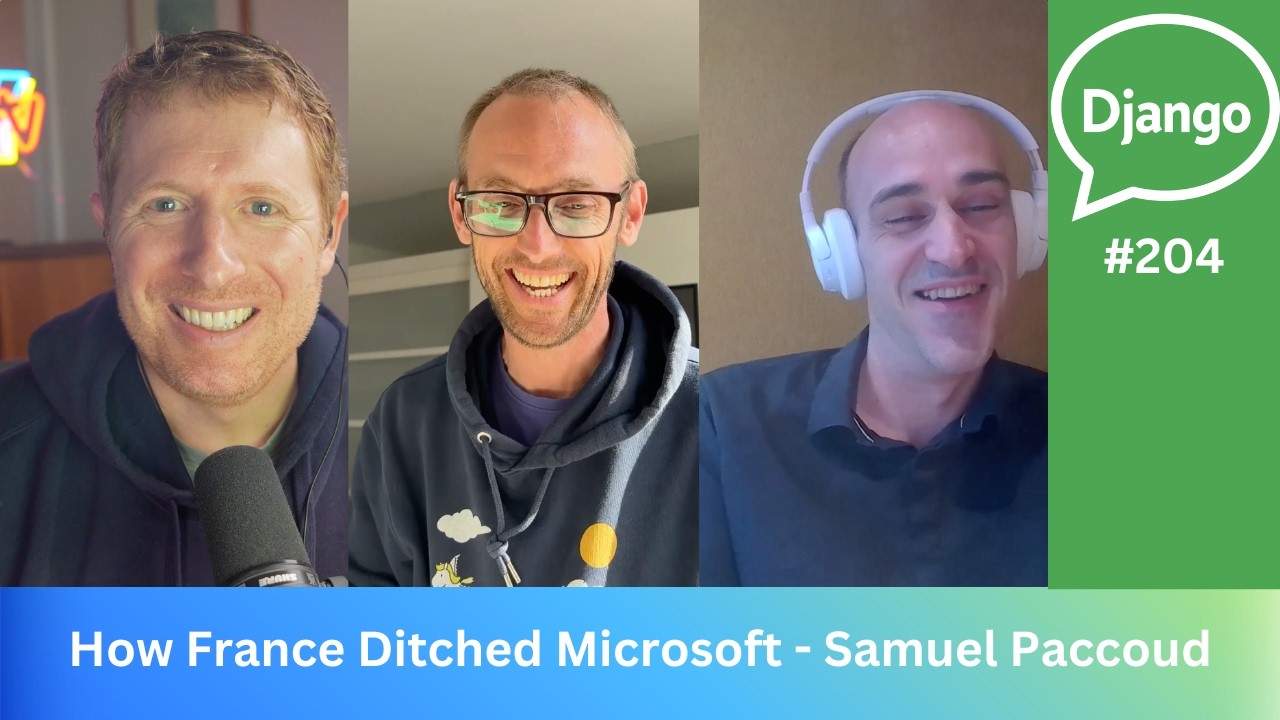
Samuel is the project lead of La Suite Numérique, a French government open source alternative to Microsoft 365 and Zoom. We discuss building alternatives for messaging, video, collaborative docs, file storage, and more that already serve millions of customers.
🔗 Links
📦 Projects
📚 Books
🎥 YouTube
🤝 Sponsor
This episode is brought to you by Six Feet Up (https://sixfeetup.com/), the Python, Django, and AI experts who solve hard software problems. Whether it’s scaling an application, deriving insights from data, or getting results from AI, Six Feet Up helps you move forward faster.
See what’s possible at https://sixfeetup.com/.
Automatically transcribed, so expect mistakes in names and technical terms.
Speaker 1: Hi, welcome to another episode of Django Chat. I'm Will Vincent with Carlton Gibson. Hey, Carlton.
Speaker 2: Hello, Will.
Speaker 1: And we're very, very pleased to have Samuel Pacou from La Suite Namerique join us today. Welcome.
Speaker 3: Hello. Thank you for having me.
Speaker 2: Thank you for coming on.
Speaker 3: Good to be here.
Speaker 1: Yes. So even in America, the the work that you're doing has raised quite a stir of having open source uh software to replace Microsoft and Zoom and other things. Perhaps you could tell us just broadly uh what you do day to day and Then we'll go from there.
Speaker 3: Yeah. So uh I work for Dinim, it's the French uh interministerial uh directorate for for digital affairs. We are attached to the French Prime Minister and Uh my day-to-day work is to build a set of applications, which we call la suite, uh, for daily work. Uh so they are There's instant messaging, uh emailing, uh video conferencing, organizing sharing files and drives, uh, collaborative editing, spreadsheets. We even uh added a AI chatbot recently, so everything for the daily work. Um and we yeah, we do it for uh state agents for public agents, but uh we do it in open source, so it's there's also a community growing around what we do.
Speaker 1: And then I think before that you were working in education, is that right? F also for the for the government?
Speaker 3: Yeah, I so I've been working for DNU for two years, two years and a half. And before that I was working in the higher education uh sector. Also doing Django with uh a lot of um OpenEdicks, if you know OpenEDX.
Speaker 2: Yeah, yeah.
Speaker 3: That's one of the big Django projects. Um so yeah, I worked for six or seven years in in uh France Université Numérique. So that's the equivalent of Dinumbe for a university.
Speaker 1: And then I think um the history is that during COVID, is that when there was effort started to Make these services available across government. Was that kind of when things started? Around 2022 or so, I think?
Speaker 3: Definitely. It accelerated things. But I was working uh in universities, I was working before COVID. When the COVID started, we were the first team to to spin up a Jitsi instance. And we had also uh collaborative editing. Very fast we tried to give tools to our agents which were suddenly at home and had nothing to work. Because we were able to very quickly put up services online, um people started to notice us and send us more money. and say okay we need more of this because people are remote and they need to work. So I think that's when people realized that uh open source was where people had a very fast response to these issues. and and they started giving more money to open source projects.
Speaker 3: While I was in France Université numérique in DNU they were also start uh they were also able to propose tools uh and with open source. But these were standalone tools, didn't have a full digital workspace interoperable with interoperable applications. So that was the the next step was to say okay now people are st after COVID people started to say okay we need to switch to we need to switch to Office 365 and Like public agents, they didn't have these online tools. They were just working on their laptops. After the COVID people started to want to move to Office three six five That was raising a lot of questions in the in the French public sector to say are we really sovereign if everybody's moves online?
Speaker 3: We started to realize that these daily tools not just uh they they are very important because all your data and all the work you do uh is done in these tools. They are really in fact they are not just Just uh detail, they they're they're really core to to your sovereignty, to your data and stuff.
Speaker 1: Yeah.
Speaker 2: So would you say that um the digital sovereignty um sort of a aspect is sort of what the driving the driving force.
Speaker 3: Yeah, I think we okay, th there's also cost. There's cost and the digital sovereignty there. Because Okay, in the public sector we we wouldn't have enough money to pay all the licenses for all our the public agents.
Speaker 2: So
Speaker 3: we we were they were starting to say, okay, let's give Office two six five to only the maybe the top level the managers or yeah they were starting to have this kind of of uh decisions and no that's not what we want uh and because there was also a big problem with that uh Victor Sovereignty then started to see a solution with open source. Uh but really frankly when I arrived in Zim nobody thought that we can do it and I myself didn't know what I was going to be able to do. And that's when we started to have T top one in uh Hacker News uh with docs and then visio later and then we start to believe in ourselves saying like okay, we are able to do it and we can maybe it's easier than we thought.
Speaker 2: Okay
Speaker 3: Maybe it can be done.
Speaker 2: Can I can I ask about um a couple of things there then about the team size and then the f the funding beh behind that? What sort of backing do you have? 'Cause
Speaker 3: the backing is growing. Like, you know, when in the public service when you come the give you just a little bit to see what you can do and then they can give you more. So when I when I uh took the team the budget was it was about like between five six million maybe everything was used to pay licenses. So I had to work nights, weekends to start to to start docs and visio. We started it as a student project. We did it on our spare time. Um and then slowly when we did top one in Iconus, people say, okay, maybe we should give them more money. And then so today uh last suite is is roughly is around ten million budget maybe It's about 80 people, uh 35 developers, mostly freelancers. Yeah, yeah, that's that's the figures
Speaker 2: But that's super, no? That's to have you know, be able to put a team of that size together. That's not a small team, that's a big group.
Speaker 3: Yeah, it's it's the potential is huge. Like when you you know the State state alone in France is 2. 9 million agents.
Speaker 2: Yeah.
Speaker 3: And if you consider the whole public service in France is uh six million agents. So the potential for these open source tools is is huge only in the public sector. And that's why it's strategic to It could it can be done in the public sector. It can't be done in the private sector by just a company starting to s starting and say I'm going to make a suite with open source and Spread it. This this wouldn't work. So we thought that okay, the public sector can make this happen.
Speaker 1: And then just the the cost savings has to be Very high, right? Because team licenses, especially for enterprises, I mean it must be millions of dollars that's saved separate from the costs invested in your team.
Speaker 3: Yeah, I think I think I can say today that we We saved more money. More public more. We saved more public money than we invested, so yes. But it's not so easy to say, okay, I mean you save ten million, so give me ten more million.
Speaker 2: That's a working way.
Speaker 3: So yes, they are the We have to we we can make savings and I think if if people make the the the correct calculations we would have to go faster. But it's more complex.
Speaker 2: Can I just swing back momentarily? 'Cause did we introduce the suite because we we we we know it what it well now I know what it is, that's why we've invited you on, but did we really introduce for the listeners what the last suite numeric is doing.
Speaker 3: Okay. Um yeah what what it's a suit suite of application. I don't know if you want to go into each application. There's there's also a a s a core of last suite which is green which which is based on Django and other applications which are not. So we can maybe focus on on the Django
Speaker 1: Yeah
Speaker 3: applications. But they there are there were some existing tools when I joined. The first one is uh tool called CHAP, which is uh basically a government instance of metrics. Uh so that's uh four hundred thousand active users uh uh monthly active users as we speak on on the metrics uh federation for the French states
Speaker 1: Is that sorry, is metrics that's the same as messaging, like instant messaging?
Speaker 3: Yeah, that's instant messaging. for instance messaging.
Speaker 2: Okay.
Speaker 3: It's quite successful in in the there are more than a hundred thousand nodes in the world in the open community, in the open federation of metrics. We have a private federation. It's quite successful also in uh uh how do you call regalion uh environments in governments because
Speaker 1: regulated yeah
Speaker 3: encrypted yeah this enc encrypted and distributed uh
Speaker 1: Can I ask about the I mean on that and then the other projects, the hosting. I assume it's also has to be like servers based in France. You're not using AWS in you know, Washington Washington DC.
Speaker 3: Yeah, we we have a certification in France called Secnim Cloud, which includes um protection against uh No extraterritorial uh access. So so it excludes uh American uh led uh clouds. So yes But we have several instances. We use public cloud with this certification of second cloud. So it could be the the French uh hyperscalers are uh like OVH or Scaleway. If they have this certification we we can use them. But but we also have internal clouds, internal to the states where we can have specific instances with more security. And that's the interesting thing with open source is that once we have the product we can deploy it tens of tens of times.
Speaker 1: Yeah.
Speaker 3: Uh in air gap, in s uh classified environments, in open environments, and and it also spreads uh uh outside of the state, so that's interesting. Uh yeah, it compounds.
Speaker 2: Yeah. I mean that that's one thing that I'm interested interested to follow up on. Um is like 'cause I think once you've built the foundation, there is a real chance to if you m if it makes it easy enough to install and uh people can run it themselves, there's a real growth opportunity there. The market and the cathedral and the bazaar type, you know, approach could really apply here.
Speaker 3: And it does. It's really starting to to pick up the the especially on docs and visio the uh like visio for was used by gamers because in visio you can share several screens at the same time And you can stream it to RTMP. So you can stream it to YouTube and it's kind of yeah. So gamers started using Visio. It was packaged for NixOS as well. So very easy to deploy and and and it's funny because the people who packaged it for NixOS, they made a fork activating all uh some features for gamers. That that was the first community that started using uh Visio. Um and then and then it as we speak, there there are I don't know how many instances there are, but they're they're quite
Speaker 3: they are It's growing. We have people who developed a full mobile application last month and that's it's coming. Like contributions are starting to come.
Speaker 2: Okay, but so you've got you've got um messaging, you've got meetings, you've got files, you've got email, you've got spreadsheets.
Speaker 3: That's the difficulty. When you want to build a digital workspace, you have to build a lot of applications and need to be big and we are not that big either. So we hope we we need the community to to to take on this and to help. But we also we are like myself I I've been working on Django for 10 years and we we have about ten developers who are really experienced on Django and so we reuse what we do a lot. There's a joke in last suite saying that everything is a fork of dogs. And if y in the case of Drive, Drive is literally a fork of docs with just a small change in the front end, we replace the editor by uh file browser, you know, and that's it. That's that's a tree, documents and with access rights.
Speaker 3: It's really, really close. So we we manage to because Django and React uh are uh We we master our frameworks, we we're able to reuse a lot of what we do. Yeah, we try to to cover the whole digital workspace with the with the resources we have, which Which are growing but slowly and trying to embark the community and yeah, be smart.
Speaker 1: And then you're often I think Django Rest framework is the what you're using, right? Like have you must have been tempted by J Django Ninja and maybe some other tools? Like how is how is Django Rest framework holding up for you? I guess is the question.
Speaker 3: Um I think our approach is we we we've been working together for 10 years, like this team, and we had our habits. and the way we do things. And we we focused on what we can build as fast as possible. And we didn't take the time to like Django Ninja when we started, I was I was looking at it and I hesitated, but it was really the beginning of big Uh yeah, yeah, I couldn't find like a big project in production that would make me feel really safe to use it, so I I just went on with REST frameworks which we were which we were using for several years. Then lately I I saw of course I saw Django Bolt and I'm really really excited with Django Bolt. Uh but you know there would be a lot of rewrites.
Speaker 3: Um I think we would love to stop and make this move, but It's also not like it's you don't need to. So if you just focus on what you ship and what you your impact, the tools and your users The tools are it's good enough. It's we master it, we know we can do whatever we want, and we it's not rocket science what we do is really Serializers, use and models, we've been doing it for years.
Speaker 2: Yeah, know
Speaker 3: how to optimize it. We don't even have cache yet on our or on docs or drive. And yeah, we know we have really room for for heap optimizations before we need to go to Django Bolt, for example. So
Speaker 2: Django Boat's super exciting that you can get an awful lot of requests per second, but if your application isn't anywhere hitting the limits of what you can already do, that's It's a big art rewrite just for fun.
Speaker 3: Yeah, and and you know, a lot of people on the on the forums and they very often you see haters like saying, Oh, everything is good about this project except the choice of Django. But the truth is Uh and then they say, Oh, Python is so slow, why do you choose Django? I mean if you when you build these applications you know that your your the speed of your application is It's really most of the time it's just in the database or the way you make your queries.
Speaker 1: Exactly. One thousand percent. It's just like people don't know what they're talking about. Oh my god.
Speaker 3: And and and and if we if we can you know we are we are doing uh APIs so if you can cache something at the serialized level and you know maybe maybe we have already super fast more more that way we can do In in France Université numérique we had a video like a YouTube platform uh equivalence and we we had three million users on it and we had only one pod because like It's just serving video tokens and uh so everything was in cache and so you could serve like so many requests with just a bug. So yeah, sometimes it's just not where the paint is.
Speaker 2: Yeah, no. I yeah, okay. Perfect.
Speaker 1: I wanted to ask
Speaker 3: We love the URM. We love we love the URM in Django, so
Speaker 1: I wanted to ask about ProConnect, which I think is uh SSO across government? Because I think one of the is it correct? One of the challenges before was getting adoption was login and maybe you could speak to Uh introducing that and why that I think led to a lot more users for you.
Speaker 3: Yeah, because basically like I was saying, you have two point nine million uh users in the states are agents in the states but they are everywhere. They they are in each ministry, they they are in small entities, organizations are everywhere. And it's nothing like hierarchical. There there's no one who can say let's do that and everybody follows. It's it's a state. So it's designed to be complex and and have independence between teams teams so that not one person can decide for everybody. You know, that could be creepy. So that that's also you need to convince people that your tools are good. Uh and to convince them y they need to have access to your tools.
Speaker 2: Yeah, right.
Speaker 3: And that that that's could be really, really uh a headache. Uh so But but we we are we were able to put up a SSO which has every everybody behind one button and they could log in in one click So that that was really, really important in in our distribution strategy for our tools. Yeah.
Speaker 2: To m make it easy for people to onboard, right? So to give it a try, kick the wheels.
Speaker 3: Yeah.
Speaker 2: Oh yes.
Speaker 3: Yeah. And uh I think we get a lot of inspiration from UK. which are really uh were ahead of us on this on all this uh government IT. Uh we get inspiration. In France we have France Connect. We had France Connect for uh for end users. uh with like hundred million connections per per month and it was working really well but so we we forked it and used it for ages.
Speaker 2: Okay, okay first I wanted to ask you to you mentioned im you know it's obviously a French-based project. I'm wondering um whether other governments in the EU are picking it up and joining in and
Speaker 3: Yeah. I would say uh across the EU there there is there is the subject of sovereignty which is growing and we talk to a lot of governments. But what we don't have is like uh we don't have a Common response. Everybody say, okay, let's do this and everybody you do this, I do that, and that's it. We we're not able to do this. I would say it 's important that everybody that the the concern is raising and open source is quite uh uh Yeah, it's it's seen as a solution in several countries, uh especially Germany, France, um the Netherlands also is joining us on this Um so yes, it's it's
Speaker 3: there's concern but I would say we are not there where we where our efforts compound, not yet.
Speaker 2: Okay.
Speaker 3: Try to work together, but for example with Germany and and Holland we and the Netherlands we we try to work together but uh the approaches are are quite different so the yeah the I wouldn't say that it's uh w Yeah, that we're very, very successful to to add it add our efforts to compound. Yeah.
Speaker 2: But that might come over time, right? I mean the the the European project is still quite nascent.
Speaker 3: Yeah, I I think whatever steps we we take Eventually we'd align, like if you if if you m if one country pushes something forward, another country pushes something else forward, eventually it Everybody gets aligned behind what works. So it's also good that everybody is trying a different approach. And if you hope that what works gets
Speaker 2: I as well, one would think that um a diversity of approaches will ri will lead to a richer solution in the end. Is that it might take slightly longer to To get off the ground. But hang on, the the Dutch perspective there brings something that we hadn't considered to the table.
Speaker 3: Yes. Yes, but there's also there are also some Some ways to back go backward sometimes.
Speaker 2: Like
Speaker 1: you know, like
Speaker 3: you're you're in the public sector, so you have a lot of pressure, a lot of lobbies.
Speaker 2: Yeah.
Speaker 3: When you succeed in something, the people come for you. they can you know, you can you can lose some battles, you have to continue fighting. Okay, so you have to hope that that you have a positive impact on on on these things, but It's never never ending.
Speaker 2: Okay. The the other question sort of that's just at the top of my top of my sort of tongue is like how to How to get involved from the listeners have you know seen last week numeralique and you know if they want to r download it, install it themselves, is it easy to get going or
Speaker 3: we we're trying to make it easy? Um it's I would say it's getting it's gotten quite easy on dogs on on the projects that have the most uh the biggest community.
Speaker 2: Yeah.
Speaker 3: Um so we we make it Um containerized, we have Docker Compose. If you go to docs, you pull the repository, you make make bootstrap, nobody works on your laptop. Like if if if you're a developer and you have Docker on your computer, it should be working within minutes.
Speaker 2: Okay.
Speaker 3: Um on develop on on going to production, we focus on Kubernetes. Like we provide everything for Kubernetes deployment to production in minutes. Like ham charts, uh we propo we have official images and everything. So and documentation Um so if you run Kvent C C Z. If you don't, okay we we you're a bit yeah you're more
Speaker 2: on your own.
Speaker 3: Yeah more on your own. But if you master Django, it should be too hard. Like it's Yeah.
Speaker 2: Okay, so you have if
Speaker 3: if you use Docker Composing Productions is if if you want to build a a VM from scratch with Uh the old way then okay, you're on your old
Speaker 2: Okay, good.
Speaker 3: But but we hope the community comes also to to contribute all this. Um and other projects we on other projects who are more recent or on which we did less community work. Maybe the it's uh there's less com less documentation could be a bit harder. So still work in progress to really make it easy to deploy.
Speaker 2: Right, okay. I mean but
Speaker 3: yeah
Speaker 2: presumably I could reach out presumably I could reach out, open an issue, I'm trying to deploy this, I'm trying to do that and
Speaker 3: Yeah of course. We we have metrics channels which are which um mentioned in our readmes.
Speaker 2: Okay.
Speaker 3: Um You can open issues. We we're quite active. Uh we we're quite responsive on all this. Um one thing maybe is that Obviously we build uh applications for scale, like like we're talking million users.
Speaker 2: Yes.
Speaker 3: So we make some choices which are like we make object storage first, we make choices for scale uh OIDC first, everything. So if if you if you're a very small company and you just want to have a VM and pay the U VM one euro per month and you want to install everything on it, you need to be skilled because You will need to have a OIDC provider, you will need to have a public storage. A lot a lot of people they they will if you want a very small instance They will realize that uh it's not not what we focus on. So if you don't have history then difficult for you Yeah.
Speaker 2: But there's an interesting contribution opportunity for people like the people who want to scale it down to come along and you know.
Speaker 3: Yeah, so some some people have installed it on on uh you know host. I don't know if we know this project, you knowhost?
Speaker 2: No
Speaker 1: Yeah.
Speaker 3: That's like uh yeah maybe it's French. It's it's quite it's quite used in free software. Minities, it's like a box on which you can self-host a lot of applications without doing like heavy sysadmin you you can click and install your so they have put visio they've put grease docs you can install it with a click I'm not I'm not in favor of these approaches so much because sometimes you make it look like it's easy, but when you run a uh an object storage cluster and uh it's not so easy, you know you still need skills in case something goes wrong. So yeah, if you hide too much. Complexity if you hide the complexity too much, sometimes people can have problems.
Speaker 2: Yeah, I mean that's that's something that uh I always think about is It it's okay when the complex system is running nicely, but what happens when it breaks? Can you dig down and work out what the separate parts were?
Speaker 3: Yeah. So I I advise people that may maybe if you want to host it, you can We we have a proxy that that uh encrypts your data for your S3 for for your object storage. So I would advise that you open on a bucket on a provider and if you're if you want sovereignty of your data you can encrypt although although you put it on a bucket on on the cloud, you can encrypt your data on this uh S3. But at least you don't have to operate it. You're not scared to lose your data. That's my advice. It's cheap to have a bucket.
Speaker 1: Yeah.
Speaker 2: Okay, cool, cool, cool.
Speaker 1: Well there's also um for h French hosting providers, there's Scalingo, which I is similar to Heroku. Um, I actually had a conversation with the developer advocate there, which is because I was surprised I I hadn't heard about it until Heroku shut down again. Um, but they have proc files. They've been going ten years. I th I believe they work with the government a little bit, um, but it's a very, very easy to use option.
Speaker 3: Yeah, we we work with them. So we can deploy to scaling. Yeah, we have some instances of scalingo. There's also clever cloud in France. Which does the bit the same thing. It's a pass as well. And they have uh how tools, build how tools of how to deploy dogs. Yeah. That's a good option as well. But maybe more expensive if you You're really looking for cheap uh hosting. Yeah, you basically you need solutions for all the profiles.
Speaker 2: Yeah, yeah. Like one machine, five machines. Hold on, manage for me. You need all of those. Eventually.
Speaker 3: Yeah.
Speaker 2: Yeah. But the project is very open to contributions, right? If people want to come in and add to the docs on a deployment story or something like that, they could do that.
Speaker 3: Okay. So the project is started by us, so that's Publications, uh the the repositories uh we we are there's no open governance at the moment, but that's one of one of our main objectives. We are we when we say we want to do digital commons, we mean it's We mean that we want the governance to be shared. We want to slowly we want to just be one of the contributors. Uh so we we were hoping to bring we are we are still hoping to bring uh other countries, companies, integrators, hosters. uh to contribute and slowly take over governance with the community. We are not there yet and we we frankly we don't know exactly how it will be done, but that's where we want to go.
Speaker 3: I think docs is to be the head and will be the first repository to w that we will really open. Most probably send it to a foundation and really look for an open governance. Um there are some communities, I don't know how much I can say, but there are some communities in the the open source, in the free software. uh communities that that are putting offers to DNIM to yeah to take the code and start to to organize this for us. I don't know what it will What what will happen? I frankly don't know. But I really, really hope that this goes through.
Speaker 2: That'd be really cool though. you know, open source, but then to give it an open governance model gives it sustainability into the, you know, medium and long term, hopefully.
Speaker 3: And and maybe we we can discuss I I'd be interested to discuss with the like Django people, Django Foundations and see Because these are the people to who would be interested to to be active in in this community. So what are the best practices, what are examples, what what has been done? And yeah, we we are at the moment we are looking what's possible and Yeah.
Speaker 2: But th that's a cool that's a cool cough. That's a cool. So how how did you end up in this you know great situation? Like you're you're working on what's a really cool project in a kind of socially worthy the thing at the cutting edge of technology doing some really good stuff. And how did you it's a kind of dream job, no, to roll in the colour.
Speaker 3: No, no, no. No, I I wouldn't say it's a dream job. I don't know if you're on LinkedIn, but it's quite it's it's quite uh I don't know how long you can hold on this kind of job, you know, it's quite active and quite exposed. So but when you succeed. When you succeed is good, but um not a dream job. Uh it's uh what I was looking for. So that but it's not easy. Maybe if it was a bit easier would be the dream job. Well how did that go? Yeah, I I end up I ended up here by because I uh like I was like I said, I was Django developer and The f the first I became a developer to to grow a family. Like I was looking for a job that would really accommodate
Speaker 3: taking care of a family.
Speaker 2: Like
Speaker 3: Uh during the day. I was when my kids were small I was coding at night. I w I wanted something really flexible. So I went I I came to coding quite late. I was like uh past thirty years old and Before that I was working in uh international commerce. So it gives me a profile, a bit double profile of uh learning coding late and and having a business international business uh experience before and so that that's a strength that that really uh allows me to navigate in the complexity of public sector and Yeah, open source stuff.
Speaker 2: I I can imagine in public sector there's an amount of politics. There's an amount of people management.
Speaker 3: Yeah, and the interesting thing when when you're uh an open And you're a developer and I had also a free software, strong free software, uh I would say background or color. And so You you come with a mission, like you you see something that's in the that goes wrong in your country or something like digital digital sovereignty was really an issue. I've I've always been sensitive to this, like really um Predatory, no predatory software. But that was always a big issue for me, like really from young. I think I I came back to this with the excuse of building a family and having a more flexible job but I it was in my head that okay that that's one thing that's important for me. So yeah.
Speaker 3: And when when coming to it, um yeah you The the I started to learn coding for ten years as a freelance and slowly moved to really to open source and it was it was progressive. When I when I arrived in France Université Numérique I was I was coming for open education more than for open source. I I didn't really I was not really in the open source communities. I was using Django but not really I was not really a free software advocate in France or yeah known for this. Uh and then from working in the in open education and slowly, slowly I I I started to really know where uh to start having
Speaker 3: strategy of how to do it, how can we make it happen. Yeah. And the strategy I'm applying at DNA is quite controversial. It's still quite controversial even in the free software uh communities, uh in the private software uh So because we succeed, people start to see, oh maybe that's something interesting the way they do it, but it's controversial. Like we are in the middle of the open source movement, the free software movement. the and and the political things. We need to convince everybody that this is how you get impact, this is how you keep control of your software, of your data. Uh yeah. So our success gives us uh gives this strategy a voice.
Speaker 2: Yes.
Speaker 3: But yeah, but I wasn't sure when I applied it that it was going to work. Well I can elaborate a bit more if you want on this.
Speaker 2: No, but it it it it seem you it seems you have to build on the successes one at a time, right? You have to you know
Speaker 3: Yeah, get
Speaker 2: documents out the door and oh look, it's working and people are using it and it's you know within our own control.
Speaker 3: Yes, yeah, yeah. Well when when you succeed something then people start to think that okay they they misunderstood something. If not they will think they are right and you must be wrong. So when you succeed something it then we can talk again that okay You see this thing you said that we I was going to fail, but in fact I succeeded. So that's why I succeeded. Do you agree with this? Okay, yes, you agree with this. So now I I propose that we go this way
Speaker 2: Yeah, okay.
Speaker 3: Um so that gives us opportunity to maybe build what like you know it's very interesting the some people come to see me and say, okay, we were trying to do this for twenty years in France, we didn't know how to do it. Please explain how you did it because we want to apply it in other sectors. Like the like what's the recipe for this? And the recipe is You know, there's a big debate here on the make or buy. Should you
Speaker 2: Yeah.
Speaker 3: When your government should you be coding? Like people will say no, as government you shouldn't be coding. You should just be defining the the specifications The interfaces, the standards, and that's it, your job is done. So maybe in some countries that that's what the the role of the state is, but in France the the state sector is much, much bigger. Like yeah, we were saying like six million agents. Um and I don't think we and and the uh history proves that when you you're not coding and you're trying to regulate stuff and declare standards and specifications, if you're not coding you have no idea what you're talking about. you know AI is coming and I also have no idea before I start coding what what it's what it should be. Now we we are working on interfaces.
Speaker 3: I w I was mentioning that Now that we succeeded some applications, we want to make them interchangeable so that when people sell digital workplaces, we we have a standard that we want to call Open Bureau. And if you comply to these standards You can change a drive for another drive, a video conferencing for another video conferencing, and it will work in your digital workspace. And when when we started building this, we realized how difficult it is. Because it's not just saying that's web dive or that's FTP or whatever. You you can't just say that. You you if you don't trust your the drive doesn't trust the video conferencing application, need to go down to the scenario, you need a tokens for and you need to know what you will allow one application to do in the other application
Speaker 3: on behalf of the user for how long. A little bit like the S3 policy, you know, S3 policy, you can craft uh S3 policy, but you will say You're allowed to push a file at this place, at this path, this maximum size, this type of file, for you have 30 minutes to do it and then that's it. And so you go down to the scenario and you say, okay, this is how it should work. But if you're not the developer doing it, how can you specify it? Uh I'm trying to tell people I can't if I don't make I can't buy. If I don't make I can't specify.
Speaker 2: Yeah, no, that's exactly it. That's exactly it. I'm so I'm I'm obviously from Britain originally. And the the the the opposite approach was always taken. Let's um let's just outsource everything. Let's do it all in the private sector for our efficient and you know And you know, that like all things you can swing the pendulum one way or the other and it can go too far. But the reality is you can't specify software s with sufficient clarity to be able to outsource it totally, and so you end up with you know, that the the history of British IT projects over the last thirty years has been one of overspends and um you know miss misspecifications and then you know budget doubling and all the rest.
Speaker 1: Yeah, but I think what's missed in that is like it's not just incompetence, like the the corruption is is the point.
Speaker 3: There's also corruption, but there's also that there's both Then
Speaker 2: the barricades will, yes, absolutely. But it it's also it's a kind of logical impossibility to specify the software up front until you're in the in the weeds writing it, right? It's something that we have at the smallest scale, writing our own applications, but it must apply a hundredfold at government scale.
Speaker 3: Yeah. So um and and another thing is when we started coding, some people said you need to give us orders. And so maybe they're right that it's important to to that the public sector is not going to do everything on its own. Yeah and and I always thought of like if I succeed, if I want to succeed last suite, I cannot just succeed in the French state. If I do this, in five years someone will come and say, how come the French state has its own digital workspace where everybody's doing something else? So the the project can only be we are building tools for our agents, but building it with open source, I mean public money should go to public code and our ambition should be to to make an alternative to
Speaker 3: to what the hegemons we have today that that uh that pose uh sovereignty issue. And so we want an open software in we want open software in Europe, we want diversity and this cannot this is the only success We we can't have success if we don't manage this. Um and so that when you say that, then your your project has become ten times harder. So
Speaker 2: Yeah.
Speaker 3: And it's far that's why I'm doing a lot of politics because I can't just succeed by coding stuff that my users use. I need to code stuff that the community takes, that other government takes. that private sector takes that uh I don't know. Everybody should be able to to get value from it. Yeah.
Speaker 1: Yeah. I mean this is the problem of success. You're asked to to boil the ocean. You succeeded in one thing and then nine more problems and and uh Yeah. It's a success problem, but still a problem.
Speaker 3: Yeah, but we had the bigger problems. We we are in a better place now than two years ago. We still have a lot of work. Where would we would we be if we hadn't started it uh two years ago?
Speaker 2: Okay.
Speaker 3: Like w when I joined, there were already two ministers in France who had uh asked for derogation to use Office two sixty five and all the other ministries were asking derogations as well and now no one is asking derogations and they they give us part of the money to build a suite. So we are in a better place and we think if we continue, we are allowed to continue and grow out of the state. Uh it's always something that would be good.
Speaker 2: That's really building a a common that's really building a digital commons at that point. Something v of value not just for the citizens of Europe but for any anywhere. Um so that's fantastic. Can I ask you, um, you know, was it just your historical background that led to Django or, you know , it's you know, why Django?
Speaker 3: Okay, uh in my case, why Django it's my brother, so I would I need to ask my brother why Django.
Speaker 2: Yeah. I think
Speaker 3: causing Python and yeah, I think why I stick to Django is Maybe like I was saying my background was I was I had a b engineering background but not uh developer and and And so I I wanted to make things done, like I wanted to make things and I was less attached to the tech than to what I could do with it. And and that's what I like in Django, like, you know. the efficiency batteries included you can ship some things. I I really love the also I I always liked the Zen of Python, clean code. Um I feel that's It's more than the product, like like it's more than the code, is is the community.
Speaker 2: Yeah.
Speaker 3: I I don't know. I think in elsewhere in the world there are bigger Django communities, but in France it's it's really small. Like in France PHP has remained uh bigger than elsewhere uh for many reasons. So Python and Django community is a very small world where everybody knows each other. It's like really a family spirit and and so I was attached to it like very fast you you know more or less I was a freelancer so more or less you know everybody and that there was really like a quality approach to code And that's how we existed. Like the Django community ten years ago existed by the being making things differently than the rest of the world. That's what I liked. And now it's the boring tech, it's really it works.
Speaker 3: It will work in twenty years.
Speaker 2: Yeah. The
Speaker 3: solution for you every every problem is is uh already solved in a elegant way. I mean, that's not the that's the second best tool for anything. And AI AI for me is making the choice of Django even more obvious. Because it's the same engineers and you see a lot of people from the JO community who have now moved to the AI community. And when you go to Python, I went to EuroPython in 2020. one and and before chat GPT and yeah it was already everybody was talking AI. We have huge community around AI in Python so makes a lot of sense to do Python today And together with Rust, I think it's really uh also it makes it maybe future
Speaker 3: proof. It could be discussed, but I'm still I still feel very comfortable with This framework.
Speaker 2: Okay.
Speaker 1: I think that um outside of the US and China, I mean France in AI has Mistral, has Hugging Face. It it's very strong. I would say it's number three Just in in my head in terms of public-facing companies that are doing cutting edge AI stuff.
Speaker 3: That's more on the mathematical, I would say. than the Python than the coding? Like like we I think so because all the people you mentioned they are from the same school in France. So It's it's a very yeah.
Speaker 1: Well let me let me make a specific question. You you had mentioned at the beginning adding AI enabled features to La Suite. Um how are you doing that? Is that Loc local models is that like what models are you allowed to use? I assume maybe not, you know, anthropic? That's a sovereignty question.
Speaker 3: No, no, we don't we don't use uh SAS. We we run models locally. on our infrastructures. So we run them on Kubernetes. It's become quite easy now with that there are a lot of tools in Kubernetes to do that. So we run models. And we run all types of models. We can run uh Whisper, we could we have uh also live live transcodings. LLM, LVM, any type of model we could run. But our approach to AI is we know our limits. We we're not AI engineers. And we w we try to use AI for our use case. We try to not invent a use case. Um we take an existing use case Something that really works or already works obviously and we try to bring it to our tools.
Speaker 3: So for example in Visio we we will bring transcription, live transcription. uh asynchronous transcription and live transcription summary of the transcription um in docs we have basic uh editing uh features like uh text generation features Um and in files in the drive we do a rag. We we try to index to make um semantic search. we we try to work on OCR on uh you know indexing any type of document efficiently. Uh so these these are all use cases that are mastered and that really you just need to run a model and make a little bit of Identic or a little bit of uh front end
Speaker 3: and make it work. Um that's the approach we have now. Um doesn't it works, but we could be better. Yeah. We we would need some help. We could we could take some help on this part of the how of our products.
Speaker 2: But we you know, I I look I look at the you know the the products coming out of say um you know the the glossy device company from California and their AI doesn't seem any better.
Speaker 3: Yes. Some people come and say, hey, we come from This tool and we went to docs and wow your your AI works better. Okay. But but we w we only use open source models.
Speaker 2: Okay.
Speaker 1: I I think that's the future. We could ha we could talk longer about that. Uh even at uh I work at JetBrains, which makes IDEs, PyCharm, and you can bring whatever model you want. So you can bring private models, you can bring open source models, and I think I mean the inference costs alone Every three months I think are dropping dramatically. So I suspect that will be more and more important for cost, for security Um and they're good enough a lot of the times. Yeah. I think it's getting better.
Speaker 3: There's one one thing in which I believe in AI is you see a lot of experiments. Uh and a lot of people will show you cool things with AI, but do they do they control the code? Do they control the data and the people's access to bring AI on people's documents and on people's uh workflows everyday use of the tools. So if your people are are uh if everybody is in Office 365 then you don't choose the model that they be using so why do you do all these AI projects? Because your people are everyday in the tool which you don't control. You can either pay the AI feature or don't pay it and you don't get it. So um we we believe also that because we do the infrastructure stuff because
Speaker 3: because we do the structural stuff and control our data and our users. we'll be able to bring the use case and to bring usage to the models that we run. Um and something that we see very few people manage uh doing and that we are able to do is that our applications We have OIDC to authenticate our users in each of our applications and not only our application, any application in the French state. Which decides to connect to our SSO, is in this federation, in this OIDC federation. And we use one spec of the OIDC uh one part of the OIC OIDC spec which uh talks about server to server uh uh authentication and so when someone is logged in on one app
Speaker 3: the server of this app can make a call to another app on behalf of the person who is logged in with the special access rights which I was mentioning to secure with the we can get a token for a special use case. And so we are able to tell any application in the French state would get the right to push a file to our drive on behalf of the users that is logged in. And so this also applies to our chatbot and to our global search index. We like I know Google did it twenty years ago, but with French ites, still don't ha didn't have it. So now we have a global search with semantic uh search with uh AI uh indexation and whatever whichever application which is on our SSO can push data to this global search
Speaker 3: and then users can query this global search from another application on behalf of the user. Our chatbot has tools that can interrogate this also this search with the the access right of the user. And this very people know how to do that. So you I mean safely with with com keeping control of your data and being allowing your users to query data live. Yeah. I don't know if I explained it well but
Speaker 1: that that's amazing. That's I worked at a startup ten years ago that was trying to do that for bring your Google in, bring your Dropbox in, bring all your things in and have one search box for everything. And the permissions were difficult. They used Algolia, which is that French as well, I think originally.
Speaker 3: That's our inspiration for global fighting.
Speaker 1: Yeah, so it would um yeah, it's a really good idea. And it's very very difficult to do, I guess, is what I'm trying to say, because I worked on it a little bit and actually
Speaker 3: it's not that hard when you control if you control it. Yeah, when you control them
Speaker 1: it gets easier.
Speaker 3: Yeah. We use open search. Basically, okay, I did this this uh project, Startin's project in just two weeks. It's very, very basic projects is uh in the hundred lines of code. It's called Find. You can find it in our GitHub. It's called Find. It's basically an open search with two views. One to push data Uh to push data you you need uh to have a token, a service account, and any app that gets a service account can have its own index and push data, so that's very basic. And on the front-end side for queries, we use this resource server, this OIDC resource server specification. And then it's really easy because you just need a field. For each document that's being pushed we we have one field with the users with the list of users who have direct access, specific access to this document
Speaker 3: We have another uh field for any group that have access to this document. And we have a few flags to say if it's public reach or it's not not it could be not restricted to these people or to these users or groups, but it could be public. And with just this, we're able to secure access and make a search that is restricted to what you can access. So it's really actually really basic. And the resource server part is the specification. We have a few classes, a few hundred lines of Python to We check those tokens uh with the the OIDC provider. But that's really not rocket science and that that's really, very cool though.
Speaker 1: Right, it's very cool. Even a even someone who doesn't know how to code can that solves a big problem for them, right?
Speaker 3: Yes, that's a big problem. And and if you don't know how to do this, you know, I I see my some colleagues who come up with oh we have this AI demo is really cool. And then tell them okay how are you going to plug it? How are you going to give it to people and plug it to their tools? And then that's becomes easy.
Speaker 2: So can I ask, what's on the roadmap for La Suite numérique? 'Cause you seem to have gone from strength to strength and what's next.
Speaker 3: Yeah, one thing that we miss and that people are asking us a lot is we we have the chat but do we have the chat sorry. uh instant messaging and we have video people are asking for teams basically for for slack the slack experience
Speaker 2: teams go
Speaker 1: yeah yeah
Speaker 3: so that's something people ask um and That's something we don't want to leave unanswered. So yeah, that's that's something that's next for last suit. We don't know yet what technology And maybe that's one of the uh weaknesses in Django to uh everything web socket 's uh you know at scale. So we don't know yet Whether we use matrix, whether we'll use something like a pub serving another language. Yeah, we we're not sure yet. We know Django is not the best tool for that at the moment with channels Um and maybe I missed something and I'd be interested if someone thinks that
Speaker 2: there's a way to do it. Yeah, it's the it's the ease of scaling that's um I mean, you know, that's um so they the the tool I'm looking at at the moment actually is uh called um Hornbeam, which is um written by um Bemoir um ah whose surname escapes me this moment, but he's the been the maintainer of GunnyCon for G Unicorn for a long time. Oh he's put out an er an Erlang server. um with Python integration um as well.
Speaker 3: I saw him in Fosdem. I met him in Fosdem, but uh I didn't know he had this project.
Speaker 2: But that's a that's a lovely looking project in terms of you if you want the kind of um low latency, um high concurrency um environment of Erlang, and then you can have your application logic in Python doing your normal thing. So it's a server called Hornbin that I've been eyeing up very s very much.
Speaker 3: So another thing that we're working on now, but it's quite advanced, we are finalizing the first box. Of concept is uh end-to-end encryption on all our tools.
Speaker 2: Okay.
Speaker 3: So yeah. So we like uh we'll have a global Enrollment to get your private key and we have all yeah multi-device uh enrollment on to get a key and once you have a key globally for the suite Any uh any application can re and ask for to encode something in the browser and then when we did our application we thought of we thought that we knew that we wanted to go this way. So docs Fichier, uh drive, everything is is uh already planned to be uh and to an encrypted like like the server is dump. So that's one thing. We also have a big challenge to of course continue growing the community, continue getting more active users in the front.
Speaker 2: Okay, so there's there's the there's the the entry point for a question then is okay Django users listening to the to the show. think oh god I want to check this out what is what's the entryway to Nasuite's community and to get involved and um
Speaker 3: probably our github github. com slash suite numeric maybe you can give the link From our GitHub you have you can see the different projects and on the readmes you you find the metrics channel you you can Yeah, you can open issues, you can talk to us like this. You can find us on maybe on on social networks, Mastodon. Twitter or LinkedIn. Um yeah.
Speaker 1: That's what you need. You need to make a social network for the French state. Something that's not some of those.
Speaker 3: Okay, one thing that's happening that we didn't talk about is There we one thing that we succeeded doing with other European countries is we did uh an edic. It's uh European infrastructure
Speaker 1: Oh, I saw this. I'll put a link with a uh Leia German colleague, I think. Or uh
Speaker 3: Yeah.
Speaker 1: Yeah.
Speaker 3: Yeah, but that that just started. The edict was created end end of December twenty twenty five and the the new director has just been appointed and will start working and so the edic is here to organize uh investment in commons at the European level and there should be big project big financing coming and that could be piped to this uh Consortium. So we we hope cross fingers that uh but the European Commission has announced that they want to push open source at the European level. So the edic is uh is a good uh vehicle for this. They are There is a strong strong uh will to push uh social network, open source and more
Speaker 3: There there is this real I I'm not sure it will be our team. I don't think it will be done at the French state level.
Speaker 1: Right.
Speaker 3: Um Once once you have this edic with financing inside, I think it goes much beyond uh what we can do inside the French government. Yeah.
Speaker 2: I mean there's been a lot of um good stuff come out of I think it's a j the German Sovereign Tech Fund, um which is in a similar space.
Speaker 3: I really I love and also NGI.
Speaker 2: No, I haven't heard of NGI. What's that one?
Speaker 3: It's uh NLnet? Okay, I'm not sure. Um that that's pro okay Sovereign Tech Fund is to to mm finance the maintenance of core open source libraries like FFMPEG or SSH, these kind of core projects. And they they give they just give them money and they evaluate their success. uh by the impact on everybody in the y companies who have dependencies on on these libraries. So the the project is really to to make it more stable NLnet is financing very small projects that most of the time is like a group of two, three developers who say, hey, I'm going to code a new object storage, decentralized object storage with Rust.
Speaker 3: And they say, Oh, okay, we give you fifty K for that. And they they ri literally take two days to decide to give you fifty K and then and then they they are really it's done by developers, it's done by really technical people, so they they really look at your code, pull your pull your look at your pull request, going to really a technical evaluation of what you did. And And so it's a really efficient uh way to finance uh innovation, open source innovation. And a lot of projects that we use in La Suite are come from uh NLnet. Okay, so for example in docs the editor, the block note editor financed by an NNET is a Dutch guy who was financed by an NNET. Um There are there are many uh small projects that come from dispendency.
Speaker 1: Yeah, we'll we'll put a link to it. I see that I think their budget is a lot bigger than the sovereign tech fund. It's Maybe ten times bigger. So Carlton, you should apply.
Speaker 3: Definitely.
Speaker 2: Maybe, maybe, maybe. I did I think that's for young people.
Speaker 3: And and then edic could be like what we think like as one the thing that is in between and that we need to finance more is a project that is not just getting started and did more than fifty K.
Speaker 2: Yeah.
Speaker 3: For example, like let's say social social network, let's talk about Mastodon or w whatever other software that's here or platform that's here and that's could grow or that could that would need financing. Uh the the edict could be doing this. Like the edict needs to it would be cross border projects that need to get more traction and get bigger. Digit digital workspace is uh is one cloud infrastructure is another yeah key key sector to boost. Uh AI maybe, but AI is capital intensive so maybe the we will burn a lot of money and have less impact. So I I would say digital workspace is one first thing to To succeed, to have a strong, you know, strong uh structure, um
Speaker 3: know how to take care of your data and host your projects. Yeah.
Speaker 1: Do we want to do the yeah, projects and books? Um Uh just as we finish up, um maybe I think do you want to go first? Is there a a book that you wanted to recommend, Samuel, to
Speaker 3: listen? Among tech books, there's one book that really saved my life, so I I uh recommend it to anybody who's talking to me uh about take more than two minutes. Um that's the Mikado method Um I don't know if you if you read that book. I haven't read it.
Speaker 1: Carlton, you must have read it. You haven't read it?
Speaker 2: No, I haven't, but I'm going to. Yeah, I'm gonna I'm gonna buy it.
Speaker 3: So me can admit that he's It it's when I joined uh France Université Numérique, I had this big uh this big project, legacy project And it was really OpenEDX is a huge code base and I had like thousands of commits of fork on OpenEDX and it's something like really, really stuck in production with three million users and you I I came to this project, everybody had left, like all the developers had been fired and I was like alone with this huge code base. And I thought I'm really good at Django, you know, but when I look at the code base I don't understand anything. It's not the the best practice code like OpenEDX is has come some really really complex parts
Speaker 3: and um and I was really depressed about two there were two CTOs who resigned before me. After taking the job, they stayed two months and they resigned. I was the third one to try. Yeah. And I told my brother about this and he said, okay, you should buy this book. This book is awesome because They he you know the game, the Mika game where you you have all the sticks? Uh yeah
Speaker 2: and you can't move you can only move one at a time. Yeah yeah yeah
Speaker 1: yeah okay okay
Speaker 3: you have all these sticks, you you Put them on the table, they they are uh how do you call it intertwined? Yeah. And yeah, and then you try to take one without moving the others.
Speaker 2: Yeah.
Speaker 3: And that's what you're trying to do with your code. You you try to find the stick that you can take. And and then once you manage to take a stick without breaking all the rest, you build you build it out of the the monolith. And so that's what I did. I did for six years. And what it where it's really interesting is that from day one you're able to take a Mikado and Prove to your management that you're moving ahead. Like when they hired me, they said we are not able to change, come up with one feature. In one year, we are stuck with this code base. If you touch something, it breaks. Yeah, so once I find a Mikado, like one month in the job, I was able to say, okay, you have a new tool, it now you have a new feature in this tool because I built it the site. And then we kept on taking make
Speaker 3: those and eventually rebuilds like of course it it becomes uh macro um uh microservice infrastructure because you take your Mikado and make services. But from day one you have impact as a CTO you can prove that okay now now I'm fluid. Although you don't understand a word of all these monoliths Yeah. So this book is game changing for someone who really comes to a big legacy code base and to show what they can do.
Speaker 2: I'm actually having flashbacks as you're describing the the situation of trying to extract this one bit of code. I'm like, oh yeah, yeah, I need this book. I'm gonna buy I'm definitely gonna buy this. So good.
Speaker 3: And it's worse if you don't have tests. If you have tests, it's maybe it's too easy.
Speaker 1: Carlton, you know
Speaker 2: you can always write a Selenium test around the outside or something.
Speaker 3: Yeah, the the books give you detailed techniques of how to you know, you they have a technique where you pull the Mikado and if you see uh too many things Come together.
Speaker 2: You pull it back.
Speaker 3: You just roll back. You just yeah, you just get reset and then you start another way. You start another way. You start they have a whole technique to say, oh, maybe this is good way.
Speaker 2: Yeah. Yeah, yeah, good. Perfect.
Speaker 3: Thank you.
Speaker 2: Okay, I'm gonna I'm good I'm gonna order that later as soon as we
Speaker 3: literally save my life.
Speaker 2: Okay. Um so my book is um Girl with the Dragon Tattoo by Stig Larson, which I'm just picked up um I saw it on Kindle. I thought, oh I'm gonna get that. It's the the the the s the Millennium Series trilogy. Uh the Millennium Trilogy I'm fairly sure that Paolo Melacorli has mentioned this as his sort of one of his favourite books and I saw it and I was like, oh it's on special. Right, I'm gonna I'm gonna get that and it's it's good. I'm enjoying it. I'm just having a couple of You know, a couple of quiet uh couple of quiet weeks away from the tech books, so I'm reading those. Yeah.
Speaker 3: Can you put it in the the comments?
Speaker 1: Up sorry, go ahead and
Speaker 3: put it.
Speaker 1: Put it in the sh in the in the show notes. Sorry, I don't understand what
Speaker 3: I didn't get the title.
Speaker 1: Oh yeah ,
Speaker 2: yeah. Girl with the dragon tattoo or uh in um other languages I think it's called uh the men that um hated women or didn't like women or something like that. It's uh It's like fifteen original Friggish.
Speaker 1: Fifteen years ago, I think it was a big
Speaker 2: big thing. Maybe twenty. Yeah. But yeah
Speaker 1: Yeah.
Speaker 2: I mean there were films a bit on all the rest there's a trilogy and the trilogy was all in one. I was like oh I I'm fairly sure I've heard Paolo r ranting about how he loves this
Speaker 1: Well the the protagonist is a female coder, right? So you have to love it, right? She solves problems with code. Okay, I'll go. I'm gonna say uh non-tech book. Um A Confederacy of Dunces, which is not a new book. It's an American book about politics. And uh I'll just say it seems still ever more relevant. Plus ça change. So uh It's a very good book. I'm reading it again and um
Speaker 3: It looks really big. Oh
Speaker 1: no it's
Speaker 3: No? Okay. Okay. I thought it was a good thing.
Speaker 1: I will refrain refrain refrain from saying more. Um Quick quickly projects. I'm going to highlight um Django Live Translations. I'll put a link into the show notes. This is a very recent project. In browser translation editing for Django Superusers. So I have st will give it more of a play, but anything that does translations is interesting to me. So I'll put a link in that. Either one of you.
Speaker 2: Tamirko?
Speaker 3: About a project?
Speaker 2: Yeah.
Speaker 3: Yeah, we mentioned earlier like Django Bolt. Um that's what that's a project that really got me excited when I read about it. Um like I said, uh to really use it with last suite uh it's quite a a rewrite, but uh maybe with AI we can
Speaker 1: Well, I mean I think uh Farhan, we had him on the podcast who created it. Um I believe he's still taking freelance opportunities, so maybe a special project he can He can do it.
Speaker 2: I will s I will n um mention since you've mentioned Django Belt, I saw um today on um LinkedIn that he's um got sp sponsorships and available now for the Django Bulk project so you know any listeners who are interested in that could, you know help out by just taking a small sponsorship of Fahan there for his work. Uh
Speaker 1: yeah, he got his first one. I saw that.
Speaker 2: Keep it keep it going. My project is related. um w web framework speed-off for the last ten, fifteen, I I can't remember how many years they've been around, but they've been a around for a long time. And I just wanted to call them out because they're being sunsetted. And they there was a a pull request opened or an announcement opened that they're they're being sunsetted there. And it's been like, wow, that has been a a sort of um sort of pillar in the API frameworks discourse for ages and ages and ages. But um Yeah, the tech tech empowered benchmarks. So pour pour one out for those because that that's been a decade or more of really good work for the community.
Speaker 1: We'll put a link to that. Was that new to you? That that benchmark?
Speaker 3: Yeah, it's new to me. I didn't know. But
Speaker 2: it's it's worth checking they've got these crazy, crazy frameworks written in p you know assembly language that can do eighty-five million requests a second on a single socket or whatever. I don't you know, exaggerate this kind of thing.
Speaker 1: I guess la sorry, very, very last question, Samuel. Is there any if there's something about Django, if you have a magic wand, one thing you can change, what would you like to change about the framework.
Speaker 3: Well I was mentioning earlier, like the better support for for web RTC uh for no sor sorry for WebSockets uh sockets
Speaker 1: sockets yeah
Speaker 3: for web sockets Yeah, maybe that may but I mean may maybe I'm not up to date, but when I when
Speaker 1: Carlton, you're still maintaining channels.
Speaker 2: Yeah, no, I mean I d I think I mean flat onset I think channels is perfectly capable. It but depends on, you know what you're trying to do or what throughputs, et cetera. But yeah, I mean um
Speaker 3: w we were running Gen e Django channel at scale on on the in my previous job with the same team. And when I the other day said okay let's let's use it again the the the engineers who were taking care of the project said well no I I don't know exactly what what what the But the problem was that they say it's was not easy to scale and was not optimal, maybe. I would I th I am pretty should we set some native native more native uh support for this in Django at scale?
Speaker 2: Like Well
Speaker 3: show you how
Speaker 2: the property I think the issue is ultimately um about the need to jump um it's not about channels, it's not about the web the you know the WebSocket implementation around channels, none of that. It's about the need to um handle the sync to async jump um hitting the ORM. And that's the same everywhere. So completing the um the ORM's async story is ultimately what's the difficult bit in there. Yeah. Um it's down to the cursor level because the cursors Even if you've got async cursors, it's still a synchronous connection. Like it's just that that's pushed into the um Psycho PG library rather than into the
Speaker 2: Django
Speaker 3: And and would you see that we are making progress and it just takes time or are we stuck on it?
Speaker 2: No, it's mak it is ticking over, it is making progress, it's coming along. There's a nice um but there's a um third party package now which i is Um it's got a kind of proof of concept l stage there for fully async down to the cursor level. But then as people are exploring it, they're like, ah, but this is happening and this is happening. And those those really hard issues are um coming up. And this is why it has to be done in a third party. People are always like, why can't we merge it straight into Django? And the bottom line is because we can't experiment in Django. The stability guarantees and the life the life cycle are too long. And so there's this um Yeah, no, exactly. Um the the
Speaker 2: Yeah, it's coming. But the the the the context managers around which which context you're sc you're you're you're sharing the connection between and do you need to maintain the same connection for multiple calls? you know, into the ORM over the lifecycle of that single it's there are so many weird edge cases. And and the bottom line is there aren't really any async ORMs out there. They just aren't. So I think a lot of people that are doing async code at scale, they're they're doing it with raw cursors. Um rather than using
Speaker 3: it remind me that when the edic is If the eddy works, that would be one of the projects that we we should find. We should find that it would be a huge impact.
Speaker 2: Okay, okay, okay. Yeah, no, also okay. When you get it up and running, ping this and we'll see if we can get an application.
Speaker 3: Yeah, yeah. I think I think now with the Django in West Suite we we are greatly tied to Django's uh future, so yeah, we should be definitely interested to support this community.
Speaker 2: Yeah. I mean I th I I think if we can get the ORM story down to the cursor level, async working with the context managers that you need and all the rest of it, if we can get that story finished, then the async story is complete. And it's not at the view level W it's that's all working perfectly fine. It's that when people need to call to the ORM they do an a a sync to async and there are complications around that. Yeah.
Speaker 3: And then and then one more thing, if I can add one more thing on on typing. Like yeah, I I personally didn't I'm a bit like uh um David Kramer's take to say okay uh Okay, he said I'm not going to code Python anymore, but I I'm not down to this level but uh developers around me uh are really into typing and I I didn't I didn't convert this. So I I have big questions about it And and with AI, I I feel may maybe uh you know, we we on one way on one side we say we we are going to stop writing code and on the other way we we we make the writing the code more painful. Um like I I in OpenAI SDK I've
Speaker 3: I found one one day I I I was in a file in the open AI SDK where there were literally like one thousand lines just for the f function declaration.
Speaker 2: Yeah, right. Okay.
Speaker 3: You know the type the The type of the function it was up to one thousand lines and I thought to myself, Well, this is going too far. Wha what are we doing? Like I really love the Zen of Python, the readability, the easiness and like typing for me uh doesn't I I don't I think we made it with at least I I'm not using it and uh it's I find it hard to convert to this, so maybe AI. And AI is not going this way. It's Yeah, I should understand types, should be able to add types without me. Like that's one of the things where I'm I'm not sure I would like to and I'm not sure where we should go on this
Speaker 2: Yeah. I give a uh uh this is one of my um topics I I've got at the moment. I gave a talk recently at um JetBrain's Pi TV event in Amsterdam that uh perhaps I'll put the link again in the show notes. But My talk was um but it was called the static islands dynamic sea. And um the idea is that um Django's core is is designed around dynamic patterns and so it's gonna be very hard for us to add you know, s type in there, we'd have to rewrite the whole thing basically. But on top of that we can put, you know, nice static islands where they help. But the the case is a very important thing.
Speaker 3: SA lasers is the same thing.
Speaker 2: Nice data classes that have and you know the type annotations in there that tell you those are those are useful things. And
Speaker 3: that's one thing.
Speaker 2: It's knowing where to hold the line. I think if we try and retrofit typing into the core of Django, we will struggle. Because there are it's deliberately built around pat patterns which um Python's type system can't express.
Speaker 1: Well that sounds like a whole other episode. Uh
Speaker 2: you will have to come back on Samuel.
Speaker 3: Well I'm not competent on this on this subject. I'm just hoping that you don't ask me to write uh function function definitions that uh go up to the ones. One thousand lines. Okay, if AI reads it for me, why not? But I'm I'm going to stop reading Python as as well. But yeah, I read something, David Kramer said something like this. I thought, okay, at least one guy agrees with me.
Speaker 2: David's always good for a controversial point as well.
Speaker 1: Okay, in the interest of time, um we will have links to everything in the show show notes. Samuel, thank you so much for taking the time to join us and thank you for all of your work. It's very inspiring to see what you and your team have accomplished.
Speaker 3: Yeah, I hope we go much further and uh yeah, I I love being in this community. Uh I hope uh that yeah there's a lot of nice things coming for for that our projects.
Speaker 1: All right. Uh DjangoChat. com and on YouTube and we'll see everyone next time. Bye bye.
Speaker 3: Thank you. Thank you.
Note: We understand that names change, people change, and bodies change. We respect each individual's journey and privacy. If you have any concerns about a video or need us to remove content, please don't hesitate to contact us. We will handle your request with care and promptly address any issues.
Published November 8, 2026

Published October 21, 2026
Published October 14, 2026

Published September 30, 2026

Published August 24, 2026

Published May 13, 2026