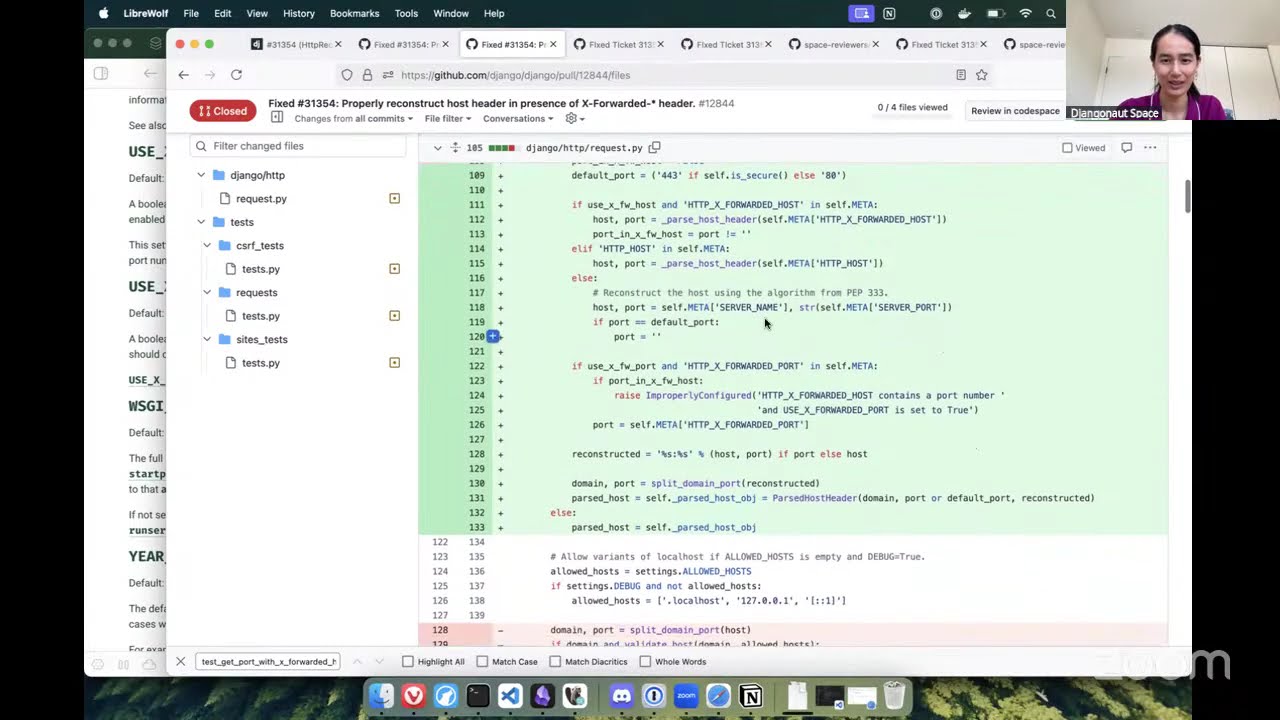
1:35:52
🚀 Space Reviewers 👾 Episode 6
Published July 13, 2025
This video features Lilian at DjangoCon US 2025 in Chicago, Illinois, USA.

This talk was presented at: https://2025.djangocon.us/talks/djangonaut-space-a-mentorship-program-for-open-source/
LINKS:
Follow Lilian 👇
Video production by the presenter and DjangoCon US 2025 volunteers.
Lilian explains DjangoCon? Space (Djangonaut Space), an eight-week mentorship program designed to bring new contributors into Django and its ecosystem and help them grow into community leaders. Teams pair three or four Djangonauts with a navigator for team-level guidance and a captain for individual mentoring, supported by workbooks, guest speakers, collaboration events, and recognition of progress. The program is built around accountability, recognition, inclusivity, and empowerment, and has supported contributions across Django, Django CMS, Django Debug Toolbar, accessibility, Wagtail, and other projects. Lilian describes how the program helped her move from mentee to contributor, organizer, and future navigator, including implementing Django’s AnyValue expression for a MySQL aggregation issue and beginning to triage tickets. She argues that mentorship strengthens the project through a ripple effect: supported contributors become organizers and mentors themselves, though the program must keep improving communication matching, support for graduates, and its organizational workload.
Summarised automatically from the transcript.
Automatically transcribed, so expect mistakes in names and technical terms.
Speaker 1: Hello? Okay. So I'm going to tell you about the DjangoNot Space Mentorship Program, why it's important for the community, and how you can get involved. So I'm Lil Lian. I'm a member of DjangoNot Space. I started out as a mentee, or what we call a Djangout, and I made code contributions to Django Core. Then I grew into the captain role, which is one of the mentor roles. As I got more involved with the program, I was curious how do programs get put together? How do events happen? How does one get people together to do things? I was lucky to have the opportunity to be a session organizer and get involved as part of the team that keeps things running. Here's the agenda. I'll cover the program structure.
Speaker 1: I'll take you behind the scenes for a sneak peek at how it is organized. I'll share my personal experiences, and I'll talk about the challenges with mentorship. And then I'll talk about how you can get involved. So, why do we need a mentorship program for open source? The idea for a mentorship program came about when Rachel Calhoun and Don Wages were on the panel discussion for DjangoCon US 2022. They realized that there was a gap in the community. There is a generation of people who have worked with Django for a long time and they have institutional knowledge. Then there is another generation of people who want to contribute, but they don't have the institutional knowledge. And trying to find their way around on their own is not easy. Rachel and Don were worried the project might not be sustainable.
Speaker 1: So they got together to create the mentorship program and they recruited the other founders who are Sarah Abdomain, Sarah Boyce, and Tim Schilling. The goals of the program are to onboard new contributors to the Django, to Django and its ecosystem, and to empower new contributors to take on leadership roles within the community and beyond. These are the four pillars of the program: accountability, recognition, inclusivity, and empowerment. For accountability, the program provides a structure for people to work together and get guidance It is an eight-week-long program. There are project-based teams. Each team consists of one navigator, one captain, and three to four Jenjonauts. Navigators are mentors on the team level. They hold weekly team meetings.
Speaker 1: They have expertise on the project, and they know the way around the contribution process. Captains are mentors on the individual level. They hold bi-weekly one-on-ones with the Jangonauts. They also have expertise on the project and the contribution process. They support the Jangonauts in a more private setting. Having mentorship on both the team level and the one-on-one level creates different types of spaces for the Jangonauts to share their work or any issues that arise. There are two to three guest speakers. The guest speakers are community members who are invited to share their technical knowledge, their experiences, and their wisdom about contributing to open source. This structure helps people stay engaged and it helps increase the chances of people seeing their work to completion. For inclusivity, the program establishes a warm and welcoming environment from the very beginning.
Speaker 1: Everyone in the program comes from all over the globe with different levels of experiences and different cultural backgrounds. There are people with years of Django development under their belt. There are university students getting started in their careers. There are participants from Australia, South Korea, Italy, Uruguay, Ghana, just to name a few places. We want everyone to have a seat at the table. People should feel comfortable bringing their ideas and participating in discussions. It doesn't matter if someone has been contributing to Django for 20 years or two days. Everyone has something to contribute Sometimes new contributors are able to see a clear and simple solution that experience people don't see or don't have the time to work on One way to ensure new contributors share their ideas is to normalize phrases like
Speaker 1: I don't know and let's learn together. Imposter syndrome is a huge problem in general. We all experience it to some degree It makes us feel out of place. In the program, one way we address this feeling of being out of place is by acknowledging imposter syndrome openly. Once one person starts to acknowledge it openly, then everyone will realize that they are not alone and people can share tips for overcoming their imposter syndrome. Over time, it becomes less of a big deal When I joined Django Not Space, I remember feeling so relieved. It was an unusual feeling because for once I knew that within this group of people I didn't have to worry about whether or not I belonged. I didn't have to worry about someone having preconceived notions about who I am
Speaker 1: or whether or not I should be allowed to touch the code or participate in a technical discussion. For recognition, the program celebrates wins, big wins and small wins. We have a Discord server and a channel devoted to announcing wins. We also post the wins on social media. Celebrating wins, especially the small ones, is important. People tend to diminish and overlook the value of their work. For example, when Jangonauts join the program, they typically start working on small PRs. This is a way for them to get the quick win and get the momentum going. However, some people might feel like they didn't do any work. They might look at the PR and see one line of code change. But we remind them that they had to overcome the big hurdle of getting acquainted with the code base and the contribution process.
Speaker 1: We highlight that the DjangoNot was able to move the needle forward on the PR. If it were not for their work, the ticket most likely would continue to sit in the backlog of 1,000 plus tickets. Besides, lines of code was never a good measure of value delivered anyway. We also encourage Jangonauts to advocate for themselves. Some people think their work is trivial, unworthy of mention, or they feel uncomfortable advocating for themselves because they think it is bragging. But we show them that their work is not trivial, they are not bragging. When they advocate by themselves, they are sharing what they learned, and other people can learn from them too. We help people shift their mentality to see that by advocating for themselves and sharing their work, they are having an influence on others. And this ties into the next pillar.
Speaker 1: For empowerment, the mentors in the program help people do things they might otherwise not have done. One way to achieve this is by sending direct messages to mentees and suggesting opportunities. In this example, it says, hey, have you considered getting involved with the accessibility group? I think you would be great at it. Sending a direct message accomplishes two things. First, it makes the mentee aware of the opportunity. And second, it tells the mentee you believe in them. You took time to reach out to them personally. You're putting yourself up to sponsor them. Here's another example. This one happened last year during DjangoCon US. I was listening to the lightning talks and Rachel Cowan came to sit next to me towards the end of the hour. She said to me, are you going to give a lightning talk?
Speaker 1: I remember thinking, am I okay with sharing my thoughts and opinions out loud? What if I say something wrong? I'm really glad Rachel nudged me. I ended up signing up and giving the lightning talk. It didn't come easily. I fretted for the 24 hours leading up to the next session of Lightning Talks, and I even missed the roll call because I was stressing out over the details of what I would say and how I would say it. In the end, I'm really glad I did it. The idea behind empowerment is one, you recognize that someone has the potential and desire to do something, but there is something holding them back. And two, you give them a nudge so that they can overcome what is holding them back. You're helping them change their mindset so that they can unlock their own potential. One of the valuable assets of the program are the work
Speaker 1: are the workbooks. The navigators, captains, and janganauts all have workbooks. For navigators and captains, their workbooks include resources on how to be a great mentor and tips for holding effective meetings and getting discussions going. For Jangonauts, their workbooks are very rich in resources too, and it is broken down by the week. There is a section where the Jangonauts can write out what they want to achieve during the week, and then there is a section where they can log their progress The navigators and captain can check those sections as a way to prepare for meetings. There is another section with learning material including articles and videos on many different topics such as how to write blogs or how to use Django ASV package to run benchmarks or how to set up and test against the Oracle database. There are also links to talks on topics such as testing, debugging, and the ORM.
Speaker 1: There have been several projects that participated in the program. The main one is Django Core. There is also a team that specializes in accessibility. There is Django CMS, which has participated three times, and Django Debug Toolbar, which has participated two times Both are returning for the next session. There's Django Packages, Django Tagget, and Unicorn. Each have participated in one session. In the next session, we also have Wagtail joining the program. One really cool thing about the program is that it inspires other programs. For example, one of the Django Nauts who was working on Django CMS wanted to continue working on their project. So Django CMS created an internship program to support the continuation of the work.
Speaker 1: It's really amazing to see the mentorship program expand beyond Django Not space. There's a lot of work getting done as part of the program. Here's a graph showing the count of PRs that have been opened by DjangoNots during each session. This is a proxy measurement for what is getting done. The real work is not limited to open PRs and not limited to Jenga nuts. There's a lot of conversations happening on the tickets and the forums Also, navigators and captains put a lot of work to triage tickets and review PRs. And sometimes we also see them contributing to areas outside of their responsibilities for the program. For example, they might end up fixing a bug that they found interesting as they carry the list of tickets. If the program did not exist, this chart would be pretty much zero all across. So with the program, we're getting a lot of new code contributions.
Speaker 1: I talked about how the goal of the program is to empower the Jangonauts to become leaders. Many Janganauts have gone on to take on leadership positions. These are just some examples. There are Jungana to our now session organizers, captains, navigators, DSF board member, DEFNET board member, and working group members. Others are actively involved in organizing local events and large conferences all around the globe. Hopefully, we can start to see people join the triage and read view team the security team, the fellow program, the steering council, and have more people get elected to the DSF board. I want to talk briefly about organizing to show you what it takes to run each session. Preparation starts six to eight weeks before a session begins. During this time, organizers are recruiting navigators and captains.
Speaker 1: That means they are reaching out to people, conducting interviews, and onboarding them. In parallel, the applications open for the prospective Jenga knots. Once the application closes, then organizers grade the applicants on a rubric and make their selections to form the teams. Navigators are also preparing by triaging and curating the tickets, and they are also tailoring the workbooks for the team projects. There's also recruitment of the guest speakers. During the program, organizers are actively providing recognition and celebrating wins. When someone merges a PR or they give a talk or they host a local event or a major conference, we celebrate that. Organizers also check in with participants to ensure they are well supported and help resolve any issues that may arise. There is a navigator coordinator, a captain
Speaker 1: coordinator. a Jenga knot coordinator and each one checks in with the respective program participants. We also send out surveys and collect feedback and we use that feedback to adjust the program to meet the participants' needs We also host events such as co-working sessions, watch parties, cosmic contributors, space reviewers, collaborative writing, and showcase. For tracking contributions, we encourage maintainers to create labels and tags. They can label tickets as reserved for Djangouts. This prevents other community contributors from picking up an easy ticket. Then as the Django knots create PRs or issues, the maintainers also apply the Django knot label. This is one way to keep track of the work. I wanted to share all of this with you because a lot of the organization of the program was new to me.
Speaker 1: I had a better appreciation for the work that goes on behind the scenes when I first when I saw it firsthand. I'll share some of the highlights of my personal experience. You might have seen this phrase used to describe the program. Janganaut Space is an eight-week program. I like to tweak it a bit and think of it as an eight-week program is just the beginning of Django Not Space. I think the eight weeks was about getting exposure to many different aspects of Django and the community. After the program, you start to figure out your interests and find your place. One of the highlights of my Janganaut space experience happened after I graduated from the program. When I was a session organizer, I wanted to know what it was like to put on an event. I was able to propose on the event and get support from the other organizers and run with it.
Speaker 1: The event I put on was the showcase and this was one of my favorite moments. The event was created to address the feedback from Janganauts about wanting more opportunities to collaborate with their colleagues. I remember when I was at Jangana, I had a similar desire. So as a session organizer, when the feedback came in, I realized I was in the position to make it happen. The showcase used a lightning talk format where Jengauts signed up to speak for five minutes and share their work. There was one Janganaut who signed up, but when I reached out to schedule their time slot, they said they signed up by mistake. They want they just wanted to attend. The day of the event comes around and we have two separate sessions about two hours apart. This Janganaut attended the first hour and after the hour ended they messaged me and said, I feel so inspired hearing the other Janganaut
Speaker 1: speak Is there space for me to speak in the next hour? I was really impressed by this because first, this person had the courage to reach out and ask for this opportunity at the last minute. And second, they were inspired to speak. This was someone who exhibited a lot of self-doubt during the program, and it was wonderful to see this shift in their mindset, to see them become self-assured and enthusiastic about sharing their work. Moments like these make me very excited about the mentorship program and its role in the Django community. I'm excited about the Ripple effect where maintainers and organizers help new contributors. And then those contributors graduate from the program to become the next organizers and leaders who help the next cohort of new contributors.
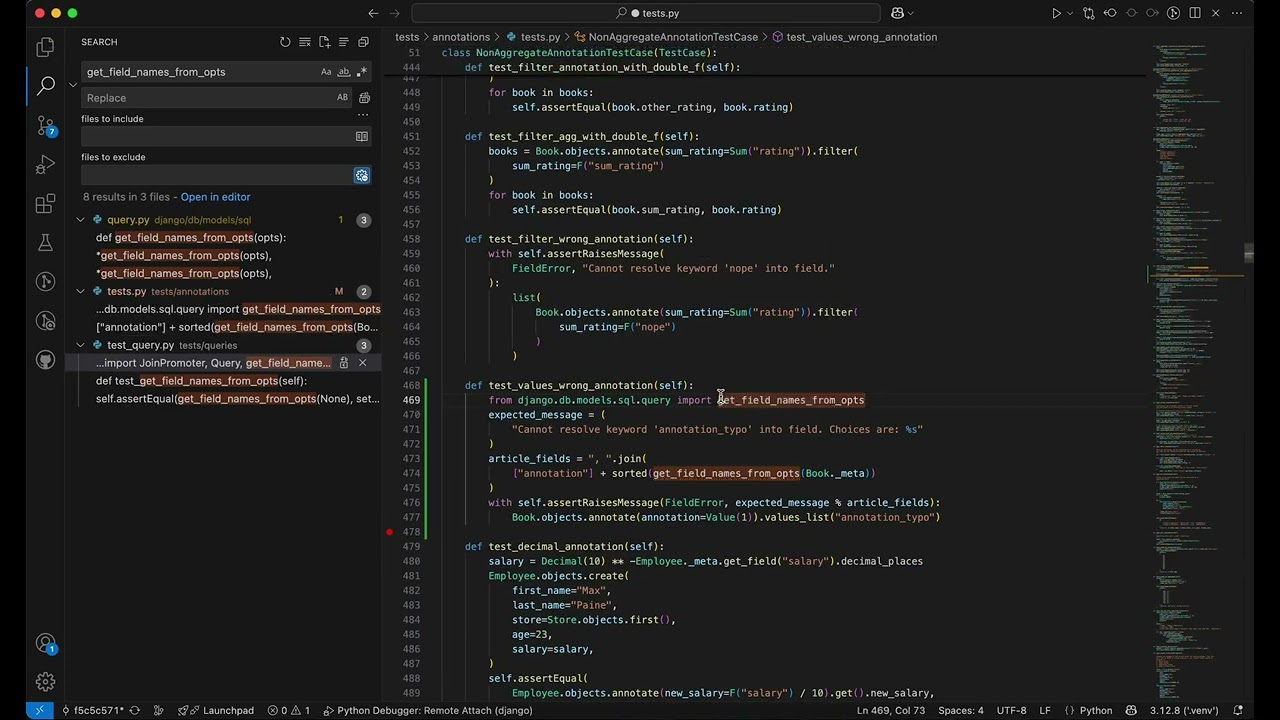
Speaker 1: the community the community becomes so much stronger when it fosters a group of individuals to take action. After going through the program as a mentee, a captain, and a session organizer, I still had unfinished business. I felt that I didn't get the code contribution experience that I was hoping to get during the eight weeks that I was a mentee. So earlier this year, I decided to try contributing something more substantial. I picked up this ticket that you see here. This was a fun ticket to work on. This ticket is is about MySQL crashing when the query involves aggregated and non-aggregated columns. This happens because MySQL is not able to detect functional dependency for the non-aggregated columns. There were three to four solutions that were already proposed.
Speaker 1: One suggested pushing down the column into a subquery. Another suggested detecting the offending column and wrapping it around the any value function in the ORM compiler. My contribution is that I proposed an alternative solution. It was built on top of the other solutions. This solution was to implement the any value expression in Django. It was easier to implement and also gave the users more control over their queries rather than ha than having the ORM make assumptions When I made the proposal, I understood most of the problem and I had an idea for the solution, but I didn't know the exact details on how to implement it. I'm sharing this because I want you to know that you don't need a fully flushed-out solution from the start and you don't need to be an expert to contribute.
Speaker 1: You can bring your ideas and the discussions you initiate will bring out the details. If you can share a different perspective and get a discussion going, you're adding a lot of value. And you become the expert as you work through the problem. This solution was implemented and we were able to close the ticket. After working on several PRs, I wanted to contribute in more ways to the code base, and the next logical step was to triage tickets. I've worked the triage queue in my past jobs, but Django project felt like a different beast The hurdle wasn't a matter of technical capability. It was a matter of not knowing if people even wanted me to do this in the first place. I credit cosmic contributors for helping me. Cosmic Contributors is a bi-weekly meeting hosted by Tim Schilling as part of the program, and it was through the discussions that I found the assurance to start triaging tickets.
Speaker 1: So I started checking out the unreviewed queue. I ended up triaging a couple of tickets and closing them as invalid. I also added comments to help the ticket authors find what they were looking for. I remember closing the tickets and feeling like I unlocked a new superpower. Janganaut Space is a really creative place where you are encouraged to try new things. To summarize my experience, as a mentee, I received high-quality mentorship from my navigator and captain and the organizers. As a session organizer, I had the opportunity to bring an event to life and have an impact on the Django knots. As a code contributor, I've fixed bugs, triaged and closed tickets and reviewed PRs. Session five of the program is starting in three weeks, and I'm happy to say that I'll be one of the navigators.
Speaker 1: Thank you. As I step into the navigator role for session five, I want to tell you about some of the challenges with mentorship programs that are at the top of my mind. One challenge is matching mentor and mentee communication styles and level of guidance required. Some people are more autonomous while others need more help with choosing tickets and breaking tasks down. Some people are more outspoken and know how to ask questions to get unblocked, while others are less outspoken and they are afraid to ask their questions. It can be challenging for mentors to tailor the level of guidance they provide because the mentors themselves have certain types of communication styles. Another challenge is providing stars with continued mentorship and opportunities.
Speaker 1: Stars are people who have graduated from the program. Currently, the program focuses its attention on the Django nuts. We also want to increase collaboration among contributors. This could involve experimenting with new types of events and activities. We want to address these challenges without adding exponentially more organizational effort. As I have shown you behind the scenes, it takes a lot of effort to put the program together. Django Not Space has ambitious goals. What makes the program work well despite the challenges is that it is experimental. There's room to improve and iterate. As it heads into the fifth session, we have stars moving into the organizer roles, we have new members who will be navigators and captains, and we have new Djangoids
Speaker 1: Everyone comes into the program with an experimental mindset. I think that is great. Everyone is bringing something new to the table. There's a lot of fresh ideas and fresh energy. You might hear some people say Django is boring and they are referring to the framework, but it does a disservice to the community. If you are one of these people, I can understand where you're coming from. But I also want to encourage you to step outside of your perspective and see what is going on with DjangoNot space. Maybe talk to the organizers about how you can get involved. Perhaps run a workshop on a major feature of the web framework that you contributed to. I think DjangoNot space is far from boring. To me, it feels like uncharted territory, especially in mentorship and organizational
Speaker 1: aspects. which are important to the maintenance of the code. Nothing is well defined. Just like it is very interesting to jump into a large code base for the first time. I think it's interesting to j to join an open source community and be part of the effort to keep Django sustainable. I think it's very exciting. I hope this was informative and I hope you have a better appreciation for the Django Knot Space Mentorship Program and how it influences the community. If you're new to open source and want to get involved, the application for session 5 is open until September 14th. If you're interested in being a mentor, I highly recommend reaching out to the organizers to express your interest for future sessions. We're always looking for more navigators to help scale the program.
Speaker 1: Again, my name is Lillian and I have um and if you have questions about Django Not space, feel free to ask. I'm also open to new opportunities and I'm happy to chat. Thank you. Take a question. Sure.
Speaker 2: Hi, thank you.
Speaker 3: Thank you, Lilian, for the awesome presentation. So we only have a minute, so we're gonna have only one question.
Speaker 1: All right.
Speaker 3: Anybody a question?
Speaker 4: Yeah, thank you so much. It was very interesting. I'm looking at these programs like a mentor, not in uh Jungle World, but in my own universe Uh from my perspective, the one of the big challenges is that um lots of mentees kind of feel uncomfortable what you just mentioned actually then saying Sorry, can you repeat? I did not understand what you meant. And I do not want to feel like you're you it's not worth it, like afraid to ask one more time. I was wondering whether you uh had these situations and do have like examples how the mentors or like the leaders of the program were be were able to unblock the situation. Because I see this most most frequent challenge.
Speaker 1: Yeah, and that's um a really great question and it's really hard to detect when someone is afraid to ask because they're not asking and they're you have no information, you have no way of determining that because I know because I've been that person. Um I think I think creating a space for people and telling them that, you know, this is the space where you can start asking questions and just being very explicit. For me, it was cosmic contributors. because it was just like this open-ended space and we could ask questions. It's really hard. I think there's a lot of persistence that you need to have and you won't know from it won't be something that's instant. It takes time.
Speaker 3: Okay, thank you. Thank you, Lillian. Another round of applause for Lillian.
Djangonaut Space is an eight-week open-source mentorship program designed to onboard Django contributors and help them grow into community leaders. Project teams include a navigator, a captain, and three or four Djangonauts, with weekly team meetings, biweekly one-on-ones, and guest speakers.
Discussed at 1:47The program has led to new pull requests, ticket discussions, triage work, and reviews, while also helping graduates become captains, navigators, organizers, board and working-group members, and conference organizers. It has even inspired projects such as Django CMS to create follow-on internship programs.
Discussed at 9:40Preparation begins six to eight weeks before the session with recruiting and onboarding mentors, accepting and evaluating Djangonaut applications, selecting teams, curating tickets, tailoring workbooks, and recruiting speakers. During the session, organizers celebrate contributions, check in with participants, gather feedback, and host collaborative events.
Discussed at 11:33No. Lilian explains that contributors can start with an idea or a different perspective, and the ensuing discussion can supply the missing details; contributors often become experts while working through the problem.
Discussed at 15:12Key challenges include matching mentors’ communication styles and guidance levels to mentees’ needs, supporting quieter participants, and continuing to provide mentorship and opportunities after people graduate. Djangonaut Space addresses these challenges by experimenting, iterating, and improving the program without adding unsustainable organizational effort.
Discussed at 18:28People new to open source can apply for an upcoming session, while prospective mentors can contact the organizers about future sessions. The program especially needs more navigators as it grows.
Discussed at 20:49Mentors should explicitly tell participants that the group is a safe place to ask questions and create open-ended spaces such as Cosmic Contributors for discussion. It takes persistence and time, because mentors may not immediately know when someone is reluctant to speak up.
Discussed at 22:51Note: We understand that names change, people change, and bodies change. We respect each individual's journey and privacy. If you have any concerns about a video or need us to remove content, please don't hesitate to contact us. We will handle your request with care and promptly address any issues.

Published July 14, 2026

Published July 14, 2026
Published July 14, 2026
Published July 14, 2026

Published July 14, 2026

Published July 11, 2026