
0:11:18
Video Tour of Wagtail 8.0
Published September 19, 2026
Wagtail CMS 2023
This video features John Abdulla at Wagtail CMS 2023 .
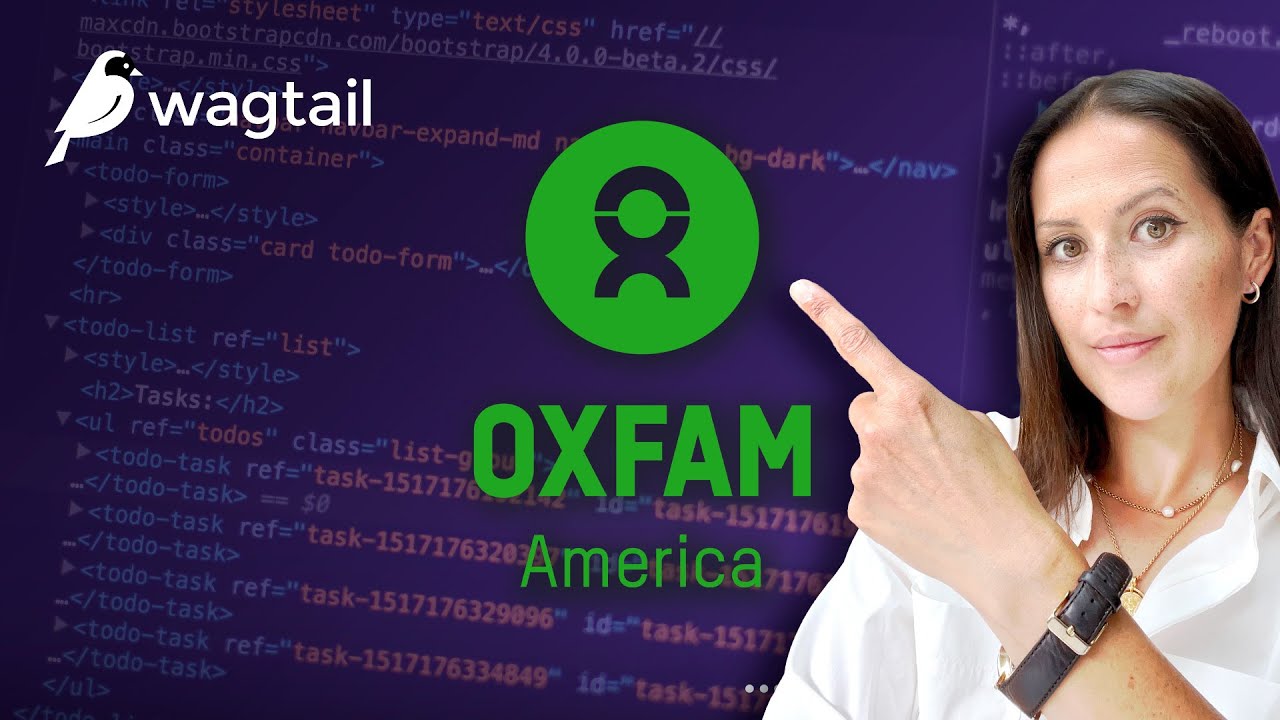
What happens when your developer leaves you with a CMS platform that you don’t know how to manage?
This is exactly what happened with Oxfam America, one of the world's leading charities and non-profit organisations.
In the latest Wagtail CMS case study and testimonial, we’re joined by John Abdulla, Oxfam America’s Associate Director, Constituent Product to hear the full story of Oxfam America’s digital transformation, and how migrating to the open source Wagtail CMS platform allowed them to break free of costly development.
The Problem:
After building a custom site with Django and Mezzanine, their Mezzanine developer moved on to another company and Oxfam was left with a CMS platform that they didn't know how to properly maintain.
Content couldn’t be scaled, and updates and redesigns were no longer possible unless they wanted to pay a third party developer.
The Solution: Enter Wagtail CMS.
“It’s a CMS for developers”
Oxfam America consulted with the team at Wagtail CMS and found that Wagtail CMS gave them the power to make updates with minimal support, scale content and be agile when it came to creating content and implementing new web design and development. Behind-the-scenes improvements were much easier, and content teams could create and manage content that not only looked good, but could be structured, edited and published how they wanted it, when they wanted it.
The Results:
“The thing with Wagtail that stood out for us was that people were able to go in and make updates, so we could scale content.“
After migrating from Mezzanine, to the open-source Wagtail CMS, Oxfam America was now able to create fully-fledged pages of content themselves, no longer restricted by costly development. Their CMS platform was now easy to use and creating content was now 10x faster, saving them thousands per year.
Support was provided by the team at Torchbox, sister company to Wagtail to ensure the migration to Wagtail CMS was smooth and fuss-free.
Read the full testimonial HERE; https://wagtail.org/blog/oxfam-americas-storytelling-platform-built-on-wagtail-cms/
If you’re using a CMS you don’t understand, you leave yourself open to issues. Speak to a team member at Wagtail and let us help you improve your CMS workflows: [email protected]
Timestamps:
0:00 Oxfam America’s Mission
1:13 How Oxfam America use digital transformation
3:18 Before Wagtail CMS
5:02 Migrating to Wagtail CMS
6:44 Use case of Wagtail
8:24 Replatforming speed
9:45 What’s next for Oxfam America
📹 Related Videos To Watch Next:
▶ Set up dark mode in Wagtail https://www.youtube.com/watch?v=v0kRzIh_YkE
▶ A complete guide to Stimulus in Wagtail https://www.youtube.com/watch?v=5WS7B8R0x0U
▶ A beginners video tour of Wagtail https://www.youtube.com/watch?v=Js8dIRxwSRY&t=11s
Wagtail future proofs your CMS system, as it’s open source, continuously updated and built on Python, one of the most popular global programming languages, used widely in machine learning and big data. So you’re always ahead of the curve when it comes to CMS platforms
Wagtail is the #1 choice for accessibility, is scalable and most importantly, secure.
👉 Get started with a FREE Wagtail CMS TRIAL: https://github.com/wagtail/bakerydemo and see how easy it is to build a website that works for you.
📊 Read why Google, NASA, and the British NHS, are powering their digital estates with Wagtail: https://wagtail.org/about-wagtail/
🎥 More Wagtail Videos: https://www.youtube.com/watch?v=cne2kxemMAQ&list=PLfwZ-fob20cPvSQ_v1hkjto8BAPN21tLJ&pp=gAQBiAQB
📣 Follow us on social:
#WagtailCMS #oxfam #cms
John Abdulla explains how Oxfam America moved from a heavily customised, difficult-to-maintain Mezzanine CMS to Wagtail. The change gave developers a maintainable Django-based system while allowing content teams to build and update rich, modular stories with little technical support. He argues that good digital transformation depends not only on systems, but also on enabling people and establishing processes that help an organisation scale its work and better demonstrate the impact of donations.
Summarised automatically from the transcript.
Automatically transcribed, so expect mistakes in names and technical terms.
My name is John Abdullah. I work at Oxfam in the U. S. I've been here for about 10 years now. It's been quite a stretch, and we are an organization that works to end the injustice of poverty And you know, we really believe that poverty is an injustice in our world today. We work across the globe um to respond to humanitarian disasters. We do advocacy work. to change policies and we do long-term work to really help people lift themselves out of poverty. And that's a mission that really, you know, is m uh very meaningful to me and specifically Um I manage a team at Oxfam that oversees our marketing technology. We're a fairly new team in the um current structure that I think uh has tried to borrow a lot from product model from other organizations where we have a team that's really looking out for the vision of our technology.
So that includes the the marketing tools that we use for fundraising and advocacy as well as our CRM and our websites as well as the back end and front end to manage that. in a way that we feel will kind of set up our organization um to be able to communicate and engage more effectively in the US So when I think about our mission and as I said, you know, it's really um it's meaningful to me and and when I look at even my role at Oxfam, it comes down to how how do we really communicate about these issues in a way that activates people, inspires people to take action, right? And that re and really can cultivate that kind of support. I mean, 'cause at some level I think many people around the world um want to help, want to change the world, right? And we have um
something we can offer which is real expertise in this area as Oxfam, an organization that's been working for many decades uh across the world, uh and we feel like we can offer something of value. The thing is, you know, we're not selling a product, right? You don't go to our website and buy something and you get a a great, you know, a monthly subscription to some great thing or um some tangible product. We're talking about something that at the end of the day um is sort of a leap of faith. You're you're saying I want to donate to help change the world. I believe in this organization. Um, but we can, you know, it's on us to really create an experience that helps show show you the impact that you're making. Um and that is important and that's where I think technology can play a huge role You know, we know now, of course, uh after being uh over a year uh
in a pandemic, working remotely, all living remotely, and all living much more in the digital space. how meaningful that experience can be or how bad it can be. And I think for us, just as a every nonprofit who's doing kind of, you know, mission-based or social justice work We have to be able to use technology to show you the impact that you can make and off offer a great experience. You know, that's something that we hear a lot about in the for-profit world. Companies like Amazon, Disney, others have paved the way Everyone expects a great experience now. It doesn't matter if it's for from a nonprofit who doesn't have the same budgets. Um, they're expecting it. And so their experience on the web It has to be great. It has to really show that impact that they're making and and cultivate the kind of long-term support that we needed if we're really going to end the injustice of poverty.
Several years ago, we did a full redesign of our website. You know, traditional kind of redesign. It all it was back-end and front end, so we moved from Plone at the time, that's TMS, to We wanted to really go all in on Django. We felt like that would set us up well for success, particularly on the development side. And so we went with Django and we used mezzanine as our CMS. Uh we had a really uh ex excellent developer leading that work and uh you know we really we customized things quite a bit to serve our our unique needs because you know every organization we're we're unique and Uh we need things to be set up in particular ways. Probably more we think we're more unique than we actually are. I think that's, you know, one um issue right off the bat, and quickly mezzanine turned into
uh maybe not our worst nightmare, but it was It was in a bad place in terms of over customization and we really what happened is our that developer went on to another organization and we felt like we were left with a CMS that we couldn't properly maintain um and that we couldn't really continue to do the kind of redesign that we wanted to move towards which is really evolutionary, right? We had spent over a year doing a website redesign, deeply consultative across the organization Um and it just took a long time and a lot of energy and you know, even a year nowadays, um it means that you're already a year behind the most current trends, right? So That was tough. Um, but that, you know, we were happy to launch and we felt like we we led a good website redesign, fully responsive, so that was a big deal for us.
We had a CMS, like I said, that we couldn't really maintain. And so when this developer left, we had this moment to really consider, do we want to continue on this path? As I said, it it's a CMS for uh developers. It works very well for developers. But that's not it, right? I mean I think it truly is a CMS for people, right? And I want to highlight that point because For us, I mean, if you really take a step back and consider um the purpose of a CMS at all, it's that we we want to sort of detangle these layers of technology, right? So that you have content as its own kind of self-sustaining layer within the website that you can get a lot of people access to and you can scale content in ways that you couldn't before CMS has existed
I think unfortunately, uh a lot of CMSs though, they're they're not really great for developers and they're not really great for the people who are actually posting content. And so they're in this weird spot where that you know, both have to be able to work within them, um, but it's rare that you truly hear uh of you of the people using a CMS like going out of their way to say they love it or they enjoy using it. Um and developers are often complaining about having to develop around CMSs. And so with Wagtail, the thing that really just stood out for us is is both parties were satisfied, you know, and that and that was huge. So we had people going in and able to actually make updates with with minimal um support and that meant we could focus on the development and we could support along the way while people could really scale the content.
And that's So that's where I think it's really helped us be agile both when it comes to the web content as well as the web design and development so that we can behind the scenes improve sort of the packaging around all of the content while we have content teams that are really working on within the site itself. So this is an example of one of the immersive stories that we created in Wagtail and this is something that we had actually the our first use case of Wagtail but also has continued to evolve in our main uh wagtail set up now and is integrated with our website. So it allowed us to really have these really full, you know, immersive um imagery, which we we are fortunate to be in a position where, you know, we travel around the world and have really phenomenal photography as you can see here with this particular story which was a kind of a fun one.
Um and, you know, everything is really uh these modules that we can move around and manipulate. So we're able to put video um large blocks of copy, we can do you know social sharing. Um you've got a great kind of map visual here. It just really comes to life and you can see how this would all translate on mobile really beautifully too being just the one column that it is. And so Wagtail again has allowed us to create what is really, you know, has been a really fantastic presentation. Um, but importantly, we have to be able to actually uh you know, have people who can use it on the back end, right? I mean this I I I remember a day where creating something like this would have been uh quite a bit of development work and more of a sort of um one-off kind of project, right?
Not necessarily something that a user could go in and manipulate and kind of move around. But if I wanted to just, you know, in two minutes move components around, add a video. I mean literally I could do it in two minutes. It's so easy to use the CMS and create this kind of presentation and so that has really been crucial and we feel like it'll set us up well for the future. So we found Wagtail um to be really compelling. You know, we hear a lot and had heard a lot, it had a good reputation among developers that it was really uh a dream to develop in and that meant That we could have our developers really um lead on this project in ways that we hadn't been able to necessarily in the past, where we'd relied on agencies Um that said, you know, we also really appreciated having the organization that developed Wagtail, Torchbox, um, as support and in a variety of ways throughout that project.
So, you know, initially we didn't expect we would necessarily need um a ton of support, but what happened is due to staff turnover in that experience we we then really did have to lean on Torchbox more significantly during that time period. What's been so great about that relationship is that it has ebbed and flowed and and basically when we need you all, you know, we just sort of put up the bat signal and we can call you and uh You know, the bad signal in this case is a new agreement that gets us, you know, the exact kind of relationship we need and is very uh I think customized in ways that have supported us through the project. And so You know, we needed that sort of focus initially and then um once we got up and running we've been able to maintain Wagtail. But then periodically, if we know that there's a big improvement we want to make, we're not a huge team We reach out again, we scope a project, and that's really worked well for us to be able to manage it in that way
So we're all hearing about digital transformation, right? I mean that's increasingly uh uh uh become buzz and maybe even, you know, maybe we've already been transformed over the last year. I'm not sure, but For me, that's always been about people. It's how do you support people? How do you how do you help people leverage digital to do the work that they need to do? And honestly, I think every single um job, everything everything we do uh in our lives in modern day society now, in some way or another, um I think can be improved by digital. I won't get into the downsides of all that, because there are. But you know, if we're thinking about how digital can improve the experience of our supporters, we're also thinking about how we can improve the experience of our people at Oxfam. um to leverage technology, right? Whether you're a marketer that needs data
or someone who needs to make changes to a website, we believe that creating a great experience and really enabling people to do more in these systems will produce a better product. And so that's where again Wagtail has been so critical for us because we have to invest in our people's ability to actually use these tools. We believe that incre you know, we'll we'll only have more users in there. And so it's really important that alongside the systems improvements, we focus on the people. and the process, that we have good processes in place to allow us to kind of scale all of that and continue to get, you know, value out of this so that we can deliver that back to our users.
Oxfam’s heavily customized Mezzanine installation became difficult to maintain after its lead developer left. Wagtail worked well for both developers and content editors, letting staff make updates with minimal support while the development team focused on improving the site.
Discussed at 4:53Oxfam builds stories from movable modules, including large images, video, text, social sharing, and maps, with layouts that work well on mobile. Editors can rearrange components or add a video themselves in about two minutes instead of requiring a one-off development project.
Discussed at 7:14Torchbox provided flexible, customized support that increased when Oxfam experienced staff turnover or wanted to make a major improvement. Once the site was running, Oxfam could scope additional projects as needed rather than maintaining constant support.
Discussed at 8:53Note: We understand that names change, people change, and bodies change. We respect each individual's journey and privacy. If you have any concerns about a video or need us to remove content, please don't hesitate to contact us. We will handle your request with care and promptly address any issues.
Published September 19, 2026
Published July 9, 2026
Published May 20, 2026
Published April 16, 2026

Published April 1, 2026

Published March 10, 2026