0:59:28
Recap
Published September 16, 2025
This video features Carlton Gibson and Paolo Melchiorre at DjangoChat 2026 .
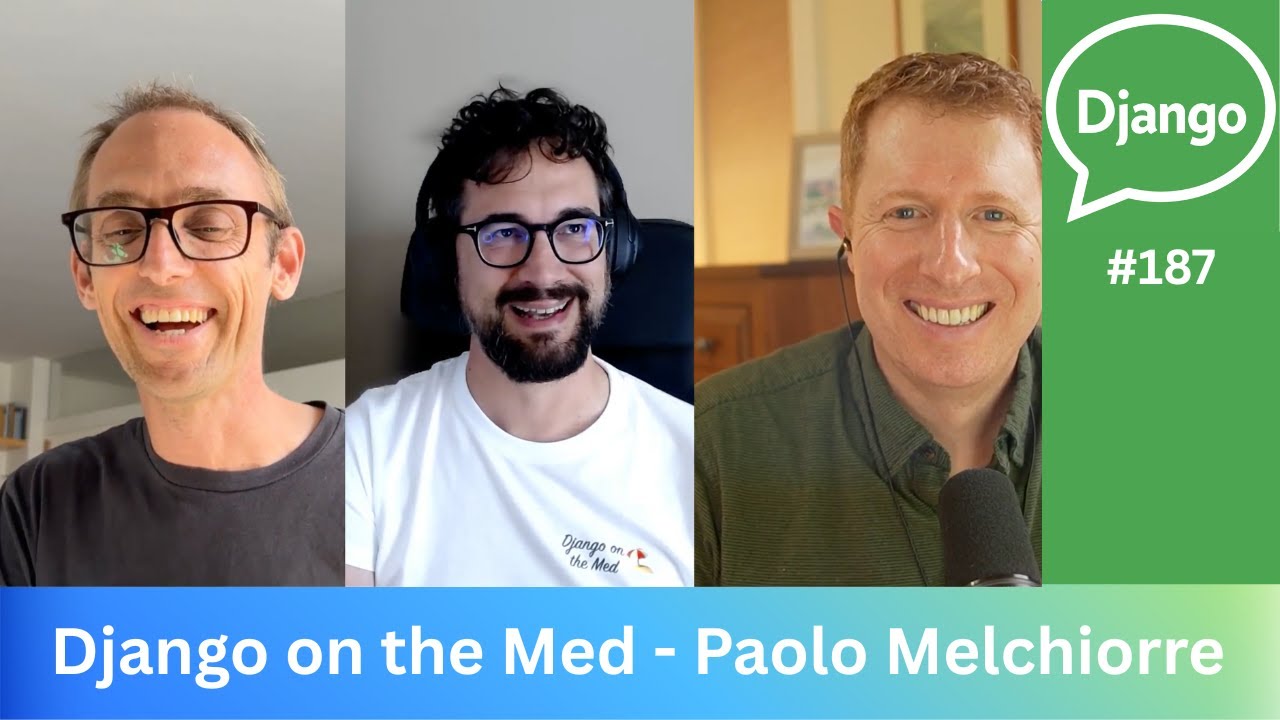
Paolo and Carlton are just returned from the inaugural Django on the Med event and here to discuss how it came to pass, the code improvements from just three days, and plans for the future.
🔗 Links
📦 Projects
📚 Books
🎥 YouTube
This episode was brought to you by HackSoft, your development partner beyond code. From custom software development to consulting, team augmentation, or opening an office in Bulgaria, they’re ready to take your Django project to the next level!
Django on the Med grew from Paolo Melchiorre’s idea for a small, affordable event where Django contributors could combine focused sprinting with time together and informal networking. Its first edition brought 14 people to Pala-frugell, with morning work sessions and afternoons for swimming, walking, running, and exploring; participants opened or advanced work on Django documentation, performance, database features, and the ORM, including native database cascades and async database support. The organizers argue that this format gives contributors more useful time and energy than post-conference sprints, while in-person discussion makes work possible that is harder to do online. They plan to hold it twice a year around the Mediterranean, with the next edition planned for Pescara, Italy.
Summarised automatically from the transcript.
Automatically transcribed, so expect mistakes in names and technical terms.
Speaker 1: Hi, welcome to another episode of Django Chat. I'm Will Vincent here with Carlton Gibson. Hey Carlton.
Speaker 2: Hello, Will.
Speaker 1: And we're very pleased to have on our friend Paolo Melchiori. Welcome, Paolo.
Speaker 3: Hi everyone, and thanks for reading me. I'm usually a pleasure to speak with you all.
Speaker 1: Yes, let me give let me give you a quick bio for those who don't know so you don't have to. But you are Django Board member. Python Software Foundation Fellow, Prolific Contributor to the Django Codebase, the Django website, prolific selfie taker at conferences where you speak
Speaker 3: Yes.
Speaker 1: And you both just got back from Django on the Med, which is the topic of discussion for today. So I'm super happy about this episode because I hopefully I won't have to speak as much. But let me start with a question, which is how did Django and the Med come about? Because it was originally in your head, Paolo.
Speaker 3: Yeah, I I remember sharing With you and and Carto in in San Diego for the first time we had this great uh conference in San Diego after a long period of non -person uh conference for the pandemic. So it was great to meet you all in for the first time DjangoCon US for me. But at the same time it was a very um uh a a long trip for me from Pescara to to San Diego and uh very tiring tiring week. So when we met the first day of sprint with Uh I remember uh S Simon, I remember Marius uh you in the beach in the morning to have uh a few times for us. I realized that we needed more to this
Speaker 3: um time as as a team, as a small group of people, to hang out together, to network a bit, to chat about our life and at the same time to sprint. and based on the history I found in the in the past in other uh Python community to organize small sprints to have half time on working on something specific and half time into uh Being together, I uh I remember I proposed this idea and from that moment I tried to force every every opportunity. Uh yeah. At the end Carton did uh uh did a good move and uh forced me in some way to to transform this idea in
Speaker 3: reality with uh its help of course and uh other people so it took three years but at the end we we did it.
Speaker 2: Yeah, I mean the the the the the the trick what there was the it it was proposed, you proposed it, you did a blog post, there was a forum discussion, everyone's like, Yeah, yeah, yeah, this is a great idea and then of course nothing happened. And a ye another year goes past and it still hasn't happened and we keep talking about it. And so DjangoCon Europe this year, right, in at the sprints in Dublin, we we we we sat down and schemed it. You posted somewhere, you posted a picture, we some notebook I picked up at the conference where I was making notes, we sort of signed in blood that we would uh we would do the do the event in Palais.
Speaker 3: Yeah, the the the opportunity was for us to being in in Dublin and realizing that uh we need to Create this this event and a cartoon and me say okay let's find a moment in the year and a place that where we can meet at least The two of us we say. So if other people will join, uh good. Otherwise uh we spend together few few days and enjoy the time together, but at the end there were more than two of us.
Speaker 2: Yeah, yeah, the danger was it was just you and me at a table, right? We sat in a cafe, the two of us. But we had in the end we had 14 people come, which was um really good for like a first a first go because it could have been it could have been just us and it could have been say um you know four or five or six people. We could have got house, you know, just one house group, but then, you know By the time we got fourteen we had like three tables worth, right? That were sprinting together.
Speaker 1: Well, I just have to mention, so Paolo, you wrote up a very detailed blog post that we'll link to with all the photos. of uh everyone together all the days. So we will link to that, but it was well documented.
Speaker 3: Yeah. They The the trick was to every day talk took some picture and post on on Mastodon. Uh also carton a lot of them and the other. So I tried to aggregate all these posts together and uh uh with some uh automatic scrape to create to the blog post.
Speaker 2: So this is just Django on the mid hashtag that you you can follow along folks.
Speaker 1: Yes. Exactly. So you can feel And there's, and just while we're showing stuff, I'll just show it all. So this was the website that went up about the event and then the forum to subscribe.
Speaker 2: So my my post-event, my post-sprint, uh my post-jango on the work home um post-jango on the med homework is to um you know flesh out the site, move some of the Pader Vigel um details to a separate page. We've got a value map of some of the things that were achieved, um, or not, you know, so that we can demonstrate the value of this. I mean, so I'll i 'll let me phrase it as a question, Paola. For me, um we've we've really demonstrated the value of it. Some amazing things were w w were done in the shorter method of time by the small group of people. And I think now we can go from look, isn't this a nice idea to look, and we did it and it's it's valuable and can we now get behind it as a community?
Speaker 1: Let me just link. There's we'll also put it in the notes, but there were five different PRs opened, one one closed, right?
Speaker 2: One's already blushed, I think. Yeah.
Speaker 1: Yeah. So Wasn't it wasn't all just drinking in the sun.
Speaker 3: Yeah. More than that, uh some people contributed in some documentation. I was working a script to create the uh the metrics of um the feature flank for the rm so we are are putting together uh a document that I think we'll share the next uh weeks. And so not only the issue on on GitHub, but we discussed this more more things than that. We created more value than what you can only see in GitHub. The the the the better part I think is the connection that we created each other. So we we came back to having more connection because new people show up and people that you uh met only on online for a long time.
Speaker 3: You spent quality time together and was very very interesting.
Speaker 1: Yeah, I was jealous. I was I was actually on the Met as well in Cyprus for a company event, but I was following it every day and actually we could mention um so Mark Smith, one of the people who was there. uh just joined jet brains pipe I actually I don't know if it's I don't think PyCharm, but so now he's a colleague of mine. So that
Speaker 2: so the the two of you can organize an initi edition of Django on the med in um Uh in Cyprus, yeah.
Speaker 1: Yeah. Down for I'm I'm I'm open to it. Yeah, we were we were in Paphos. So the entire PyCharm team. So kind of same thing you were saying, like a lot of these people I work with but I hadn't met in person and There's a similar mix of, you know, some fun stuff, some work, but nothing replaces in person. So it's important to have
Speaker 2: I think as well, what was one one thing that worked really well was that we did sprinting in in the morning from eight A. M. which sounded which is early. We had breakfast, coffee, croissants, you know stuff to get us going and then till two um o'clock when we broke for lunch and then people had the afternoon to explore. They could, you know, walk in the woods or go to the beach, walk along the Cami de Ronda, which is the coastal paths we have here. Um I think people seem to like it, no.
Speaker 3: Yeah. So I I I was able to go uh swim in the in the sea which which is was great. Uh I didn't do a long swim but I saw a lot of the coast, uh the fish, uh other people like Marius. But for uh multiple runs around uh people have a drink, people enjoy the beach or the uh the parfum, the the town. So everyone did what they wanted to do to relax and to the um They compress after they had to work in the morning.
Speaker 1: Right. There was someone I think it was on Foslaton. Some um Mariush documented his runs and one of them was with Simon, but Someone called him the Paolo of runs at Django events. So that's hyphrase. Yeah, yeah.
Speaker 3: I I saw Eric posted that you know Maurice is the official selfie run.
Speaker 1: Yeah, selfie runner. But I want to ask so Django on the med, the idea was that this is what twice a year, right? So it's been in Spain, but then it'll also be in Pescara. Is that still
Speaker 2: We're gonna move it to Best Colour next year.
Speaker 3: Yeah, yeah. Yeah.
Speaker 1: Well, because and that um that mug comes from when you went to PyCon Italia, Carlton.
Speaker 2: No, Marlowe got it for me as a as a gift for this time.
Speaker 1: Well you also went to b you also went
Speaker 3: Yeah, I you I was specifically thinking of this moment when Carton was able to show the scara Just got a mug in front of the camera. No, I'm I'm joking. Yes, this this is the the plan to organize uh twice a year and uh in the in a period that is not um uh high season. So this year the the weather has been married in Parafrigel. We was able to to run, to swim and sea, but it was not so crowded. Um at the same time was sunny and but um the prices of the everything was not high, the flights and the hotel rooms and we want to try to do that the same things in Tescara. More or less the weather uh is similar.
Speaker 3: We are still the Mediterranean, specifically in the Athletic Sea and Um the original idea was to organize in April, but we see if we organize it in the beginning of May. We will let you update on that. Uh well the the goal is the same, to organize in uh area not so touristic but still a great uh area to explore in a period that is not so high season to uh let everyone not spend a lot of money to to reach us. uh to to be there together and try to explore different area in the the Mediterranean. But we are open also to other other locations like Cyprus or I don't know.
Speaker 2: Or Malta Ghostbase Yeah, I mean there's plenty of people around the Meds, right? So the the theme is very simple. You know, if you're in the Django community and you can see the Mediterranean not too far from your house, then you know, let us not
Speaker 3: and
Speaker 1: it counts. Yeah, Fran I mean France would be nice if somebody in France wants to. Um well and Paulo I remember back three years ago when you first were talking about this, you mentioned that the plone community that you worked in had something similar. I think it even you said You know, Plone had these events. I think you even asked me, has Django ever had them? And I don't think so. Is that so is that the initial what or one of the inspirations is
Speaker 3: Yeah, the the Plone community has been the first I have um been and was the the Python commuter has I ever been and they used to organize um sprint uh conference but also sprint uh in this way if I remember correctly the first one was in Sorrento 'Cause they after organizing a conference in Naples, organized nearby in Sorrento in a hotel in a s very similar way with it uh in Palace. Off season but still good weather and the sea. Uh but they also organized uh a one uh another one in in in Eastbrook uh during the winter and they go skiing after. Um but other others community organize very similar events like that. And then there is also the
Speaker 3: the core Python developer that's organized. Usually see the the last time they organized I think in uh in in September And in Cambridge.
Speaker 2: Yeah, it was at the army offices.
Speaker 3: Exactly, exactly. So they those very similar things. Um I asked a lot of people but nobody remembers something like that. Of course we had sprints after conference, but this type of sprints uh are Something different.
Speaker 1: Yeah, and maybe that's a question for or just to expand upon. So there are typically there are sprints for two days after Django Cons, but It feels to me, again, not having been at Shango on the Med, those are people are a little bit tired and it's not quite long enough. And people sometimes come for I stay for one day but not two. Um does that match your experiences? I know Carlton, you usually were you were fellowing, so you were running around uh helping everyone.
Speaker 2: Yeah, I mean which you know when I was fellowing, I would try to run the getting started contributing thing because you uh a DjangoCon you would have number of new contributors turn up each time and they all need you know it needed um some guidance otherwise they they come they're giving their time but they're they were They'd be wasting it. Um Django on the Med, we had um I think five people who were you know new contributors. I mean they had some awareness. They had some they weren't totally new contributors, but they they you know, self-identified as new contributors and we managed to get all of them going on, you know, good projects, which was just super. Um, you know, including um an 18 year old ticket on the cash framework, which I would dearly love to see revolve as a result. There's an there's an open PR for that, which we hopefully get in.
Speaker 2: Um
Speaker 1: And
Speaker 2: some things about speeding up um yeah, that one, that one there at the top there.
Speaker 1: Yeah, it's loading with my slow American internet. Here we go.
Speaker 2: Um but you know, we 're working on that over a couple of days and um You know, to to see a new contributor come in and pick up an 18-year-old ticket, it's got a ticket number of something like 5,000, 5,500. That's really low. You know, anything under 10,000 is rare these days. And then there was work on speeding up um the static files, the collection, and and things that will make really big differences. And these are from new contributors, right? These are from people that haven't aren't established that aren't, you know, n known within the community already. And so that was phenomenal for me. Um But the yeah, I think you're right. The end of a Django con, it's often you stay for the first day or p and then people start flying out. It's not enough time to sit down and get a dedicated piece of
Speaker 2: of work done. Whereas in three days we had, you know, a really good amount of time. I mean, you know, if uh Marish has taken on um in implementing um native db native cascade. So when you've got on del the on-delete clause, instead of having it done in in Python so it collects all the objects and walks the tree backwards, you'll be able to um use the database constraints there, which for years has been one of those performance gotchas when you start scaling up your project and you You know, you have to delete a whole tree of objects and you've got thousands of objects being deleted all in memory. That's gonna be a massive optimization for a lot of people Um and Marish said quite openly, there's no way he could have got that done without being at Django on the Med where, you know, Simon Charette was there, Liddy was there.
Speaker 2: Um Jacob Balls, the new fellow, was there and those the four of them together working on the ORM, you know, they're all ORM sort of um specialists. And to have the four of them in the room working together.
Speaker 1: There is this photo. Let me see if I oops, not that one.
Speaker 2: Yeah, that isn't.
Speaker 1: Alpha.
Speaker 2: Yeah, no, sorry.
Speaker 1: Yeah.
Speaker 2: So the four of them there with a whiteboard doing work that just literally isn't possible to get done online. Right.
Speaker 1: Yeah.
Speaker 3: Yeah, I I I remember b for the first time being um in the the sprint of Django Khan Europe in 2017 in Florence. That's been my first time. So at that time was very great for me because I only was an attendant of the conference. I had no uh responsibility or talk to deliver. So for me it was great. Went there, full of energy and it was great to speak uh with everyone. I I sh share every in every talk this image with me, Marcus uh McCammel uh working my first um issue. Then I realized after uh conference by conference how different can be the same event, the sprint, because when I went in
Speaker 3: other sprints when I was supposed to deliver a a talk, I found that myself at the end of the the conference very tired And I try to join the the sprints. I try to share what I learned, but I realized also that uh I already had a few energy to share with the with other newcomers and and the worst is when I help organizing some conference. uh I usually try to work for Python Italian and other conference. In the case it's less energy you have at the at the end of the so it depends from what role you have in the conference. Having the springs at the end can be something that you can enjoy or you can put a lot of energy or not.
Speaker 3: So the idea for this type of event is to uh don't have to have a lot of responsibility, uh create at work or other things. maintain the the event the the less structured as possible so everyone can can enjoy it. Carlton did a lot of job finding for breakfast and other things so he worked it there but I I I hope it was not too much for him to to do and he was able to enjoy the the 3D
Speaker 2: Yeah, no, it was fantastic. It was fantastic. Yes, there's a lot of work organizing things. And and what was interesting was because it was just you and I doing it at small scale, there's lots of things we couldn't do. you know, we knew we couldn't do them beforehand. So that took the pressure up in a way. It's like give yourself permission to do it in a small scale and then prove that it works. And then we can, you know, get more people on board to to try and do more in the future. Um but yeah, I mean so I was working on what I've I I've nicknamed the Fast Django project. Um, you know, it's just a it's just a bench you know, about benchmarking Django. It came up in the roadmap. So in the first morning we had it held a roadmapping session where we, you know We we went through various things and we'll do a write-up of that and the findings that we had. But it was a really great session and the the the conversations again in the room, which just don't work the same on the forum or on the you know uh on the GitHub issues.
Speaker 2: They just There's an understanding that you can reach between people that sometimes gets missed in those those written online environments. But coming out of that, there was this talk about, you know, can we benchmark Django? Can we profile it? Can we improve the poems? Okay. So I didn't manage to get much actual coding done for that, but I did manage to get a Google Doc worked out with an outline of things that I'm can then come back to and work on. And more I can open up to, you know cont contributors, I can say, look, here's an outline of work that needs to be done. Can we, you know, anyone fancy putting this bit together, or anyone fancy putting that bit together? And hopefully then we can get some um some speed momentum for that. But I did have ti I did have j just enough time and energy to get that.
Speaker 1: Well there there were some interesting I mean not benchmarks, but I mean there's the Nano Django project, but then I'm I'm blanking on the name of it. But the um Um person you worked with on on template Google Summer Code, he's he's got a project. What is it?
Speaker 2: uh just a a a kind of example of a a rest view layer um we're using what's called message spec serializers. And then he profiled that against FastAPI and showed that, you know, within You know, you're getting comparable performance already with Django using modern serialization techniques for compared to say Fast API. And that's a nice benchmark because we always hear this this story that Django's slow, Django's slow, Django slow. No, Django's not slow. If you you know, a lot of the benchmarks are comparing um, say async to sync and they're not running enough workers to really exercise the CPUs on sync because you've got blocking operation. So you know you that thread is just sat there idle so you have multiple workers in order to get good throughput on a sync deployment. And things like that and pr the problems like that. And also, you know, a lot of this is from a few years ago.
Speaker 2: Um, that's Django Bolt, the second one. Lots of it from a few years ago where Django wasn't as fast. And what we need to show is look, this is what Django was doing, this is what it's doing now, this is what's you're capable of. That Django bolt project there is a whole nother exciting thing again. So that is using um a rust front end in front of um in front of Django. So the the why is why has Python historically gone slow? Well you've got this gill and the whole excitement one of the exciting things about Python 3. 14 coming out is the the free threaded Python or try and say that with a Lisp.
Speaker 1: Um it
Speaker 2: which will remove the the gill so that you probably have to have proper concurrency with threads. Whereas previously we haven't had that. Now what um the Django Bolt project there is using Rust threads, which are proper OS threads not bound by the GIL to run each um separate um Python ham handler and he's getting results like what's he say they're achieving sixty thousand plus requests per second which is just lightning fast. I mean that's Faster than
Speaker 1: other frameworks that we know and love too, I think.
Speaker 2: No, absolutely. And there's no reason why they couldn't do the same trick, right? But what you're what it's What do I think? It's kind of a a trick, right? Rust is much faster than Python. Why is Rust much faster than Python 1A? It's lower level code, it's it's compiled down code, but also you haven't got these guild problems and whatnot. Well, if you take if you use Rust to take the the gill problem out of it, you can make Python go quickly. You've always been able to do that. But what Fahan is doing is demonstrating this and hopefully with that and with some nice benchmarks and some blog posts and and other such things, put pulling all of these these all of this work together, we can help change them this narrative that we have in the community that somehow Django slow when really it's not.
Speaker 1: Right.
Speaker 3: Yeah.
Speaker 1: I mean, benchmarks, right? If it's not measured, sort of doesn't count in a way. I mean, there's the same thing going on with LLMs, right? Like with What is we we were discussing with Jeff Triplett. I think that episode will comes out after this, but you know, forty-two percent or something of the SWE verified is just Django tests. And so Yeah, it's like we all love a number, but it's like where did that number come from?
Speaker 2: And yeah, and Jacob Wolz was joking um about when we were discussing this about doing a blog post about oh Django's so slow and then getting some ORM stuff Which you know might be costly and then just tweaking it going, oh actually if I did this, then it comes out at this. Oh yeah, where where this what it comes out as is lightning fast and more than fast enough for any service level requirement you might actually have in the room.
Speaker 3: Yeah, in in the web field, uh speaking on this benchmark sometimes it's not It's not correct at all. Um I remember um a very great talk of Antonio Puni, a core Python developer at EuroPython. He was demonstrating uh Python is is low for certain things, but uh in in a way that it it doesn't matter, for example, in the web context, because when you have to interact with other services, uh services like your cache, your database. The things that matter is not how the language is fast or not, because more the time you were waiting for others to give you content. Uh the great things we saw during the Jung on the Matt was to see
Speaker 3: two great guru of the Ramlex. Simon and Maris working on try to find a way to improve. Uh Maris was working to improve and speed up the delete uh phase on working with the B. So the more we work on that on the uh topic I think the more the world system will be uh faster and another interesting thing is the asynchronous connector in the DB the is another great pull request that is still waiting for could be completed and merged. And the more we know about this topic, the more we can improve. I what I tried to explain an article I wrote just before the Jump on the mat to expect
Speaker 3: that we need to do that.
Speaker 1: I was gonna mention it. Here it is.
Speaker 3: Yeah. We we need to to measure what feature we have and what number we can improve. the more features we have for all the data database, the the better will be the experience for everyone uh with Django and the feeling that Django per se is not is not slow. So the the language is not something that impacts so much.
Speaker 2: Just on that that that point, it's like what really frustrates frustrates me about benchmarks is you know people just do these synthetic benchmarks and so rarely Do they talk about well how many requests per second do you actually need? What is your service level requirement? How what is the throughput you need? Most, you know, most websites, if it if if it did a hundred requests a minute, that would be like amazing. But you can do thousands of requests. a minute without even breaking a sweat on the small list of instance. And yet people are like, oh I can't use Django, it's slow. It's all how fast does your service really need to go? And it Yeah. It it doesn't. The second thing though is just on that um DB grid, Power and and um Jacob Walls were able to sit there in the first morning and they were able to get like the proof of concept for actually putting together the real data for your grid there. Within you know
Speaker 2: a cup yeah. Within a c so that's um dummy data, right still, Paolo?
Speaker 3: Yeah, yeah, yeah, exactly.
Speaker 1: So
Speaker 2: disclaimer. Yeah, so it's but the the idea there was to demonstrate that it's like what we need, but you had within a couple of hours you had you know proof of cost.
Speaker 3: With the help of Jaco we created a table for the feature flag we already have in the database driver for database we had uh internally so uh and also we found a way to improve this the documentation but we the proof of content this is being made the first the first morning together with Jaco. Yeah
Speaker 1: Yeah. Ugh. It hurt me that I couldn't be there. I s
Speaker 2: we did. We did mish
Speaker 1: yeah. I d um I did wanna call out you did have s At least one sponsor, right? Um Python España?
Speaker 2: We had um three yeah so Python España very nicely sponsored the breakfast. So thank you, Python Espana. And the DSF Um caversum's sponsorship as well, so thank you, DSF. And also but uh button down um sponsored the newsletter, which you know you know It was it all counting for you. It all counts and it I it was something that if I hadn't had that I'd have been like, well, how am I gonna do this? So thank thank you again, button down there. And as well the Ajentamender Palafigel, um which are the council in Palafigel, they provided the venue and you know, lots of help there. So um, you know, I wanted to thank them.
Speaker 1: Yeah, absolutely. So should we should we switch to Books, other things we wanted to mention? What else?
Speaker 2: Well, okay. Any any leftovers.
Speaker 1: Are you, Paolo? Before we switch to
Speaker 3: Yes, the uh uh things I want to say is to uh Daniela that has to track everything we did during during the sprint. He uh was very, very effective in help us uh learn how to track everything, how to provide uh the value of what we did. Sometimes we want to solve an issue and then we start thinking to the next one because it's what we we do what we like and Yelling did a great job in helping us to tracking everything and maybe we'll share uh something after after the the event. It's a lot of knowledge on this field so it's been very, very effective in doing that. I think also Carlton appreciates.
Speaker 2: Yeah, no. Yeah, I think it the s the event was so successful that if we can't show that beyond us just saying, oh, it was really good, if we can if we can really point to something that, you know Look, these concrete things were w were achieved. Then not only can we get the community on board for the for the future editions, not only can we um you know help it to grow into a bigger event, but we can say to sponsors, look, and you really should be backing this because look what comes out of it. it. It you know, there was this line on the on the Python blog about the core developer sprints there that the the sprints are the best bit of a conference and the great thing about the core developer sprints was well they're they're sprints without the conference bit. Well the same on Django on the med, right? It's where it's where the work's gonna get done ultimately. So um to be able to demonstrate that is great and to
Speaker 2: Daniele to bring his expertise there is something that we just don't have. You know, it's a talk. set of tools that we 're not equipped with otherwise.
Speaker 1: So if anyone is interested in the next one, they should definitely sign up for the newsletter on the Django and the Med site. I mean we'll feature it in the Django news newsletter, but that'll be the
Speaker 2: And it's gonna it's gonna take me a couple of weeks to, you know, refresh the site and get get Powell on board contributing to it so we can get uh get it moving forward. But um Yes. Basically, keep your eyes peeled. We will be pushing it forward for May next year in Pescara.
Speaker 3: Yeah.
Speaker 1: Okay. I think we're at the book section. of the show, Carlton. Do you want to go first?
Speaker 2: Yeah, okay, so I'm gonna um say I've been reading this book, which is How Infrastructure Works by Deb Deb uh Chakrada. Um, it's a wonderful book. It talks about um, you know, water supplies and other such infrastructure things, but how we f how they form systems and how we fit into those systems. And it's kind of perspective changing. You know, it's like everyone likes to think that they're this freestanding thing, but we're very much not. We're very much nodes in a in a much bigger um a much bigger thing and I find I I'm really enjoying it, I recommend.
Speaker 1: How did you find out about it? How how do these things cross your I think this one came
Speaker 2: flying past on Mastodon one day and I was like, oh okay, I'll take that out. And then I Googled it and then I was like, okay, wow, that looks great. And then I read I'm you know, I I ordered it and it arrived and it's like, oh yes, this is This is a lovely perspective changing way of looking at it. Um she's some kind of en um engineer or maybe she does a teaching teaching it, but you know the way she places the human being in the built in their built environment, in their their social environment, not so much socially, but in their physical environment, the built physical environment that we depend on so much. Um and is able to talk through the interconnectedness of it all. It's it's eye opening really I think. Um
Speaker 1: add it. Yeah, she's a professor uh actually here here near Boston.
Speaker 2: Right. Okay, there you are. Yeah, she talks a lot about Boston actually in the water supply and whatnot. I was gonna bring it up to you when we
Speaker 1: 're there's a few professors around here. Um Paolo, did you have one you wanted to mention?
Speaker 3: Yes, of course. I I have more time this time these days, so I'm trying to reread something already. This was not planned, by the way. This was not planned. Yeah, it's just a good thing.
Speaker 1: So he's showing he's showing Django for professionals, but yeah, I'm working on the update. Well, I I mean Carlton, you've I mean Carlton. Paolo, you've long talked about a book you might want to do. Is there anything you want to say around that, right? Is that can we say that publicly? A book that You might write since you've written a lot around search, databases.
Speaker 3: Yeah. O of course I was thinking um I did a lot of job in it past as a consultant and in consultancies we a lot of time we try to help customer to improve the performance of the project or start using best practice. So it's something that I I try to to write down and to have a lot of uh a list of things to do or things with I experience and maybe uh it's something I can share in the future if I will have enough time to uh be there and writes a write down on the things. Which safe can save. I think I think should.
Speaker 1: Well it's a bit like a s in my experience like a sprint. You you have to you need a chunk of time to commit to it because you can't just Twenty minutes here, thirty minutes there. I mean maybe maybe some people can, but you really need ideally a couple hours, ideally a couple days, because Just you know, there isn't a one-to-one time to words on the page uh process. But like code, right? You know, it all counts, but you need these blocks blocks of focus. Well, I w I I would read it of course if it comes out.
Speaker 3: Thanks.
Speaker 1: And so for me, I've got this More, Everything Forever, yet another book about AI, Overlords, Space Empires, and Silicon Valley's control. Um, I still haven't quite gotten enough of this. I know you're a bit bored of the topic, Carlton, but I'm finding new ways to be enraged by uh
Speaker 2: I'm impressed by your stamina on how many AI books you can read.
Speaker 1: Well, I'm just not that knowledgeable about it. So uh I'm starting to see some repeated repeats and patterns. Um Yeah. I mean, you know, everything comes down to people, even though it's code, right? It all comes down to people. And so if you just like in any organization, I find if you You look at the background of the top person in an organization and you can tell the the DNA of it. So if it's a salesperson, it's a sales B2B organization. If it's an engineer, like JetBrains, PyCharm, that's a different thing. Both have strengths and weaknesses, but it all Yeah. People people are endlessly interesting. I think that's what it is for me, Carlton. The tech, you know, but the people and the motivations. And also I'm I'm sorry I'm forgetting who someone that um maybe it was Was it Mario? Someone at DjangoCon US mentioned this book in particular in one of the talks.
Speaker 1: Yeah.
Speaker 2: And that's how it popped onto your radar.
Speaker 1: That's how it popped onto my radar. I was like, other one. You know, these ones are fun too, because I can read 'em so fast. You know, they're they're not it's not deep literature, you know. I can blast through it in a couple sessions and pick something up, take some notes, and then yeah. Um what else?
Speaker 2: Well we've got we've got a project. I've got a project that I want to do.
Speaker 1: Oh sorry, yes, go, please project.
Speaker 2: We just released a new package called Django HTTP compression. I can put the link.
Speaker 1: Yes.
Speaker 2: Um now what this is is a like um kind of middleware type thing, um which will apply modern um uh encryption um compression sorry so we've got the gzip middleware right but there are much better um compression algorithms now there's um z standard which is now in um the python 3. 4 um standard library, Brotly, G and Gzip as well. And if you just swap and use one of the modern ones, you're going to get better compression and better performance. And it it's It's just not great. It's like, yeah, this was this is one for and you can configure this at say the N Nginx level or whatever your web server is, but a lot of times your Django project is sat behind on a generic um platform as a service and you want to use one of these middlewares yourself.
Speaker 2: I think this is a super project. It wraps it up. It demonstrates it, gives the pro ship concept, and I think this should be on the, you know, the path for to be includ for inclusion on Django. in Django Core. It's a precisely the kind of thing that Django to sort of package itself. It's not, you know, it's generally useful. It's something that we can recommend to everybody. um s sort of thing you don't really want to be implementing yourself. Yeah. So I 'm
Speaker 1: battery.
Speaker 2: I'd like to see this gain some uh gain some pickup and you know if it's Once the bugs have been worked out, there's no reason why this can't be, you know, added into Django
Speaker 1: might. Okay. Well I'll I'll mention one because Paolo, I don't know if we mentioned the the projects part to you, so I'll I'll give one. uh which is base pyrite, which one of my colleagues at PyCharm is a co-maintainer on. So this is the Pyrite fork with type checking. And so type checking in generally it generally is an area I'm I need to learn a bit more about it. You know, obviously I've done basic stuff, but there's all these new things coming out. So Astral has TY. There's was it PyRefly that face I'm saying that wrong that that Facebook meta just put out. Um typing, typing is big. Um, and specifically on PyCharm, we've long had our own built-in type checker. Um, and we're You know, we hired Morgan, who's great, to figure out what the next uh generation looks like.
Speaker 1: So yeah, I'm playing around with that. Sorry, guys.
Speaker 2: It seems an exciting time for type checkers. They say like once upon a time there was just um you know my pie and then there was the Microsoft one which w It was good, but then it was closed source and it didn't have plugins, so you know. Or was it it or like maybe the type checker bit was open source, but then the the VS Code extension was closed source and so it was a bit like well
Speaker 1: Yeah, the same thing with the debugger. There's there's sort of a history of open source things and then Microsoft hiring people and then
Speaker 2: But then there's there's well now it seems like there's three or four different options out there that uh and I'm not entirely convinced or not entirely sure which one I should be using, but it's nice that there's options.
Speaker 1: Yeah. No, there's a lot I mean, Python tooling in general, if we can lump that in, there's a lot of change. Uh so yeah, it's exciting time. It's uh I mean no one's quite sure. I mean, so the again, Morgan, my colleague, he's got opinions and he's tasked with sorting out exactly what the next generation looks like within PyCharm.
Speaker 3: I haven't prepared a project myself, but it is a f a feature I I find it very interesting. Maybe we I think I worked on that the with an article maybe. Was the new uh release for uh Python 314 that added the support for the UAD version 7 and also that was being released a few days ago and also Postgres uh 18 released uh the last month added this new feature. So in theory it's already been ab we ha already been able to use that directly in in Django and we want to experiment on that. We had a chat about that with Simon and Lily. I jjango on the mat. It's been interesting to see that
Speaker 3: Django can be uh already uh can be already used this new new feature that are very interesting in the the context of database. So try to to experiment and let they share what what they find. If you can.
Speaker 1: Yeah. Awesome. Well as we as we wrap up, Paolo, is there anything you want to share about What comes next for you, professionally or otherwise?
Speaker 3: Yeah, I'm in searching for mute job opportunity right now. It's been uh uh year of ex uh consultancy and I want to find something something new of course uh if I can working with with Python and Django the things are in more uh experienced head well also with with teen and if someone uh is it searching for uh an engineer uh I'm hoping to
Speaker 1: Super engineered.
Speaker 3: Yeah, yeah. And yes, uh and uh uh other than that, uh we'll start working on the next edition of Django, Django on the Mat for the space.
Speaker 1: Yeah. So we'll we'll put a link. If anyone doesn't already know how to contact you, uh LinkedIn is the best way. So we'll put a link to your LinkedIn profile. But um I would hire you if I did. So yeah.
Speaker 3: Yeah, all my contacts on the website other than LinkedIn if other people are more comfortable using I don't know Mastodon anime. I just an email it's on my website.
Speaker 2: Yeah, I'm I'm desperate to get my company to the the next. It's still just me and Mark. We're still going. You know, I I want to get us to the point where we've got a little pool to hire people because every six months or so somebody f you know S some superstar from the Django Sist ecosystem is on you know comes up and you're like, oh I need to grab them and I can't. And they keep slipping through my fingers.
Speaker 1: Yeah, maybe next year. Um, I'll just end with I this is even though I wasn't there, I I was there three years ago when you first were mentioning this, Paolo, and I think I've been there through many of the steps, and so I'm very uh pleased that the two of you took the initiative and did the hard work to make it happen. Because it needed to happen, right? I think both for the Django community, but also like the sprints weren't enough. And so hopefully this sets a precedence. that can be repeated.
Speaker 2: No, and it it was amazing. Like it you know, there are things that we weren't able to do because it was the first time and it was just the two of us and what okay. Those things are totally fine. But of all the things we wanted, we uh We it was just a brilliant event and um the you know, the next ones are gonna be even more
Speaker 3: Yeah. The thing that m made me very happy to read some posts that people shared, uh Irish uh and Daniel and others and team. how they appreciated the the fact that being there and meeting for real new people speaking with them and uh they was for them was able to achieve something that they waited for so long to achieve and in other contents was was not able. So seeing that people uh uh get something useful from that and the join was very very great and I hope that in the future we'll be more initiative like that. Not only maybe you can go to Handman you can organize also in that place.
Speaker 1: Yeah. Well, I mean Django Cons are there's DjangoCon India this year, you know, Django Cons are spreading. Hopefully DjangoCon Africa. So yeah, Django on the blank. But you don't have to do all the work, Carlton and Paolo. That would be the goal. Paulo, thank you for taking the time. Thank you for coming on. Thank you for sharing this. Again, I wanted I wanted to hear from Carlton and you how it went. And hopefully this shares it shares the story with other people as well who weren't able to attend.
Speaker 3: Yeah. Thanks for having me to be able to share this. Yes, uh which which you all has been incredible to uh did after a long time we spoke for this time together and Now we are talking in at past. Yes, yes, in the first
Speaker 1: hand. Yes. Um So thank you every Carlton, did you have something to say?
Speaker 2: No, no, no, no, no, don't let me interrupt you.
Speaker 1: Okay. Yeah, don't let me don't interrupt me doing the ending. So we're at DjangoChat. com. Thanks everyone for listening and we'll see you next time. Bye bye.
Speaker 2: Bye-bye.
Speaker 3: Bye.
Paolo came up with the idea after realizing that conference sprints did not leave enough time for people to connect, relax, and work together. After several years of discussion, he and Carlton turned the idea into a small event during DjangoCon Europe in Dublin.
Discussed at 0:46The group opened and closed pull requests, worked on documentation and Django performance metrics, and produced concrete proof-of-concept work such as database feature-flag tracking. It also enabled collaboration on projects including faster deletion handling, static-file improvements, and benchmarking Django.
Discussed at 5:25The event combines focused Django sprinting in the morning with unstructured afternoons for swimming, walking, exploring, or relaxing. The plan is to hold it twice a year, in quieter Mediterranean locations and outside the high season to keep costs down.
Discussed at 7:14Unlike post-conference sprints, attendees are not exhausted from speaking, organizing, or attending a conference, and they have several uninterrupted days to work. That made it possible for new contributors to get started and for experienced contributors to collaborate on substantial ORM and performance work.
Discussed at 12:34The speakers argue that Django is not inherently slow and that many comparisons use misleading benchmarks or deployment setups. Better benchmarking, appropriate worker counts, modern serialization, database-level operations, asynchronous database support, and technologies such as Rust can all improve measured throughput.
Discussed at 19:25The next edition is planned for Pescara, Italy, around May of the following year, with the exact timing still to be confirmed. Updates will be posted on the Django on the Med site and newsletter.
Discussed at 28:48It is middleware that lets Django use modern compression algorithms such as Zstandard and Brotli, alongside gzip. The package is useful when compression cannot conveniently be configured at the web-server or platform level, and the speakers hope it may eventually be included in Django itself.
Discussed at 34:03Note: We understand that names change, people change, and bodies change. We respect each individual's journey and privacy. If you have any concerns about a video or need us to remove content, please don't hesitate to contact us. We will handle your request with care and promptly address any issues.
Published September 16, 2025

Published June 4, 2025

Published December 6, 2024

Published October 23, 2025

Published June 13, 2025

Published December 6, 2024

Published September 30, 2026

Published September 19, 2026

Published May 6, 2026

Published May 4, 2026
Published April 28, 2026

Published March 30, 2026