0:45:08
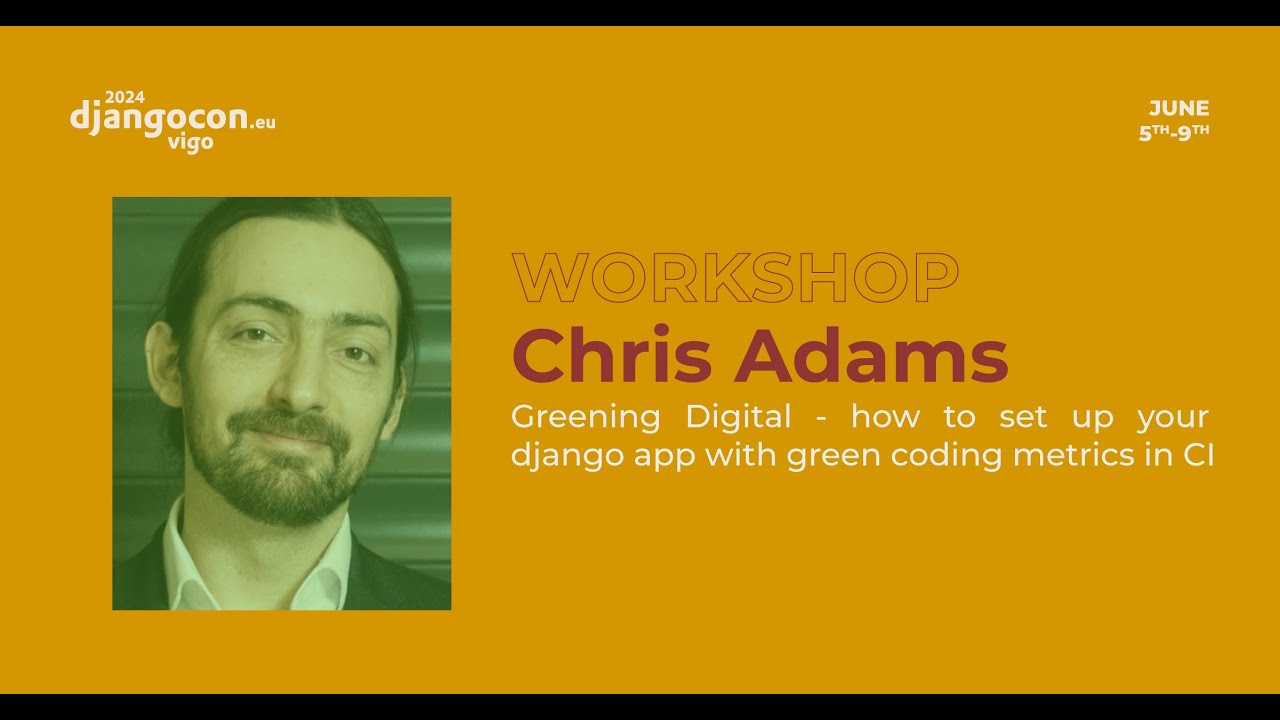
Greening Digital - how to set up your django app with green coding metrics
Published July 11, 2024
This video features Chris Adams at DjangoCon Europe 2024 in Vigo, Spain.

Talk: Greening Digital With Django by Chris Adams
https://pretalx.evolutio.pt/djangocon-europe-2024/talk/QP39VQ/
Digital services emit greenhouse gases both while they run—through electricity used by devices, networks and data centres—and while their hardware and buildings are made. Adams argues that the internet’s footprint is significant and that developers will increasingly need to measure it as climate disclosure and emissions-reduction rules reach organizations and their suppliers. He outlines usage-based and cloud-billing methods for estimating impact, then shows how tools such as CO2.js, Green Metrics Tool and CodeCarbon can help teams measure and reduce it. Django is well placed to contribute, he says, because its versatile, mature community already has climate and energy expertise and can build sustainability checks into development workflows.
Summarised automatically from the transcript.
Automatically transcribed, so expect mistakes in names and technical terms.
Okay folks, hello there. Um as I mentioned, my name is Chris. I'm Chris Adams. Welcome to my talk, Greening Digital, with Django. Uh I know the resolution is not great here, so I've shared a link to the talks. So that's also online if you're inside the Slack. Um just briefly about myself. My name is Chris Adams. I've been part of the Django community shortly after I graduated in university and I've been working with Django since around two thousand and eight. Well actually I I started working with Django first in two thousand eight and eight and I've done various other things as you can see on this page. So generally speaking, my background is largely working in climate themed or open data tech startups. LOCO2 is a was a startup which was based around the idea of making trains easier and cheaper to use than planes.
And it was a three layer pun like low CO two, trains, loco, and going crazy or loco. So stuff like that. Uh Amy is Is a well basically us putting an API on carbon calculations about 13 years earlier than people started paying attention. Um I also work uh with the Green Software Foundation, which is an industry body that sets that to kind of standardize how to kind of talk about About green software and stuff like that. I also help organize a community called ClimateAction. tech, which has around 10,000 climate-aware techies like yourselves, or presumably some of you. There's also a podcast I do, and uh I work full-time at the Green Green Web Foundation, which is what I'll be talking about. I've also done a number of other talks and various Jenga cons from 2017 onwards on this topic, and I've linked to that in the deck.
So this is what we'll cover in the time I have available with you, and let me just make Make sure I've got the time checked. Here we are. Okay. I'll cover three things that you can see here. So first of all, we'll talk about how carbon emissions result from our use of digital services and why people are starting to worry about it or care more. We'll talk about how they're measured and estimated and the common tools you might use if you were to do this. And then we'll talk about why Django is particularly well placed in my opinion to help with greening digital. Now this deck is online, there's loads of links. And loads of notes. If you have your phone you can take a picture of that and that will link directly to it. But we also have the link to this and I've shared it inside the Slack. Alright? So like oh sorry folks. Um some of you will take it.
Uh all right, everyone's got that? Good. Okay. So the Green Web Foundation, this is where I work. We are working towards a fossil-free internet by 2030. We do this, but fundament we do this in a few different ways, which I'll talk about. But fundamentally, we do this because we believe the internet should be a public good available. For everyone and should be a tool of liberation and progress. Like we're here to build Star Trek, my friends, not build Mad Max. So like this is so how do we do this? What do we do? So for a star, we basically provide APIs and services for checking if anyone website in the world runs on green energy. We also publish open source software to make it easier to calculate the environmental impact of technology in a number of different languages. Uh we also work with other organisations because we're small, that's one of our
w one way we can increase our reach. So that means that we work with other providers and other c another c other organizations. So do we have any Firefox users here? Okay, good I th I figure this would be the right crowd. You probably have some of our software already on your laptop. And that software inside Firefox will allow you to work out the carbon footprint of pretty much any interaction you can think of on your browser right now. We also publish open data and make it easier for you to use this data in various applications. So the stuff we make available over the N API. We also publish we also publish as a data set for you to work locally for privacy, enhancing reasons and things like that. We also work with academia figuring out what kind of protocols you might actually need to extend so you You can support a greener, more carbon aware internet.
This paper actually outlines how you can extend the headers of IPv6 to embed energy and carbon data so you can route to the greenest next hop when you're d when you're when you're sending packets around the internet. Linked again to that, uh, to the actual paper as well. And we've done other things. And also we try to shift the narrative around sustainability in technology. So we've been publishing a magazine called Branch, get it, Branch, get, uh, uh since 2020, where we highlight people working at this Intersection between technology and climate. And why do we do this? We do this because, well, we should as an industry be ready to talk about greening Amazon, the giant firm, but I think it's also on us as responsible professionals to think about how the rollout of technology We build affects climate activists in the literal Amazon, as in therainforest.
com as well. So we feature these voices in Branch magazine and also this is a carbon-aware website. So the design changes based on the quantity of fossil fuels on on the grid. So if there's loads of green energy, you get a full, fat, really nice version of the site. If it's lots and lots of cold on the grid, it'll c it will scale back accordingly to stay inside a budget. We also do now while while most of our funding does come from grants, we do do things like commercial work so we help people kind of navigate this new emerging field and we do accept donations but that's not what I'm here to talk about today and I don't have one of those cool QR codes like the Django Girls presenters did. Alright, so how does digital cause emissions and why would you measure it? When we talk about digital services, what we might experience at our end
might be playing a game, watching a video, buying something like a or on a device, on a tablet or a phone for example. But in reality, there's a really complicated supply chain at work. When we use a service, we're relying on a network of always on undersea cables, routers, cell phone towers, and no one and which connect to data centres which are on pretty much twenty four seven. This all takes energy, and right now, for the most part, most of the energy, the electricity we use, comes from fossil fuels. So we call these kind of use-face emissions, and these are the bits at the top, all right. However, someone also has to actually make the technology. we use and they need to build the buildings that we actually put the servers in. This is often energy intensive and water intensive in its own right.
So you can think of us putting energy into the creation of things. So we call this embodied emissions. So we have two sources of missions when we think about digital, all right? There's using the infrastructure and there's making the infrastructure. Now we've linked to some more details in this slide deck as well. So we figured out there's an impact. Is it is it a big one? Should we care? Generally Speaking, if you work in industry, you will say the carbon footprint of technology is around one to two percent, which is kind of large. If you're an activist, you might say it's close to four to five between four and five percent, and there are ongoing bun fights in academia all all about this. Now I don't know about you folks, but when I hear two percent of global emissions, like is that a lot? What is that what is that comparable to? So I think it's easier to think about this in terms of a sector that you might compare it to.
So that two percent figure That's kind of about the same as the entire aviation industry. Now, quite a few people use this as a comparison, but one problem is that fifty percent of all the emissions in aviation come from one percent of the people doing the flying. So, moreover, most people people in the world that haven't flown, they're never gonna fly. And I think that this is not necessarily the best thing to compare it to. Instead, I suggest thinking about shipping as a comparison. So ninety percent of the goods we use, they come by ship. And it has a comparable carbon footprint of around two to three percent of global emissions. Also, for most of us, shipping isn't something we experience directly, but we know that it takes massive boats, burning huge amounts of dirty fuel, to power the global economy.
And while we know that shipping makes things convenient, I don't think we would say it's clean. Now almost all of us rely on shipping, just like almost all of us rely on the internet. And if you want to keep using the internet, we need to find a way to clean it up because I don't know about you folks, but I do not want to stop using the internet. In the world of shipping it's hard work, but we are seeing this take place. Now there's a company, Mayask, which is the one with the blue boat behind you. Last year they ran their first ever container ship running on entirely fossil free fuel. So we know this stuff is doable, it's just kinda hard. Now right now the internet is a bit like shipping in that it's massive in scale, mostly runs on fossil fuels, and is somewhat invisible. So it's the biggest machine we've ever built and it mostly runs on fossil fuels.
So why would I care beyond feeling a little bit kind of bad about this, I suppose? Like how does this affect me apart from feeling the whole kind of climate anxiety thing, I suppose? So there are two trends I think that you might want to know about as technologists that kind of happened recently. So and I call these trends climate disclosure, which you may be familiar with already, and a new one, which I'm calling climate response. And these are things, these are concepts I'd like you to take away. So we're used to thinking about things being small or or it's good to make things smaller. When you talk about kind of climate. But I think it's better to think in terms of having a really big, bold, honking great climate response inside an organization. Because we need to see, like, A, we're in a climate emergency, need emergency responses, and also we need to make these changes
ambitious and transformational if you want to make them basically attractive or for people to get on board with them. So let's look at climate disclosure first. You can think of climate disclosure being the thing that governments and investors are really calling for right now. I've linked to two acts in this talk, but the TLDR on the left is basically what you said, what you can see on the left. Show us it's gonna be law that you need to as if you're an organization above a certain size, you need to show that you're tracking your emissions and you need to disclose this and share this with society. So in the U in Europe, there is the CSRD, the Corporate Sustainability Reporting Directive. And in the US, the largest state in California with the largest economy in Califor in America, California, they have the CCD. AA
Act, which pretty much requires the same things. And it looks like lots of states will be adopting this as a kind of default. Now, this the thing that's interesting is that these are actually starting to have some teeth. So in Europe, when you have a directive, which is a bit like it's a little bit like having a Python class that you then need to kind of subclass into your own country, then put into your own laws. That's kind of how it works, basically. And France were the first uh of all the countries in Europe to basically do this kind of transposing or subclassing into their one. And uh they've got some pretty impressive stuff. They basically are their implementation is really, really badass and it goes quite a bit further than what you'd be seeing in other countries. And uh as you can see, well I'm not sure if you can see this, I'll read this out for you at the back. Basically, corporate directors are
there's a risk of jail time for people at the very top if they don't actually start disclosing this information. So I think most bosses would prefer not to go to jail. So they're probably going to talk to you about okay, how do we disclose this thing? Because if It's part of our emissions now. Now, just like money accounting has accepted standards, we have standards for disclosing an environmental impact too. Now you won't get to see too much of this, and in the world of carbon accounting, there is this thing called the GHG protocol, the greenhouse gas protocol. They list all the things that you might need to kind of categorize and include in your disclosure. And just like accounting, it's extremely detailed. And I'm sharing this with you here, not because I want you to memorize it, but because Just to give you an idea, it's there. I'm going to share with you a mental model that I use to kind of think about this and explain to other people.
I use coffee as a mechanism to help me talk think about scope to missions and their role they might place. You can think of scope to emissions, like um carbon emissions in the sense that scope one, this might be things like direct emissions. If you boiled water by burning gas to heat up a kettle and then there's carbon dioxide emitted, that's scope one. That's your direct emission. Scope two is emissions from electricity that you purchase. Let's say you've got an electric kettle to heat up water that you're then going to use to make coffee. Someone's burning coal somewhere and but you don't see it, but you just see the power bell. Scope three is the entire supply chain. So there are there's going to be a s entire supply chain along with us all these emissions associated if you walk into a cafe and get like a flat white or something.
Alright? Now for m for most organizations websites count as scope three. basically. And if you're in a large firm you need to report some of this. But if you're in a smaller firm, because they need to re report their supply chain, you're probably gonna need your organization will likely need to have provide these numbers to the people upstream. So if you sell to a firm that has to report, they will be asking for this stuff for you. And also on the right hand side, there's a thing which I'm pointing to which shows the use of sold products. Some organizations that make up a material amount of their footprint. So Mozilla, they work to out their carbon emissions I think a couple of years ago. And uh when they did it the first time, ninety eight percent of their reported emissions came from end user use of software.
So this gives you an idea that it's actually material in some cases. So that's one thing, disclosure. Now there's actually thing about response. You need more than disclosure. And earlier in March we saw this other catchily titled law, the Corporate Supply Chain Due Diligence Directive. cost. And the key thing that you might want to know about is the TLDR. You need to show that you have a plan that's in line with kind of national goals to kind of halve emissions by a certain date. Alright? So this basically means that organizations above a certain size now need to To show they have a plan to kind of I guess steer away from the kind of collective iceberg that we're heading into. But also we need to report uh progress on this each year. And there are various tools which are now basically
really, really happy this is actually available. But you but I think this is quite helpful. I think it's much better than accelerating into that iceberg, for example. So you have an idea about climate response, which is a kind of thing that I think as developers, we know that this is gonna take chunk up take up some of our invo our our impact. There's a chance for we can do something here. So these are the kind of takeaways for this part. Climate disclosure, that's about what are my emissions. Climate response is how do I change this going forward? Digital has an impact, and we're gonna have to answer these questions from management as as they get pressure from regulators and investors and people like that. Okay, so how do people estimate emissions from digital in the first place? Now the thing I need to share with you first is that this is a quote by a guy called George Box, who's a well known statician.
All models are wrong, some models are useful. This applies in digital, it also applies in pretty much all of carbon calculation across every single sector you can imagine. You can think of there being two main kinds of tools for understanding The carbon emission from digital. There's usage-based, which is basically looking at the observed stuff in your system, and there's billing-based, which is about looking at your billing data and turning that into emissions data. Now there's pluses and minuses for Now if we look at usage-based, there's a few flavors specifically. There's like component-based stuff, which basically self-report their own figures, and I'll show you some examples a little bit later on. There's system-based tooling, which looks at maybe the entire service. You may
Might make available. And there's maybe global view stuff, which is like looking at some activity and seeing what share of the global two percent is your share, for example. Likewise, when you look at billing, there's like native tools, so Amazon, Google, and Microsoft have their own calculators, then there's third party ones which might have slightly different ways of calculating this, but they but they are applicable and allow for comparisons between them, for example. So let's look at usage-based ones. Now On a component view, you might have something that looks at a single system, right? And it reports its own impact and you would use that to kind of focus on your own changes. So the thing I told you about Firefox browser, that's one example that as a developer you can use if you're looking at the front end. Uh
for client-side stuff. You might compose that into systems because there's back-end bits as well. So a system view might be composed of these tools, and you might think of this as a way of doing like an integration test where you fake a browser, fake a system. server and then and then replicate some of the activities that you would typically do in a test there. There are also some other tools which do the which expose this at production level. So there's a tool called Q for Ke for Kubernetes called Kepler that does this. In global stuff, like I said you, that was seeing one thing and then seeing how that kind of you extrapolate one model to see your share of global uh global emissions. And uh there are some tools that do this. So I mentioned the Firefox profiler in Python, there's code code. carbon.
There's another thing in French called scapange. There's a tool called Green Metrics tool, which is more descriptive than it is creative, I suppose, but it's a one that we'll be looking at. And likewise there are tools like website carbon and things like we have here. If we look at billing, these are the things you might want to know if you someone's asking you about this. Okay, billing native stuff, they will take your billing data and turn it into a carbon figure. Now, if you have a whole Platform you've got access that people don't have if they're right outside. Now the thing is these figures and these methodologies will be proprietary. So it's very hard for you to understand how they're being shared a lot of the time. And as I mentioned before, Amazon's one is totally different to Google's one, which is totally different to Microsoft's one.
So if you're using multiple clouds, it's gonna be a real headache. Third party ones, they are easier to compare, but because they don't have this kind of access, you'll often have large providers basically saying Well, ours is better because we've got access and this is why you see laws p calling for disclosure now, don't you? Now there's some examples. I've mentioned Microsoft have one, Amazon have one, Google have one, OVH have one, platform And if you're a customer they will give you these figures. And then if you wanted to look at this yourself, there are tools like Cloud Carbon for a print, which is open source, written in JavaScript, there's OpenCost, which is written in Go, and there's a few other ones as well. Green Pixie is a particularly uh well-known one now.
And if you are hearing from your boss asking you to figure out what these numbers are, you're probably going to start with basically the billing-based tools because you've already got that data. But if you want to change something and you want to kind of think about okay we're gonna halve our emissions by this much, you look at the usage-based tools to help you understand what interventions would make sense. So let's look at what these tools look like in a bit more detail. So I'm gonna talk about some of these ones here because these are all open source and ones that you can play with uh pretty much tomorrow or even today. So let's start with global view things like website carbon tools. So has anyone here used a website carbon calculator before? Okay, we have one person. Three b okay, great. This is what they look like, okay? There's one there's a website uh car
carbon calculator called website carbon. Uh again, not particularly creative, but at least it's descriptive. Um you put your website in. you'll get numbers back. We've basically we we've basically got a library called CO two JS and we've worked with a company called webpage dot webpage test, which is a common web performance tool. We've added those tools into that. So if you've heard of webpage test, you can do this kind of calculation now. We do this using a tool called CO2JS, like I mentioned before. And this is like kind of the high level view. It lets you work out these calculations because most of us are developers and not sustainability experts. So We use it in a number of places. I won't talk about all of these, don't worry. But the key thing is that we do
we basically take peer-reviewed academic models, put it into code, and then we provide get get access to energy data so you can figure out how clean energy might be. And then because we have been tracking the transition of the internet for the last 15 years, we tell you which websites are running on green energy already, for example. So Web Page Test uses this. They're PHP, but they use this a bit of JavaScript in their tool for this. Mozilla uses this inside their profiler like I just mentioned. And uh that's like component that's but that's the thing that's giving you a global view, for example. So let's talk about some other tools. Green metrics tool. This is This is something that lets you kind of take a full stack view because in many cases if you're looking at one thing that might not represent
that might not represent your particular context, for example. You can think of GMT as a usage-based system view tool. You can create a scenario like you would do for an integration test, uh, simulate various interactions, and then you can get an idea about what the environmental impacts of certain things you're you're you're you're supporting in your browser to do. And uh it works a bit like this. This is how GMT, greed metrics tool people, expla explain it. They set up Docker, and then for each single part of each Dockerized container, they listen and they track some of the metrics from that, then they re-expose that for people. And uh this lets you do some cool things in my view. You can see like well, is it gonna actually make much of a difference if I kind of pre compile stuff then serve a bunch of static pages for example
versus serving things dynamically? So this chart is showing WordPress. Serving the same data as, say, Hugo, a static site generator. You can see, as soon as you've you can see more or less how many pages, if I was to kind of compile something, is it gonna make us is it gonna make much of a saving compared to the other ones here? And this is showing us that. Uh Yeah, by essentially pre compiling, we're we've got a saving there, but we've also got a saving just because using a static serving something statically is going to be that much faster than serving dynamically. And you can do this in Django, and this is what it looks like when you do do this. So So if you have like a Dockerized application, you'll maybe have something like a Docker compose file listing this stuff here. And then you'll have another file which basically takes some of the kind of interactions you've already kind of written about in some integration tests.
And then you use that to drive a browser and then see what figures come out of this, for example. So this is what we did last year with Wagtail with uh the Google Summer of Code project that we were doing. So we used GMT to basically test some of the common scenarios for the Wagtail Bakery. Now the Wagtail Bakery is a demo site which shows some of Wagtail, the CMS's features. So you get a bunch of pre generated pages, pre-generated images and stuff like that, and then you can try very various flows through the application, for example. We we hook this up and uh we can get some numbers like this. We can okay the resolution is terrible on this, but what you would be seeing is CO2 figures, energy usage figures. You would see for certain parts of a site.
If you're gonna do a search, it's it's worth this much. If you're gonna visit a home page, it'll be this much. And then you can actually then see in more detail where is the energy taking place, where where where is the impact taking place inside this. So So if for a particular scenario we can see is it the browser doing all the work or is it the application? In this one here, the browser is the yellow part, and the blue is the kind of application server. And while you can't see it very well against the pictures here, there's a redis. server and there's a database server and you can see those kind of spiking and going down in response to certain activities that you have. So you've got visibility in s into this. Now the thing that it's worth bearing in mind is that we are now starting to see standards emerge for how you talk about the environmental impact of software.
And an organization I mentioned before, called the Green Software Foundation, they've basically got a standard called the Software Carbon Intensity standard. So the software and carbon intensity spec is now an ISO standard. So it's free for anyone to use and this is likely to be one of the things that people end up having to show that they'll improve over time to show that they've actually got some plan for digital emissions, right? And basically this is a bit confusing to see this slide. But I'll just take you through it. The R is like the per thing. So we do like vi f every s every single time I do a thing, this much carbon is emitted. Alright? That might be loading a web page, it might be a e commerce, uh it might might be uh sending a file, downloading a file, or maybe even long, long user journeys, for example.
So you've got some freedom over that. And then we spoke a little bit about there being impact from making stuff and impact from using stuff. So that's what the E and the M bits are. Now tools like Green Metric Tool, which is an open source AGPL license thing, it lets you track this. So this is an example of the kind of aggregate SCI figures for Wagtail stuff over time. So every single time there's a change to CI, you can see these metrics. And this gives you something that you can actually optimize over time or shoot for. So you can basically put CI in the CI or SCI in the CI, I suppose. And this is kind of cool. Because basically you break the build before you break the planet, I suppose. You know, that's kind of nice.
So this kind of stuff I think is actually useful because we're seeing this show up in uh, in my view, leading open projects in the kind of Django community. community. So White Tail now have a sustainability roadmap for looking at this kind of stuff. And I think it's worth if you're curious about this, their roadmap is really, really impressive because there's butt a lot there's there's a load of really really helpful things that will probably be up to applicable to your own projects and it's in the open. I think it'd be really cool if more open source projects had this because it feels like it's a thing that we're gonna have to deal with even if we don't want to because the law is being kind of sh is is is changing around us. So that's like GMT, but if you want to just play around with this and you want something even smaller, there's something called code carbon, which is
just written in Python. It's really nice and easy to use. You can visit it at codecarbon. io and to use just taxonomy. It's a component view usage based way to look at this stuff. It's basically the library that everyone uses when they talk about the environmental impact or say an AI training run or something like that. And uh it's literally some it's about as this easy to use. You start a class You tell it to start listening, you run some code, and then you stop it. And uh there are nice things like context managers and decorators and things for you to use. It's really not that hard to use. Like you could do it in maybe half an hour in the sprints and you could take your first Steps into this new field basically. So why do I think Django is well placed to be the greeniest framework out there?
So, first of all, it's a really versatile framework. We've seen and we've discussed it being used for web pages. We know it's used used for chat tools. We've seen some of the support. There's high there's large projects like Zulip and so on about where you can learn from to see when this stuff is adopted. You can even see things like, as Carlton mentioned, collaborative editing, things that you typically wouldn't think of Django being used used for this is a good example for this. And as we know and as we see in other workshops and you can't throw a brick without hitting someone who's talking about it, AI. Like there is all this stuff out there that you could actually see and represent inside the Django framework to see what's going on there. Also It's quite a mature community in my view actually. We've had well-run open source projects in Django for decades now, well, decade and a half, one decade at least.
So there are things you can learn from there. And also, because Python isn't that fast by in its It's quite common to see it shell out into other languages. So you don't need to be fast, you just need to be productive. So I think this is one way that we can see, we can actually kind of build on some of the successes from other communities that we're working with. And there are plenty of examples that we have there. And finally, we have a long history of expertise in this domain specifically. So the first un online carbon calculators were created in two thousand seven using Django and we have active community members who really know energy and really know climate right down right now. like the fastest growing energy company in the world right now, um octopus slash kraken, that's a Django shop. Like we've got this as expertise that we that other communities might not have that kind of access to.
And then finally, like green is literally the most common in colour on the Django website. Like that's got to count for something, right? So yeah, that's kinda me. Um I think I'm at time. I've got a little bit time for for for questions and things like that. Uh this is that slide, the the the the deck I pointed to. You can also follow the bit. ly link if you fancy. I'm reachable at chris at greenweb dot org. I'm on LinkedIn as you have here. I'm also on FedI or Mastodon, whatever the term you should be using. Is a don't know if it's a bit kind of GNU l GNU slash Linux, right? You should you call it Mastodon? Should you call it Feddy? I don't know. But yeah. And then if you want to find other like minded people, there's a community, ClimatAction. tech, ten thousand other techies trying to figure out how to do all this stuff. Uh there's also a podcast where for the last two years I've been interviewing
World experts to kind of share what I learn along the way to actually help people implement some of this stuff. And then finally, I mentioned that magazine that's been running for since 2020 and shows as a showcase for this stuff. And finally, I'm doing a workshop. shop on Friday to help people level up in greening digital with Django. We'll be using Green Metrics tool. I'll show you how some of this stuff actually works. So if you want to take your first steps into this field and generally be seen as the guy that or the girl or the whoever whatever you'd like to be referred to as the person your boss is has to speak to when the w when when they're asked, oh, how do we report this stuff? Then that might be a place that may be useful for you to go to. And yeah, that's me. Thanks folks.
Digital services use energy across networks and data centres, producing use-phase emissions; manufacturing devices, servers, and buildings also creates embodied emissions. Much of the electricity currently comes from fossil fuels.
Discussed at 5:37Estimates vary: industry figures are around 1–2% of global emissions, while activist estimates can reach 4–5%. Adams suggests comparing it with shipping, which accounts for roughly 2–3% and is similarly essential but not clean.
Discussed at 6:23The talk distinguishes usage-based tools, which estimate emissions from observed activity, from billing-based tools, which convert cloud bills into emissions estimates. Billing tools are a practical starting point for reporting; usage-based tools are more useful for evaluating changes to reduce emissions.
Discussed at 15:00Green Metrics Tool can run scenarios against a Dockerized application, drive a browser through test interactions, and report energy and emissions by component. The talk describes using it with Wagtail to compare common site journeys and track Software Carbon Intensity over time.
Discussed at 21:06Adams points to Django’s versatility, mature open-source community, and ability to use other languages where performance matters. He also notes Django’s history with carbon calculators and the climate and energy expertise already present in its community.
Discussed at 27:23Note: We understand that names change, people change, and bodies change. We respect each individual's journey and privacy. If you have any concerns about a video or need us to remove content, please don't hesitate to contact us. We will handle your request with care and promptly address any issues.

Published June 13, 2025

Published June 13, 2025

Published June 13, 2025

Published June 13, 2025

Published June 13, 2025

Published June 13, 2025

