
0:43:47
Deploy Django: GitOps & Kubernetes Made Easy with Calvin Hendryx-Parker
Published November 6, 2025
This video features Calvin Hendryx-Parker at DjangoCon US 2023 in Durham, North Carolina, USA.
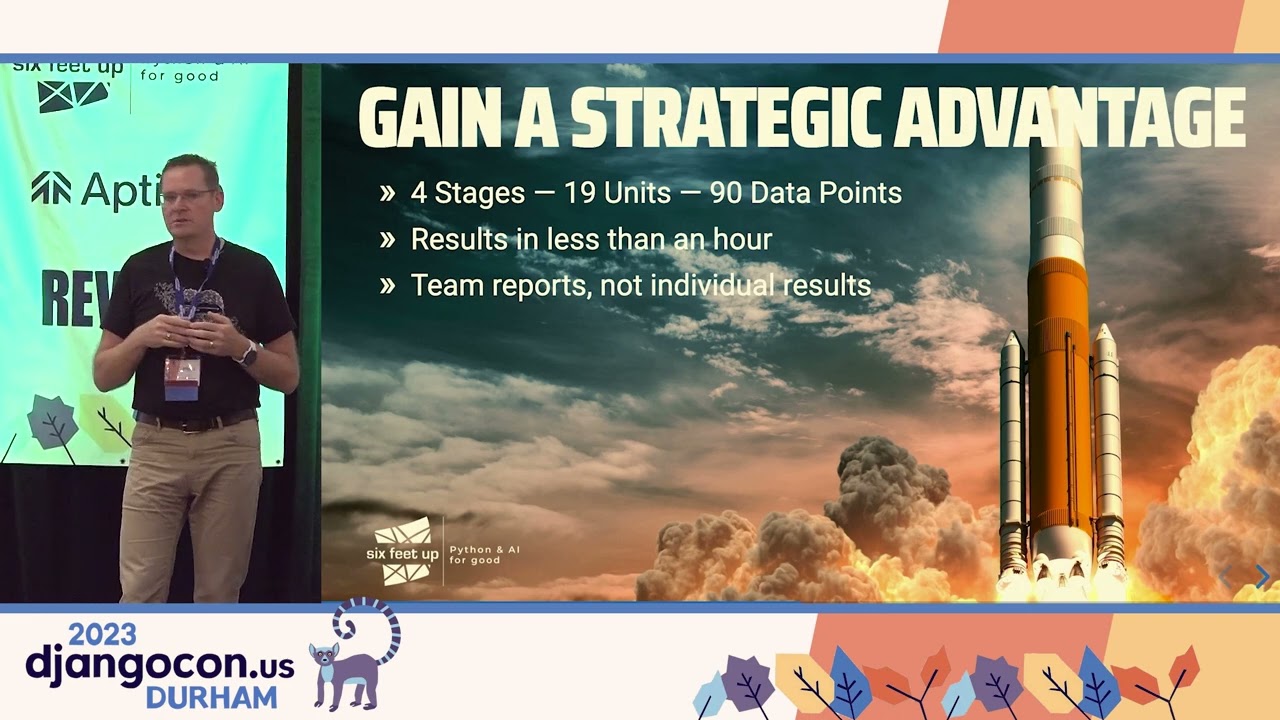
Ever sensed an unseen throttle on your team's potential? Get ready to unmask those bottlenecks and elevate your Django prowess. Explore the BEST framework with Six Feet Up CTO Calvin Hendryx-Parker. BEST is a catalyst designed by devs, for devs, to turbocharge team efficiency. Ready to up your game? Join Calvin and dive into insights to lay the groundwork for unmatched synergy.
This talk was presented at: https://2023.djangocon.us/talks/sponsored-talk-six-feet-up/
LINKS:
Follow Calvin Hendryx-Parker 👇
On Twitter: https://twitter.com/calvinhp
Video production by the presenter and DjangoCon US 2023 volunteers.
Calvin Hendryx-Parker argues that internal development teams can learn from the care, documentation, quality practices, and knowledge sharing common in open-source projects. Six Feet Up has built a framework that assesses the developer experience across four stages and 19 units, using nearly 100 data points gathered through a survey completed by everyone on a team, including developers, QA, frontend, backend, and data staff. It examines areas such as access control, documentation, learning culture, and secret management, then presents heat maps and radar charts to show strengths and gaps across teams. The goal is to help teams compare practices, share knowledge, and identify concrete improvements to their working environment.
Summarised automatically from the transcript.
Automatically transcribed, so expect mistakes in names and technical terms.
Awesome. I'm so excited to be here. DjangoCon. Welcome everybody to North Carolina. Excited to be here for the conference. My first DjangoCon was in 2017. I feel like that was kind of my bringing to the community. you know, done awesome things to kind of build more around what happens uh in Django and especially around development teams. So something I want to share with you that Six Feet Up has been building over the last year has been some tooling around how to build better development teams. I think we get spoiled sometimes being in an open source community. And so actually raise your hand if you've contributed to any open source package in the past. So you all have gotten a taste for how awesome it is to develop in the open and
like like you know worry about kind of code quality because that's kind of like your rep as you you know contribute into these projects. And the contribu contributions can be as small or as big as possible or as as little as they they need to be. But you there's great document typically good documentation because people are passionate about what they're doing and they're contributing on their own time. So they're they're kind of giving it their best effort. That's not to say that teams you know inside of organizations aren't giving their best effort, but it's sometimes They guy get stuff done, so they don't have time to think about some of the luxuries I I feel like we get to afford it in the open source community So part of what we've done is put together a framework, and you'll see a couple banners around the venue, and if you come by the booth, uh. I've got some things to show you about that.
But we're we're basically looking at the developer experience front to back and all the pieces that are are parts of that and putting in there how how can we help other teams Use that same level of efficiency and same level of like I don't know care in all the processes all the way along the the whole the whole journey of being a software developer. This actually came about when we were interacting with a potential client earlier this year, and before they even wanted to sign a contract to do a project with us, they're like, before we do anything, we want to look and operate more like you guys do. How do we do that? And so we went through a process of interviewing a couple of their teams and understanding where each of the teams inside their organization stood when it came to software development best practices and found that there were some gaps.
And they weren't, they were easy to, I think, not easy, sorry. I tried to eliminate the word easy from my vocabulary, and all of you should too. Easy and simple are kind of terrible, terrible words. But there are things you can go do that actually can improve everyone's quality of life as developers. And that's what we all care about as as being up here and coming to things like DjangoCon. So we wanted to actually find a way to help identify these issues more easily. Can we do it in an automated fashion? And so how can we actually help companies operate more like maybe an open source project or have better practices in certain ways in certain areas. So I came up with a set of a tool where we actually can go through a survey And you can do, there's four units, or no, four stages and nineteen
units, almost a hundred different data points we look at through part of this process. to help understand where one stands. It takes less than an hour for each, and we encourage like each developer on the team, actually every member of the team, whether you're doing quality assurance or whether you're front-end or back-end or doing you know data science It's applicable to everybody in the team. And so we could actually give back team results about what's going on. Like I'm being able to understand where things are falling down. And this is it's a it builds on each other too. If you think about like the stages That first stage is going to be things like access control. Do people have access to the documentation? Do they have access to even a VPN or however they need to get into whatever system?
Do they is there a culture of learning uh going on inside the organization? Where how do you manage secrets? Do people still paste secrets into Slack or an email? or put them on a wiki page someplace for even as simple things as as basic access into uh you know maybe testing websites. So looking at those kinds of things is really where we we went with this. And we wanted to be able to give back some visuals. So if you think about an organization, you could have numerous development teams. Maybe they they don't even know about each other because they're in different you know subdivisions of an existing organization. Some of them may be high performing, some of them may be a little lower performing. Wouldn't it be nice if they could collaborate and actually share that knowledge across
uh between the teams and actually help make each other better. Another thing I think we get spoiled about at events like this You go to the code sprints after the conference and you get to watch how other people work and learn from their techniques and their processes So if you've never been to a sprint, I highly encourage that. And conferences like PyCon and DjangoCon are great opportunities to Dive in on open source projects, scratch your own itch. Well, this is kind of the same thing, but for internal. Think about it as an internal you know days of innovation or being able to share those kinds of techniques back and forth with each other. So we put together these these charts. There'll be like heat maps showing you those are the the 19 different units that are a part of this whole survey. And then per stage we put together these radar charts to show and help
easily identify where there's room for improvement. This all just came about because we wanted to build other development teams to look like we do so that people can perform at a higher level. And we think it's worthwhile for everyone to do. I won't take a ton of time, but I would love to show this off to everybody. We have just released a kind of a beta version of it. If you want to come see a demo, you can come find me out at the booth. You can also scan that QR code. It'll take you to a type form. There's nothing nefarious there. If you don't end up at a type form, someone has hacked somehow my GitHub repository that I have this presentation in. But that should take you to a type form that allows you to sign up. And then we'll just do a quick 15-minute one-on-one outside of the conference. Or find me around. My name is Calvin Hendrix Parker.
I'm co-founder and CTO of Six Feet Up, and I love participating in open source communities, and I also love building better developers and development teams. So anything I can do to help you all, I would love to talk more about it. Thank you for giving me a few minutes to be up here and chat with you all and enjoy the rest of DjangoCon and come to my talk tomorrow. Thanks.
The framework uses a team survey with four stages, 19 units, and nearly 100 data points. It takes less than an hour per team member and produces results showing where practices are falling short.
Discussed at 2:47It evaluates the developer experience from end to end, including access control, documentation access, VPN or system access, learning culture, and how the team manages secrets. It is intended for everyone on the team, including QA, frontend, backend, and data science roles.
Discussed at 3:34The framework provides heat maps for the 19 units and radar charts for each stage, making it easier to identify areas for improvement. Teams can also compare practices and share knowledge with other internal development teams.
Discussed at 5:06Note: We understand that names change, people change, and bodies change. We respect each individual's journey and privacy. If you have any concerns about a video or need us to remove content, please don't hesitate to contact us. We will handle your request with care and promptly address any issues.
Published November 6, 2025

Published September 19, 2025

Published December 15, 2023

Published July 14, 2026

Published July 14, 2026
Published July 14, 2026
Published July 14, 2026

Published July 14, 2026

Published July 11, 2026