
0:05:40
Creating an Inclusive Django Community with Kenya Phelps
Published July 15, 2026
DjangoCon US 2026
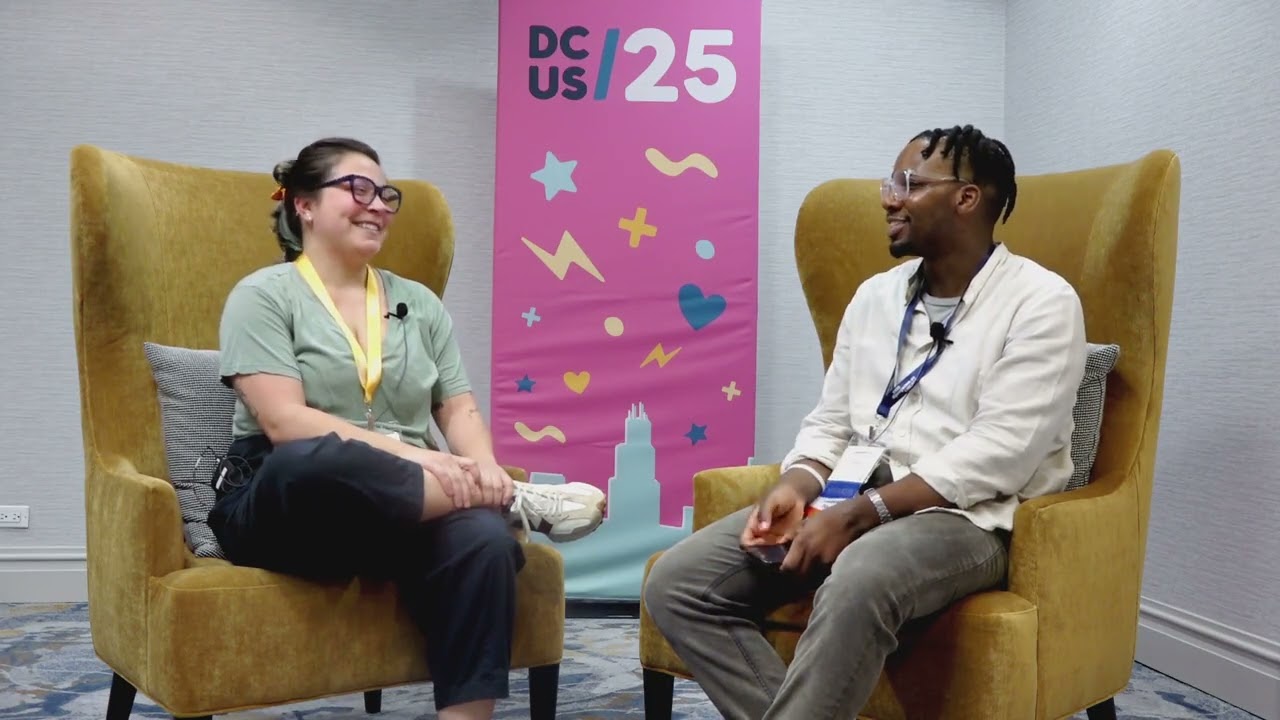
This video features Kattni at DjangoCon US 2025 in Chicago, Illinois, USA.

This talk was presented at: https://2025.djangocon.us/talks/the-source-of-change-bettering-online-open-source-communities-can-begin-with-you/
LINKS:
Follow Kattni 👇
On Mastodon: https://social.afront.org/@kattni
Website: https://kattni.com
Follow DjangoCon US 👇
https://fosstodon.org/@djangocon
https://x.com/djangocon
Follow DEFNA 👇
https://www.defna.org/
Video production by the presenter and DjangoCon US 2025 volunteers.
Kattni argues that safe, inclusive online open-source communities are built through deliberate action by everyone, not just formal leaders. She describes the scale and unequal impact of online harassment, then gives practical guidance: establish clear codes of conduct with consistent enforcement, welcome people intentionally, communicate clearly and empathetically, give constructive feedback, thank contributors, report mistreatment, and use privilege to support people who are not being heard. She also stresses that communities must address “missing stairs” rather than warning newcomers to work around known offenders, and that people pushing for change need to monitor their capacity, set exit plans, recognize burnout, and step away responsibly when necessary. Lasting change is gradual, but individual choices establish stronger expectations for the wider open-source ecosystem; in a follow-up question, she says even highly productive contributors must leave if they refuse to change harmful or harassing behavior.
Summarised automatically from the transcript.
Automatically transcribed, so expect mistakes in names and technical terms.
Speaker 1: Hello everyone, I'm Katney, and here's the most important thing you need to know about me. I am tolerated by a cat and three kittens who continue to let me live with them. In 2017, I started a six-year career as, among other things, an open source community leader. The community I built over that time was safe, welcoming, supportive, and inclusive. We had a thorough and evolving code of conduct that we strictly enforced. We actively ensured new folks were welcomed and encouraged appropriate behavior. We highlighted those who embodied our values by promoting them to official roles. Throughout the years, we continuously received feedback that people's experiences were significantly more positive than what they were used to. While this was excellent, it was deeply disappointing that the experience wasn't more common. Today, I want to talk to you about the underlying problems with online communities and how bringing about change within the system begins with you.
Speaker 1: There is a serious problem with online communities, and open source is unfortunately no exception. The issue is pervasive antagonistic behavior, mistreatment, and abuse. Online harassment is now commonplace and it's more widespread than you might realize. 56% of adults in the US report having experienced some form of harassment on the internet. This 2024 survey split harassment into less severe forms, including offensive name-calling, purposeful embarrassment. And more severe forms including physical threats, stalking, doxing, swatting, and sustained or sexual harassment. Forty-one percent of the adults surveyed reported being the target of at least one of the more severe forms of abuse While harassment can happen to anyone, it disproportionately affects marginalized and underrepresented people.
Speaker 1: This group reports being harassed more for their identity, which can range from race race or ethnicity To physical appearance, disability, gender identity, or sexual orientation. The research indicates that the severity and intensity of harassment is increasing. More than ever, it's critically important to focus on building safe, inclusive communities. The broader topic of safety and inclusion is a bigger one than I can actually do justice today, but I want to acknowledge that you cannot separate it from the conversation about harassment in online spaces. 91% of uh Americans say that people being harassed or bullied online is a problem. That's nearly everyone, but it continues. Why does it continue? Some people are comfortable being horrible on the internet.
Speaker 1: They distance themselves from the target being another person, or they use the ability to remain anonymous to avoid facing consequences. Many people are resigned to people being terrible and feel that the continuation is inevitable. This can feel uh like trying to even change things is pointless to even initiate in the first place. In general, people don't prioritize things that don't affect them directly, especially powerful people. They're not the victims of harassment and abuse When people see someone being treated badly, it can be perceived as tacit permission to do the same. Some may believe this just is just how it is and choose to tolerate or engage in these behaviors. Too often harmful behaviors are ignored, or even worse, encouraged. The apathetic approach of ignoring harassment allows communities to fester and degrade over time, while active encouragement guarantees that they will deteriorate quickly.
Speaker 1: When it becomes clear that nothing is being done, victims and advocates are forced to continue dealing with the abuse or leave. This exodus disproportionately affects marginalized people. This is the result of both unintentional behavior based in ignorance and intentional behavior designed to deliberately drive these groups out. All of this is unacceptable. So, how can you begin fixing such a deeply systemic issue? You can't fix the whole internet in one go and trying would absolutely lead to failure. You need to be realistic, focus on what you can change and acknowledge what you can't. Start small, or you'll feel overwhelmed, and it'll feel impossible. Small changes create momentum, which carries effects beyond your actions Begin within the spaces that you occupy by engaging in purposeful actions. Making important changes within a community
Speaker 1: results in change far beyond. When leaders behave appropriately, communities follow. When community members behave appropriately, other members and even leaders follow. Break the pattern and be a role model and the better person that you want to see. Representation and diversity are core to this effort. You need to consider who's absent from a community. If community leaders are saying we talk to everyone in the community and there's no problem, you should ask, who should be a part of this conversation and isn't here? And to truly bring about change, you then need to ask, how do we get them here? Part of what makes this such a deeply systemic issue is an existing infrastructure of harmful beliefs and values designed to persecute marginalized and underrepresented groups By challenging this infrastructure within every community, you encourage a space that prioritizes the people within it.
Speaker 1: Now you have some concept of where to begin. However, for real change to happen, you need concrete practical actions Which leads to the question, what can you actually do? I will cover multiple categories today, each with specific actions. First and foremost, you must intentionally encourage and promote safety and inclusion within every community. This is fundamentally critical to safety and well-being of all those involved This section is aimed at both community leaders and members. But remember, leadership doesn't have to come from the top. As a community member, you can lead through the choices you make regardless of your role. So, how can you outwardly show that you're doing your best to establish safety?
Speaker 1: Implement a code of conduct or community guidelines and display them prominently within any community, regardless of the size or space. Guidelines don't need to be lengthy, but they do need to be clear. And regardless, uh, or and include explicit enforcement mechanisms. A community must demonstrate that it will carry out enforcement with follow-through and consistency. At its most basic, follow-through means doing what you say you'll do. More critically, it means enforcing the guidelines as outlined, regardless of who the offender is. Keep in mind by the time the consequences are being enforced, the victim has already gone through the incident and the experience of reporting it. This is the only way to prove that they can safely remain within the community. Across the board, it is important to be consistent with your actions and treatment of others.
Speaker 1: When it comes to enforcing community guidelines, you should know what to expect if you or someone else violates them. Be open to adapting your participation in the community as it grows. All communities should be open to evolving their guidelines to meet changing needs over time, and they should always be transparent about these changes. Being a part of this process wherever possible builds stronger communities, gives a voice to everyone involved, and fosters deeper involvement. When follow-through and consistency are not maintained, people lose confidence in the community's ability to keep them safe. The safest assumption for those who are targets of harassment is that online spaces are inherently unsafe. It is the responsibility of a community to prove that it is safe through public, active, and continuing effort and demonstrate a dedication to protecting everyone who participates.
Speaker 1: Your presence in safe, inclusive spaces helps reinforce them. Support, patronize, and promote communities that have a code of conduct that they diligently and consistently uphold. There are some fundamental things that you can do. You can foster an appropriately welcoming and inclusive environment through your choices and actions. You must be deliberate and intentional about whom you welcome and include. Allowing even one offender to join and remain in a community unchallenged is a signal to others that their behavior is and presence will be tolerated. The paradox of tolerance is the fact that growing a community that's welcoming to people who will encourage a safe, inclusive environment results in that environment. While counterintuitively, growing a community that's welcoming to everyone and everything results in the opposite.
Speaker 1: Engage in the behaviors that you want to see in others. New members of a community look to everyone there to see what the culture is and what behaviors are and are not tolerated. It's important to set a consistent, tangible example. Your actions affect everyone involved in a community. You must remain mindful of your actions and their impact on those around you. This is especially true when it comes to maintaining a safe community, as this has the biggest potential to cause the most harm. There is an unavoidable cross-pollination between open source communities. This can be brilliant, as it means joining one community gains you access to folks in other communities. It can also be detrimental for the same reason. You must acknowledge that sometimes you'll be in a position to peripherally deal with a less ideal community. If put in this situation, engage with the parts of the community that are in line with your values and do what you can to deflect the rest.
Speaker 1: Always remember that the entity on the other end is another human, like you, with feelings, emotions, and widely varying environments, cultures, and lived experiences. Even if you might never intentionally do so, it's always easier to dismiss someone when you forget they're a person. This is one of the most important things to keep in mind with all interactions. Purposefully commute so the thing the next thing you can do is purposely communicate with everyone involved in a in a community. Online communication has its limits. Textual communication has serious limitations, including a complete lack of body language, intonation, and facial expressions. If something is unclear, ask the person to clarify. For example, you can say, I think I'm hearing you say that you feel blank because of blank. When people see you reaching for an empathetic connection, they'll correct your guess if needed.
Speaker 1: People for whom a given language is not their first, second, or beyond language can struggle with that language, which can result in significant miscommunications. The differences between communication styles that are commonplace in various cultures can lead to the same. Humor, idioms, and colloquialisms are different in every culture and are sometimes the last thing that someone learns. People of different age and generational groups communicate in vastly different ways. There are endless examples of this. Punctuation, shortened words, emoji, and slang all lead to different interpretations. Try to be clear and remain objective. You have no idea whether the person you're dealing with is someone aiming to troll or a good person having a wildly terrible day. Assume positive intent until you're given a reason to re-evaluate. This will help provide context and make the situation clearer.
Speaker 1: While understanding that positive intent is a good default, always bear in mind that there are those who will try to weaponize it and use it to their advantage. It's also important to practice more effective communication. There are always multiple ways to phrase something, and your choice has a huge effect on how it's received. To ensure understanding across various barriers, it's important to be direct and unambiguous. This doesn't mean limiting what you say, but it does mean considering how you're saying it. There is often an immediate reaction to communication. Written communication provides you with more time to think about how to reply. Thoughtful responses can mean the difference between escalating a situation or diffusing it. It's okay to take time to get back to someone as long as you communicate when and follow through. Drafting a response and stepping away and coming back to it with a fresh perspective is invaluable for productive communication.
Speaker 1: Choosing to perceive communication as neutral or positive gives the person the benefit of the doubt and keeps the tone of the whole conversation moving in that direction. It also allows you to reply more effectively by addressing the content instead of the perceived tone. Many languages have many series of words that have essentially the same meaning. Unnecessarily using complicated or unusual words can lead to confusion, and there are almost always more obvious or common words available This is especially relevant with cultural and language barriers, as people may be relying on translations or dictionary definitions. For example, using ubiquitous when common works, or superfluous instead of unnecessary, decreases accessibility of your communication. Further, these words can have very different implications. Consider the words easy and straightforward.
Speaker 1: When you state something is easy, you set the expectation that it should be effortless. When someone tries and finds it difficult or fails, they may blame themselves. The word straightforward speaks to the nature of the task, instead, setting the expectation that it should be clearly outlined, which is often what's meant anyway. These concepts are important with all communication, and providing feedback is no exception. Maintaining a welcoming, inclusive environment does not mean that you can't point out issues. Constructive feedback can help people grow and improve. Therefore, you need to be willing to provide it. Choosing a supportive approach to feedback positively affects how it's received. This approach to behavioral feedback is far more likely to result in the person being willing to change. And continuing support reinforces improved behaviors. When it comes to reviewing a contribution, you have no idea who you're working with.
Speaker 1: A new contributor would clearly benefit from your support, and a seasoned expert definitely isn't likely to mind it. Keep in mind that passive aggressiveness and subtle negativity are still harmful. Blatantly stating, this is terrible and you did it wrong is really no worse than the subtle, I don't know why any competent person would do it this way, but okay. When changes are needed, it's important to suggest alternatives and provide an explanation for why. This empowers the person, giving them somewhere to start, and enables them to not feel like they're simply being told what to do. This may be appropriate when someone is acting in good faith and makes a mistake. Instead of saying the comment you made was wrong and you should have known better, you could say that word was inappropriate, please consider this word instead. In a review, this is one of the best ways to successfully guide a contributor through the uh through the process.
Speaker 1: Consider the difference between saying this code is wrong and it should have been done differently, or saying, I have a suggestion for line 34 that would shorten up your code. In both cases, the second one isn't only clearer and more productive, it better helps them accomplish your expectations and increases the likelihood of feedback being implemented successfully. You should always respect people's time and effort, especially when they're volunteering. Participating in the community in any way takes time and energy, and acknowledgement goes a long way. This last thing might seem simple and the most obvious, but it's routinely overlooked. Thank people for their work. Clearly, expressing thanks is one of the most unmistakable ways that you can acknowledge time and effort. You will almost certainly do or say something harmful at some point, unintentionally or otherwise.
Speaker 1: When you receive personal feedback, resist the urge to get defensive. Acknowledge what you did, how it may have impacted others, and explain how you'll improve. Everyone makes mistakes. The important thing is what you do next. Providing feedback when wielded irresponsibly can be itself a form of harassment. Before you jump in, consider the context. Does this person want feedback? Are they in a mindset that's conducive to receiving feedback? If the answer is no to either of these, providing feedback is unlikely to be productive. There is another piece to this, however, not everyone is in a position to take it on. It is important to know whether you can, and doubly important to know that if you can't, that's okay. Actively challenge mistreatment, abuse, and antagonistic behavior when and where it is happening.
Speaker 1: This means deliberately confronting those engaging in harassment. It is the responsibility of everyone involved who is able to to help protect those who are not being effectively protected. You must confront harassers, challenge abusive behavior directly, tell the person to stop, do not validate defensive responses. Confrontation is often enough to disengage an active situation. However, when perpetrators are acting with intent to harm, they have likely done so before and are likely to do so again. Anytime harassment is happening, there are almost always collaborators who make apologies and excuses. Perpetrators depend on collaborators to legitimize them and provide plausible deniability. You must confront collaborators if you intend to address the problem as a whole. Collaborators may not be aware that they are collaborating, so you shouldn't make assumptions
Speaker 1: as the person may not be aware of what the perpetrator is doing. Active collaboration begins when they refuse to accept the evidence of a perpetrator's actions. If you have enough privilege that people in a community will listen to you, you have an obligation to use that privilege to speak out in support of those who are not being listened to. As someone with influence, choosing to remain silent can be actively harmful. Privilege is a tremendously effective tool to leverage against harassment. You are in one of the best positions to make a positive difference in the worst situations. When you witness someone being mistreated or abused, report it. However, not all harmful behaviors are as drastic as overt abuse. It's important to report small issues as well, such as overhearing a conversation or comment that makes you feel uncomfortable, as others almost certainly are too. A community where members are reporting the small issues has demonstrably created a space where people feel safe making reports.
Speaker 1: Most reporting situations allow for you to remain anonymous, which means avoiding the risk of becoming a target yourself A literal missing stair on a staircase is a problem that should be dealt with. The lowest effort way to deal with it, though, is to put a traffic cone on it and let people work around it. Communities that tolerate missing stairs choose to work around issues by discreetly warning newcomers of an offender's behaviors instead of dealing with them directly. You should proceed with caution in any community engaging in this behavior. If you're seeing a problem, the best thing you can do is bring it to the attention of community leaders. If you see one person being harassed, don't write it off as being only one person, as mistreatment and abuse are rarely singular events. Sometimes when the offender is someone well known in the community, it's easy to find ways to blame the victim and avoid addressing the problem.
Speaker 1: Remaining aware of power differentials and authority gradient is also important as victims are chosen deliberately to make it that much harder for them to come forward. Recognizing the behavior and pattern of abuse is incredibly difficult, but it is imperative to solving this problem. Finally, I want to leave you with the most important thing you can do: take care of yourself. Engaging in self-care is essential and non-negotiable. Pushing for change in a sea of toxicity can be a thankless and exhausting experience. It takes energy and can have a serious impact on every part of you While people thrive in this environment, some people are slowly drained by it, and even those who thrive can take on too much. It's important to know how to protect and take care of yourself. Tracking your mental health status is really important.
Speaker 1: It is changing constantly in response to both internal and external factors. You must check in with yourself regularly. As you start in something new, it's especially important to create a checkpoint and a baseline so you have a state to compare to moving forward. Try to set a reasonable expectation for your available capacity. It takes a lot of work to remain aware of how much you can give and even more to admit when you're becoming overwhelmed. It's incredibly important to focus on what you can control, including who and what you give your time and energy to, and where and how you engage. There's an endless list of things you can't control, and it can be a lot of work to truly internalize the difference. You should never start anything new without knowing when and how it will end. This can be a set of criteria, such as if this community becomes toxic, I will leave.
Speaker 1: Or it can be a time limit, I will reevaluate my situation in two years. Acquiring responsibility with no established exit strategy should be a red flag. You need to make it a priority to create one if you don't have one. And if you don't know how to put something down, it quite often becomes impossible to put down. Affecting real change is not a trivial task. There's a very real risk of burnout. Burnout's incredibly difficult to identify, and knowing the signs can help. It's different for everyone, and it can affect you physically, mentally, and emotionally. It's often marked by fatigue, decreased motivation or performance, and negative feelings towards yourself or others. It leaves you unable to continue at a pace you once kept and comes with an extraordinary level of frustration. Recovering from burnout can take years. That is why it's so crucial to do your best to recognize it before it starts.
Speaker 1: Check in regularly and trust yourself when you feel something isn't right. As soon as you realize it's happening or happened, you must take action. Asking for help or support can make a huge difference, but sometimes it's not enough or even impot or even possible. If the time comes, you can and should step back from situations that are pushing you beyond your healthy state, even if that means stepping back completely. Choosing to leave a community can feel like abandonment or giving up, but there are ways to make it a more sustainable experience. Ideally, you have a plan to hand off responsibilities well before you reach the point of needing to leave. In a healthy community, if you express that you are experiencing problems, others will bend over backwards to take responsibility off your hands. Stepping away responsibly should be a priority, as the opposite has the potential to cause damage
Speaker 1: or to create a vacuum that can be filled by bad actors waiting for such openings. If at all possible, the process of leaving should be a transition plan, not an ejection seat Always remember every action, negative or positive, has an impact. And you can influence the impact you have on the and the enduring effects on the communities in which you participate. I want to leave you with the key takeaways from what I covered today. Put bluntly, building safe, inclusive communities saves lives. It's not optional. Your presence in these communities helps reinforce them Online harassment results in real quantifiable harm. Challenging harassment helps improve the overall experience for everyone involved. Purposefully communicating is critical to building trust and confidence in you and with those that you participate
Speaker 1: interact with. You cannot continue to put yourself or your energy into anything if you have neither left to give. Actively working towards these actions can bring about these outcomes. Supporting someone who's experiencing harassment can lead to the difference between them being able to survive and escape the abuse or experiencing permanent harm. Safe, inclusive communities naturally lead to people wanting to be a part of them long term. Exposure to a diverse variety of people who are in a space for the same reason you are can lead to quality connections. People thrive in a space where they can safely be their authentic selves. When people feel safe, they are more willing to provide honest feedback. And the more resilient you are, the more able you are to take care of yourself and still work towards these goals.
Speaker 1: All of this leads to change on a bigger scale. It sets an expectation for how online communities can and should be. And this fundamental shift in perspective and outlook is the biggest key to bringing about lasting change. Things will not change overnight This is a long-term endeavor. It never stops, it's never over, and it's never done. It can't ever be done. But we have to start somewhere. You can be the source of change. It begins with you. Walt Whitman wrote a poem that begins by asking about the point of existing amidst so much struggle and sadness and ends with his answer. That you are here, that life exists and identity, that the powerful play goes on, and you may contribute a verse. What will be your verse? Thank you.
Speaker 2: Okay, great job. Thank you. Um we have two minutes if there's a question from the audience.
Speaker 3: Thank you, Katney. That was a great talk. I was hoping you might have some resources or techniques someone can employ. when there's somebody in the community who is actively contributing but is also um actively harmful in ways that may they may not be aware of, but they then get aggressive or Um yeah, they're they're yeah, being harassing, I suppose. Yeah.
Speaker 1: Gotcha. So it's one of those things where you you have to be willing to be patient and be willing to be direct. Unfortunately, like the only way to handle it is really to explain to this person what they're doing. The issue becomes if they do not try to change or do not put any effort into changing, you're in the unfortunate position where you either need to Let them continue causing problems, which is not a good solution, or you need to ask them to leave. And it's always really terrible to do that when you've got someone who's a very Positive contributor on the contribution side, but in terms of how they're treating people, it's completely inappropriate and unacceptable Um this I've gone through it a couple times where it was someone who was very, very involved in the community and and was providing lots of assistance, but all of it was very brusque or inappropriately presented
Speaker 1: and it just reached a point where We had to say, I'm sorry, but you are no longer welcome in this community. It's a tough decision to make, but it's a decision that you will ultimately as a community leader have to make at some point. Yeah.
Start with the spaces you occupy rather than trying to fix the entire internet. Focus on realistic changes, act purposefully, and model the behavior you want others to adopt; small changes can build momentum beyond your own actions.
Discussed at 3:30Publish clear, prominent guidelines with explicit enforcement mechanisms, then apply them consistently regardless of who violated them. Communities should also be transparent about evolving their rules and prove through ongoing action that participants are safe.
Discussed at 5:49Treat the person on the other end as a human being, ask for clarification when meaning is unclear, and account for differences in language, culture, age, and communication style. Be direct and unambiguous, assume positive intent initially, and take time to write thoughtful responses rather than reacting impulsively.
Discussed at 8:57Use a supportive approach, identify the issue, suggest an alternative, and explain why the change would help. Avoid both overt insults and subtle negativity, and acknowledge the contributor’s time and effort—especially when they are volunteering.
Discussed at 12:12Confront the behavior directly when you are able, tell the person to stop, and do not validate defensive excuses. Use whatever influence or privilege you have to support people who are not being heard, and report the mistreatment, including smaller incidents.
Discussed at 15:19A “missing stair” is a tolerated problem or offender that people work around by privately warning newcomers instead of addressing it. Bring the issue to community leaders, proceed cautiously in communities that normalize this pattern, and do not assume one harassment incident is isolated.
Discussed at 16:57Check in with your mental health and available capacity regularly, focus on what you can control, and establish clear limits or an exit strategy before taking on responsibility. Recognize warning signs such as fatigue, declining motivation, reduced performance, and persistent negative feelings, then seek help or step back when necessary.
Discussed at 17:43Step back when continued participation is harming your health, ideally with a plan to hand off your responsibilities before you reach a crisis point. A transition plan is safer than abruptly leaving, since an unplanned departure can create a damaging leadership vacuum.
Discussed at 20:02Be patient but direct: explain what the person is doing and give them an opportunity to change. If they do not make a real effort, leaders must choose between allowing continued harm and asking the contributor to leave, even if they contribute substantially in other ways.
Discussed at 23:46Note: We understand that names change, people change, and bodies change. We respect each individual's journey and privacy. If you have any concerns about a video or need us to remove content, please don't hesitate to contact us. We will handle your request with care and promptly address any issues.
Published July 15, 2026

Published July 15, 2026

Published July 15, 2026
Published July 15, 2026

Published July 15, 2026
Published July 14, 2026