
0:05:40
Creating an Inclusive Django Community with Kenya Phelps
Published July 15, 2026
DjangoCon US 2026
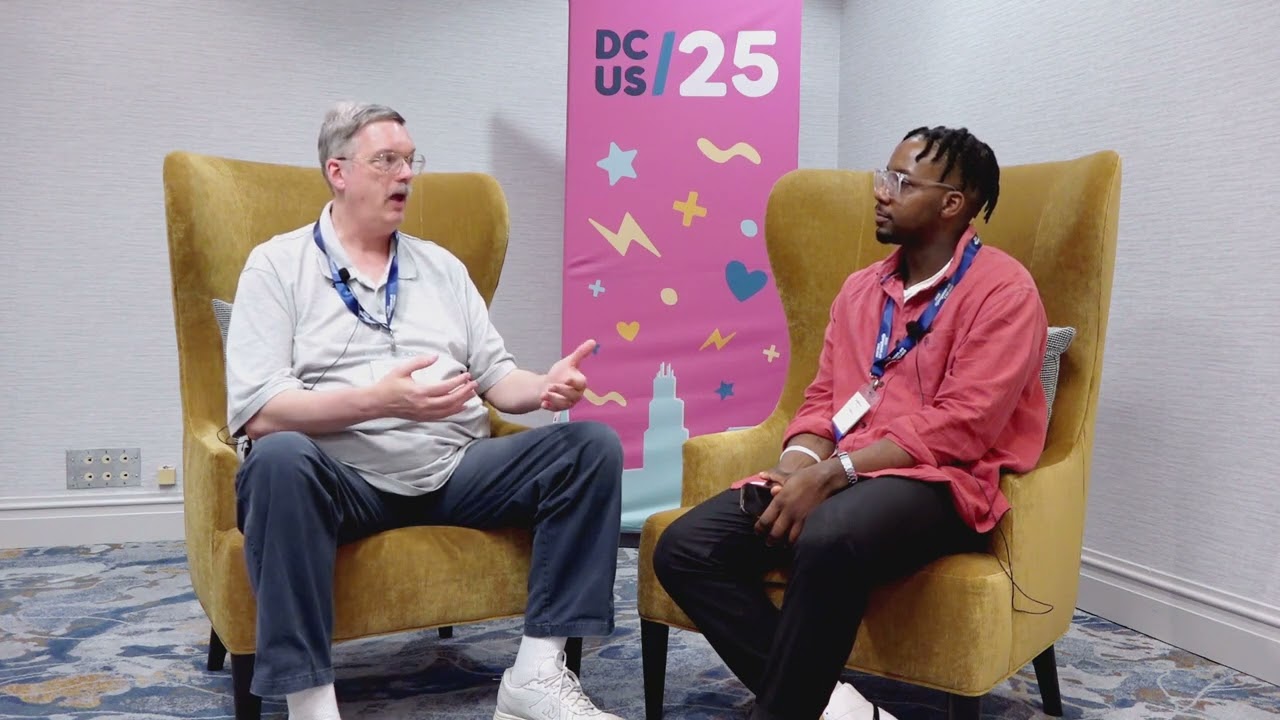
This video features Timothy Allen at DjangoCon US 2025 in Chicago, Illinois, USA.

This talk was presented at: https://2025.djangocon.us/talks/what-a-decade/
LINKS:
Follow Timothy Allen 👇
On Mastodon: https://fosstodon.org/@FlipperPA
Website: https://PyPhilly.org
Follow DjangoCon US 👇
https://fosstodon.org/@djangocon
https://x.com/djangocon
Follow DEFNA 👇
https://www.defna.org/
Video production by the presenter and DjangoCon US 2025 volunteers.
Timothy Allen reflects on a decade with Python and Django, beginning with Wharton’s careful but ultimately lucky decision to replace ColdFusion. He explains that Django’s value lies not only in its technical capabilities but in a community whose collaborative governance, commitment to inclusion, and willingness to support people aligned with his moral and ethical values. He describes how the Django and Python communities, his colleagues, and his recovery community supported him through alcoholism and sobriety, and argues that open-source communities built on human connection matter especially as companies promote AI hype, cut jobs, and surrender ethical principles. He closes by dedicating his words to his colleague and friend Lindsay Reese, whose recent death underscored the importance of community and mutual support.
Summarised automatically from the transcript.
Automatically transcribed, so expect mistakes in names and technical terms.
When I went to DjangoCon the first time in 2015, I was a volunteer and I ended up hosting it in our own city the next year, so watch out. Uh you never know what's coming next. So good afternoon. I mean what a great DjangoCon. I've seen so many awesome topics. Like Eric and I have been talking about deployment the whole time we've been here because I run a silly little package called Django SSH deployer that we might be able to integrate just The spirit I come here. I get so excited every year to come out here and spend time with my tribe. Like you are my people. And uh I also love Chicago. Just a little uh anecdote about Chicago. The first time I came here was just over 20 years ago for a friend of mine's wedding. And I got into town, got landed the airplane, and uh went to get the rental car, got up to the rental counter and they're like, we're sorry, Mr. Allen, we're out of Comcat
cars. And coming from Philadelphia, I'm like, oh damn, this is gonna be some kind of argument And the friendly guy was like, we'll just upgrade you to a luxury vehicle at no additional charge. I'm like, wow, that's so nice. Then we got to the hotel in this nice luxury vehicle. And we got up to the counter and they're like, oh, we're sorry, Mr. Allen, but the hotel block, all the rooms have sold out. I was like, oh damn. But again, we'll just upgrade you to the corner king-size suite. We hope that's acceptable So that was kind of nice. Then we decided to go out to explore the town a little bit. And my friend who was getting married, this was before cell phones were so prevalent. He had told me they were going somewhere that had an all-you-could eat bacon night at a bar. So we were walking around Chicago, like, do you know where the all-you-can-eat bacon night is? And everybody was like, no, I don't. But if you find out, let me know. So somebody finally said it might be up by Wrigley
and I always wanted to see Wrigley Field. So we went up by Wrigley and we never found the the the bacon bar. But what we did do we stopped for a drink at a local bar I started chatting to the nice person next to us and got him a drink and he said, Oh, it's your first time here. You're from Philly. He's like, wait a minute. So he walks out of the bar, comes back five minutes later. And it turns out he owns the ticket agency right like two doors down from Wrigley Field, and he gave me free tickets to Cubs Cardinals the day after the wedding. And that's not like Cubs Rockies or Cubs, you know, Tampa Rays or Cubs Marlins. That's like Eagles Cowboys big. That's like, you know, for you uh for you Premier League fans, that's like Chelsea Man City You know, that's not a cheap ticket. So I have always loved Chicago. What a first impression. So thank you all for being here.
I also wanted to take a quick moment to just say a huge thank you to the DjangoCon U. S. organizers in particular. The amount of volunteer work that goes into running one of my favorite weeks of the year is immense. Y'all are awesome. So I want to take my time today to reflect on how I got here and what Django has meant to me. As I look around at this room of friends old and new, I see many people who have been on a journey together Some have joined more recently and some have been here longer than me. I see people who are trying to be a better version of themselves every day. In short, I see the kind of people I want to spend time with. People who I look to for learning patterns And sometimes those patterns are for betting well, you know, writing better code. We hear about writing better code patterns all the time, but also
patterns for how to handle life. Patterns for how to make the world a better place. That's what I see in all of you here. So thank you for sticking it out to the better end, the bitter end here with the uh the final talk of the conference. And let's celebrate that spirit of community and I'll dive right in. So I'm Tim. A lot of you have met me. I started at Wharton 17 years ago when Wharton was a Cold Fusion and Microsoft SQL Server Shop. The Wharton Research Data Services Platform, that's the division of Wharton I work for, or Words as we call it, WRDS, everything's an acronym in colleges. Was being rebuilt to use ColdFusion and SQL Server for the website, which ran on a back end, get ready for this. It ran on Solaris Perl, MySQL, and SAS, the statistical language from North Carolina, not the CSS
transpiler, not software as a service like 1960s invented SAS. Like their epic is not 1970-0101. It's 1960-0101. That's how old SAS is. It was quite a stack, and you know, these days I'm now the principal engineer there, but we'll get more into the history of that tech shortly. I'm flipper PA pretty much everywhere online. You can find me on YouTube, Blue Sky, whatever you want. I'm also not sure if you're aware of this. But the Philadelphia Eagles are champions of the National Football League. This is a photo I took of Saquon Barkley throwing a beer during the parade a few feet from my front steps. You can see the upper right of the photo. What looks like a drone, that's actually a beer can.
So we're still pretty happy in Philly about all this. And you know, defeating the Cowboys last week to start the season, that was icing on the cake. and without our best defender, but we won't go into any of those details. But I'm not gonna talk about the Eagles for the next 40 minutes, as tempting as it would be to do that. Instead I'm gonna talk about another Philadelphia institution. The Wharton School. Wharton is the top business school in the world. In fact, I learned a practical test of rankings from one of our own faculty members. If you see a ranking of business schools and Wharton is number one, it is a good, reliable ranking. Otherwise, it clearly has used a questionable, questionable methodology But about a dozen years ago, the Wharton School had a problem we needed to solve.
As I mentioned, Wharton was in Adobe Cold Fusion shop. And it had treated us well for many years. Who here remembers cold fusion? Oh, a lot of people remember Cold Fusion. If you look at my shirt, I'm this old. There should probably be like an additional slot for Cold Fusion on here, like right next to the five and a quarter floppy inch disc, or I think there's an eight track on here somewhere Um but you know cold fusion was chosen before my day there. It was actually chosen back when it was made by a company called Alair, named after its founder. It was eventually sold to Macromedia, and Macromedia was eventually bought out by Adobe. And by 2012, it had become apparent that as other languages and frameworks were advancing, Cold Fusion was not. It felt like Adobe had been treating the product as sort of a money-making afterthought for a bunch of years.
It wasn't even featured on their homepage. In fact You couldn't even find a mention of it on the homepage if you did that like right-click view source and looked in the HTML and hit Control F and tried to find Cold Fusion. It was nowhere. So when the company that's supposedly supporting this product doesn't even have it listed on a homepage, I think that's what's known as sort of a hidden indicator that it might be time to looking to look to be moving to something new. So we had a significant amount of technical debt from not having adopted a more modern language and framework earlier. So it was clear by 2013 we had to find something new. We developed DevTap. The development technology assessment process, and we assembled a team of about 20 developers and project managers to assemble our strategic goals and governing principles.
We sent out surveys and held many conversations with our entire technology team. And we had a pretty big technology team. for, you know, a university school. We had over a hundred people to involve in this decision. And, you know, it's difficult to build a consensus for this type of decision given the complexity of weighing so many options and honestly so many opinions, my own included. So we broke down the decision-making process into logical areas that we that were assessed using performance indicators. So the primary strategic goal for the team was to ensure that the process Was usable for more than just this one decision. We wanted to be able to use it for like any technology in the future. So DevTab 's assessment framework was designed to be iterative. So our decisions could be visited and reassessed.
And you can see up here the five parts of that process. First we would survey all the people who were sort of involved, all the stakeholders. Then we would assess and reassess, analyze and compare the results. Then the leadership team would come together, recommend and approve a solution, and then we would plan and implement that solution. And then go back to the beginning after a couple of years to make sure we never fell into this trap of falling so far behind the curve again. So we built this system where we could survey various options for any technology. And in this case, as I mentioned, it was our new web framework and language of choice. That's what we wanted to pick. And we built a survey Of questions. Over 200. And we assessed PHP Encodeigniter, Ruby on Rails,
C sharp. net, Groovy on Grails. Python Django, and for a baseline, we actually tested our old solution, Cold Fusion. We asked about security. We had a bunch of qu we had questions about what kind of ORM support is there? What features are in the ORM? How many questions are there on Stack Overflow? What kind of CSV capability does it have? What kind of training resources does it have? What kind of long-term viability is there to this? How does it fit to our business needs? I mean we're business school, so let me tell you, we asked a lot of questions about Excel support. I don't know if you know how important Excel is to people at the Wharton School, but that was one of our top priorities, was making sure that it supported Excel and all one million rows of big data that that product can support.
We asked about its extensibility. We asked about support. We asked about cost. So we split into teams to do our research. And we answered all 200 questions for each potential solution. And we kept notes for some of the answers because some of them weren't so cut and dry, but we tried to keep it as objective as possible. We didn't want like a one to ten scale where it can get kind of out of whack how you know objective you are and different people have different ways of scoring that way. So to keep things objective, to that end, we came up with a score of zero, one, or two, depending on the equation. So most of the questions you could only answer 0 or 1, true or false. Does it support it or does it not support it? But in certain cases we would give a rating of 2 if it supported something really well, if it excelled. So for example In the case of Django, we would give something
in the if if there was a backend database support, for example, um Django does not support the Fox Pro database, so it would get zero. It does support Microsoft SQL Server through a third-party package. It now also supports MongoDB through a third-party package. Thank you, Mongo. That would get a one. Postgres and MySQL would get a two because it's included in core. So that's an example of the 0, 1, or 2 scoring we did. And all in all, it went pretty well for a new system we had just developed. The excitement around choosing a new language gave us all motivation, and the results we found were pretty interesting. So our instincts are were absolutely right. Our current solution had been surpassed by more modern frameworks. So you can see on this chart, cold fusion is the light blue on the inside of the web chart.
The lightest blue on the far inside. And the outermost octagon on this chart, on this web chart, would be a perfect score. So cold fusion did not perform well. On the other hand, the modern frameworks were all fairly equal. They had about the same feature set. You know, none really jumped out over the other as being particularly excellent. Or maybe they were all particularly excellent by this point. You know, they had basically the same feature set. And you can see up there that you know our internal expertise pool, C sharp. net, was a bit higher than Ruby on Rails, Groovy on Grails, or Python and Django. We had one of our departments that had used C sharp. net fairly extensively, so we did have some expertise in that. But uh, you know, Python and Django scored a little bit better on stability and viability.
But they were all clearly better options than cold fusion. And this left us in a little bit of a quagmire. So we did all our research here, but how do we choose which one to go with? So we decided that we were going to build the DevTap process itself as an application for three finalists from this list. So we had three advocates. One team had been sort of into Ruby on Rails and Groovy on Grails, and they decided to choose Groovy on Grails instead of Ruby on Rails. We had a team that really was into C sharp. net. And I know it will shock all of you deeply, but I was the Python Django evangelist and led the Python and Django. So we each had a team with an evangelist, and we wanted to see how far we could get on building this process, which we
sort of whipped together using duct tape, bubblegum, and Microsoft Excel. We wanted to see how far we could get in just two weeks. So it was interesting. It was a little bit of a struggle because You know, while we were decent engineers, we were still total noobs and trying to figure out um you know all the syntax and commands and what packages to use in these vast ecosystems was a little bit of a struggle. But we all got pretty far in two weeks and made some pretty good progress. And we presented each solution to the group after these two weeks that we had done in these three different platforms. But still, all three solutions were pretty compelling with no clear winner. So we ended up having an opening discussion. And like I said, I was the evangelist for Python Django, and yeah, I know, shocking, shocking.
Um, but I was absolutely sure that Python was ascendant. I made the case. That I said I would be shocked if Python wasn't the top language on the Tyobi index within the next decade. And some people openly laughed and said there's no way it's ever gonna knock Java off the top spot. And uh, you know, others just said I was crazy. Um, but I also pointed out that Python had started to gain significant adoption in academic circles, and we had seen this around campus. So, spoiler alert, Wharton ended up choosing Python and Django as our language framework of the future. And uh we were happy with our selection. We had asked so many questions. We had done our homework. Here we are a decade later, and we're still very happy with our choice. Python has ascended to become the most popular language in the world by many measures, including the Tai
Obi Index. And is used pretty much everywhere. So I was right. It positioned us for tr for the trends of the past decade, like sentiment analysis, machine learning, LLM integration, and yes, ugh, AI. So we are glad that we were so well positioned. And uh, you know, this must have all been because of the excellent job we did back then, right? Because we had all done all of our homework, because we had dotted every I and crossed every T. Because we had done all of the research necessary to make the perfect choice, right? Well, the truth is The truth is, we got lucky.
We had asked 200 questions about the technology. What databases does it support? How does it handle CSVs? How does it handle Microsoft Excel? Et cetera, et cetera, et cetera. The only questions we asked about the community were how active it was on Stack Overflow, and I don't know if that even counts. We didn't ask any questions about whether the people around the framework support human rights. We asked no questions about government, whether it was driven by a corporate entity in their interests, an individual, or a nonprofit. We did not concern ourselves with whether the technologies com the technology communities around these frameworks, whether their moral and ethical code aligned with ours. We asked no questions about how decisions were made.
For example, many frameworks are driven by a singular leader, a singular charismatic leader making decisions. And Django instead operates with more of a group consensus model. But we asked no questions about this. We got lucky. We got lucky because we ended up in a community that aligned with us morally and ethically. We got lucky because we met a plethora of people willing to help us. We got lucky because of all of you. This started to crystallize for me when Adrian Holavadi and Jacob Kaplan Moss, two of the initial four creators of Django, willingly stepped down from the internal, from the informal BDFL title that had been bestowed on them. It further crystallized when we saw a pull request a couple months later, changing language throughout the documentation to remove problematic terminology, switching instead to use
terms like primary and replica. I was amazed when I attended my first DjangoCon US in 2015. And the president of the Django Software Foundation, Russell Keith McGee, gave an incredibly heartfelt and brave talk about his personal battles with depression. It was underlined when we when Wharton hosted DjangoCon in 2016. And I got to see up close that this community walks the walk when it comes to diversity, equity, and inclusion. And yes, I will continue to say those words loudly and proudly. It was reinforced it was reinforced over the years as I have seen further talks about mental health at this conference. I've seen sponsorship money used to bring friends from faraway places to share their experience, strength, and hope with us instead of spending them on open bars like so many conferences do.
So let's revisit our timeline for a moment. In 2013, we created the DevTap process and had over 100 staff members involved in research, data collection, surveying, analysis, discussion, and the decision. This repeatable approach for measuring both existing and new technologies gave us the ability to deliver solutions that meet the mission of all Warden departments, no matter how diverse. Technologies in this context were scoped to the languages and web frameworks, but this apparatus could be applied to any technology. One place we haven't kept to the original vision is the reassessment. Realistically, people get busy and momentum shifts to other projects. Despite this, the time investment and intentionality we demonstrated made this project a success. Python and Django were our winners.
Now we needed to implement. The one thing we would do though differently next time, that number of questions we asked, I think well over 50% of them would be about the quality of the community. and about the governance. Because if we had asked those questions, Python and Django would have, you know, won hands down with no doubt about it. This community is so morally and ethically aligned with ours, it would have been a no-brainer instead of sort of a toss-up. In 2014, a colleague and I led the implementation team, and we started to see how lucky we had really gotten. We reached out to well-known community members such as Audrey Roy and Daniel Greenfeld, authors of Two Scoops of Django, and they were friendly. supportive and happy to help. They referred us to Frank Wiles for training, who taught several Django 101 sessions at Wharton.
As part of this effort, we developed our first Django app, a shoutouts app. This allowed Wharton's staff to send gratitude to one another through almost like Twitter-like handles back and forth, and it's still used occasionally today. So it's pretty cool to see that a decade later, what a decade! That's the title, our first app in production is still being used. In 2015, when the Shoutouts app went live, a crew of us attended PyCon 2015 in Montreal. Little did I know how much my life was about to change, and how an amazing community I had just joined would support me. We road tripped in a minivan from Philadelphia to Montreal for PyCon
2015. And several Python friends we'd made had become fans of the legendary Philly restaurant, Han Dynasty. So we actually coordinated with a friend at the restaurant and brought a full Han Dynasty meal with us to prepare a hotel room to sort of bribe the Django community into letting us host DjangoCon 2016. Now I'm not sure if this was entirely legal taking that kind of food over the Canadian border. I'm also not sure if it was entirely up to the rules to have a heating pad in the hotel room and cook a full like Sichuan meal. But I've also learned in my career, sometimes it's best to, you know, beg for forgiveness rather than ask for permission. So we went with it, and it kind of worked, and the meal was good. But uh, you know, we went to amazing tutorials and talks and met some wonderful people, and we were having a great time.
But I've been fighting a personal battle for years. My alcoholism had been progressing steadily since I was in college. I used to try to take a month off from drinking every year after the Philadelphia Flyers, our local hockey team, were eliminated from playing And uh I never made it the full month in my entire life. During the weekend of PyCon, the Flyer season had ended. You know, over that course of that week, you know, they didn't make the playoffs that year and they were eliminated And on April 11th, 2015, PyCon was wrapping up, and we were having drinks at the hotel bar across from the Palais de Congrès in Montreal where PyCon was being held. And little did I know it, but Frank Wiles bought me my last drink ever there. It was a moles in ice.
Now I've heard of hitting bottom as an alcoholic, but I always thought it involved like a police car chase or an explosion or something like that. But I guess having a mole in ice That that's kind of a bottom. So my last drink cover was a molson heis. On Sunday, April 12th, before we drove back to Philadelphia, we saw Jacob Kaplan Moss's amazing keynote, The Talent Myth. In it, Jacob spoke about how most folks think he has more to do with Django's creation than he actually did, and noted that it was Adrian and Simon Willison. who were the first two really working on the project. And during the talk, he challenged the assertion that rock star developers define and drive this industry.
The part that has been permanently imprinted on me was his challenge to the white males of privilege in the room to do better. A conversation he had had with Lynn Root inspired the talk. Root is a programmer and longtime Python community member. And also founded the San Francisco chapter of Pie Ladies. And Jacob had commented to her, it's great to see all these badass women programmers. And while Root agreed, she noticed, she noted that, well no, we've truly been successful when there are a bunch of average women programmers. For a long time, the person who'd been looking back at me in the mirror every morning was drifting farther from the ideal of who I thought I should be. I was compromising my moral code to feed my addiction to alcohol.
Well, I'm not saying Jacob's talk got me sober. It was part of an amazing confluence of events that forever changed my life. The fact that this community makes space for that kind of real honesty, that difficult conversation, that life-changing possibility is incredible. And we are all a part of it We drove back after Jacob's keynote from Montreal to Philadelphia. I had no idea it was my first day sober, and I had no idea what was coming next. I got home that night and went to bed and noted that my wife was not acting very happy to see me after a week away. And uh I didn't have to wait long to find out why. The next morning As I was getting up and getting ready to go into work for the first time in a while, my wife told me to come downstairs.
To my shock, my family was there to stage an intervention. They knew about my silly attempts to stop drinking after the flyer season ended, and they had decided it was time to make it permanent. And while I was away, they had arranged for me to go to rehab. After initial hesitation, I realized that my way wasn't working anymore. I'd resisted help for years despite, you know, hidden indicator after hidden indicator, like drinking molten ice. I did something different this time and accepted the help that was being offered to me. I had to call my manager Charles, and the phone felt like it weighed 1,000 pounds. And, you know, while Charles is the most honest, no nonsense boss I've ever had, I was still worried he'd be angry that I was doing this after a week away at a conference.
But his reply is something I'll never forget. He just said, Tim, do what you need to do to get better. We've got it covered. And since that day, my team at work has been incredibly supportive of my recovery. We're an incredibly typed team at Wharton, and I can't say enough about my colleagues and their support over this past decade. I went to rehab for 28 days, and when I got out I chose to be open that I was now on recovery. I was well known for being the life of the party at both work and already with the Python friends I'd made, so I had to be open that I was being intentional and no longer drinking. My first DjangoCon US was 2015 in Austin. It was my first conference sober, and my first time away from home since rehab. I signed up as a volunteer to help out at my first Django Con.
The community was so incredibly supportive. I had several friends from the Python community, as I've mentioned, but I made many, many, many more. I met Tom Dyson from Torchbox for the first time, which would eventually lead to me becoming part of the Wagtail Core team. I met people like Lacey and Kojo, who continue to be pillars of the community. The conference had a diversity chair, Anna Asalski, who assured me that people in recovery are part of the diversity initiatives and openly welcomed at the conference. And You know, DSF President Russell Keith McGee giving that closing talk of the conference about his struggles with mental health, I was really blown away by his honesty and the way he shared his experience, strength, hope, and privilege In such a vulnerable way. This was somebody who was the most accomplished people in the history of Django, serving as president of the Django Software Foundation, more
commits than almost anybody, part of key features, who was getting so vulnerable. To give us all space to be able to be that vulnerable, to be that honest, to reach out for help if we need it, to not be embarrassed if we need help with depression or alcoholism or whatever problem you might be facing. You know, we all have these things we all need to do. We all have that deep-rooted fear that nobody could possibly love us if they ever got to know us. And that is one of the worst kept secrets in the world. It's just the truth. We all had these thoughts. So after that, you know, I started to be feel really invigorated by my recovery. I started to feel like myself again. with a lot of help from my recovery community, my colleagues in my work community, and my Python Django community, which had embraced me with open arms
I wrote a proposal to host DjangoCon US 2016 at Wharton, and we did. It was an amazing experience. We listed local recovery meetings on the DjangoCon website for attendees to access easily. and to help fight the stigma of addiction. It gave me the courage to give a talk about alcoholism in tech and share my personal journey. Tech folks have been in such high demand for so long that a lot of bad behavior has been let go for so many years. And this was the case with me I can't repeat it enough. I've had amazing people in my life the past decade. The Python Django community, my recovery community, and my colleagues at Penn, Wharton, and especially my crew at Wharton Research Data Services. Which is why I wanted to take a moment to talk about AI.
I gave a talk here two years ago where I implored people not to buy into the biggest tech hypewave I'd ever seen. The theme of the talk was not me hating on AI. I designed my own major in college and written my senior thesis in 1996. On neural nets and emerging algorithms, which could lead to AI. I studied ELISA and I immersed myself in John Searle's Minds, Brains, and Science and his Chinese Room Argument. My central message of that talk was that the absurd hype around AI only served to make some tech bros richer. while actively preventing us from finding how these amazing technological advances and algorithms could be used to improve the human condition. AI is a marketing term, it is not a technical term.
A huge percentage of the stock market's current value is currently backed by nothing but hype. This has created a major risk of recession. The headlines have started to enter the trough of disillusionment of the Gartner hype cycle. As I've become a more and more senior software engineer throughout my career, eventually becoming the first principal engineer at Wharton and Penn, You know what I find? I find that with each step of me getting more senior, I press the buttons in my coding IDE less and less. I found that my pull requests often delete more code than they add. This is contrary to what LLM code generators do. Do LLM coding assistants help? Absolutely.
But studies are already making it clear that LLM generated code adds more technical debt. And while they have been shown to be eliminating junior pro junior programmer roles, where do you think senior programmers and principal engineers come from? Eliminating junior engineering roles is like cutting off your nose to spite your face. It's just so dumb. By the way, this is a new ChatGPT 5. 1 I really liked. How many strawberries are there in the word R? The letter R has three strawberries. Way to go. Glad we're making so much progress Speaking of eliminating roles, a lot of the reason for this hype overvaluation is the idea that AI will make a lot of jobs redundant.
It just feels really gross to see market gurros like downright gleeful about people losing jobs. But here we are. Mark Benioff, CEO of Salesforce, recently claimed of one of his teams. I've reduced it from a 9,000 headcount to about 5,000 because I need less heads, ostensibly because of AI He then went on to call the first eight months of twenty twenty five, during which he claims ten thousand of his employees had been lost to AI, eight of the most exciting months of my career. That felt a bit heartless to me. But let's dig a little deeper into this. During the COVID-19 pandemic, I commented to many people that big tech was hiring stupid. It was like, you know, trust me as an alcoholic, I can recognize somebody on a bender.
Big tech was on a hiring bender. It was absurd. He previously admitted that they had hired too many people. So let's look at the numbers. By the end of 2022, Salesforce had 30% more employees than they did in 2021. Over 70,000. That means they hired over 20,000 people in just over a year. 20 ,000 in one year. Around this time, Salesforce also noticed these employees were less productive. How shocking! When you go on a reckless hiring bench like this, proper vetting of candidates goes out the window. And there's no way you can onboard and integrate that many people at that pace. So I ask, what is more likely?
Is AI actually replacing these people? Or is a CEO covering for a bad policy, a reckless hiring binge, while simultaneously getting the benefit of boosting his stock price? There's no doubt the job market is rough right now. My sympathies to those struggling to find work. While AI may be destroying the open web. I believe this brutal job market has a lot to do with other forces in the world than waving some magic AI wand automating half the workforce overnight. The problem runs so deep. Just last week, the CEOs of the most powerful tech companies in the world came to the White House to pledge fealty. It was bad enough a few years back when the president's cabinet were falling all over themselves to fawn over the president in a dear leader scene of unabashed praise.
One by one, he went to each tech exec, prompting them to shower him with praise of his presidency as if he were Kim Jong-un. This is not normal. This is not democratic. Mark Zuckerberg of Meta, Bill Gates, the founder of Microsoft, Tim Cook of Apple, CEO of Microsoft, Sadia Nadella. Sundar Pinchai of Google and OpenAI Sam Altman, all pandering to the president and praising his AI policy About a third of the value of stock market. Most of the so-called Magnificent Seven were here giving up any kind of morals for money. Oracle CEO Saffra Katz may have taken the top prize for Psychophant Flunky saying, listen to this, you've unleashed American innovation and creativity. All the work you're doing in basically every cabinet post, in addition to what's coming out of the White House, is making it possible for America to win.
I think this is the most exciting time in America ever. Wow. Bill Gates, who was seated next to First Lady Melania Trump, thanked the president for setting the tones such that we could make a major investment in the United States and have some key manufacturing. Advanced manufacturing here. While this chart shows the reality of the manufacturing sector losing 42,000 jobs since April. Trump said at one point, get ready for this , it's an honor to be here with this group of people. They're leading a revolution in business and in genius and every other word. All right. Sorry, I I won't torment you anymore.
We are gonna need open source communities of good people. Communities like ours, where we don't agree on everything, but I think we can all agree to stand up to this nonsense. A line from Babylon 5, my favorite work of fiction, seems appropriate. And I quote: I've learned the hard way that governments deal in matters of convenience, not conscience. If they fall behind, it is up to the rest of us to make up the difference. If we don't, who will? The big tech companies relinquished any moral high ground, committing the biggest intellectual property theft in history with no regard to copyright or consent, pushing AI to pump up their stock prices. But they can never replace what we have here. This amazing community of wonderful, supportive people, the Python and Django communities
They keep trying to say they'll replace all of us. Anthropic CEO Dario Amadi claimed in March that ninety percent of all code would be written by AI by now. That was in March, and he said six months. How's that going, Dario? But our friend Ken Whitesell might have explained best why this will never be the case. And I quote from Ken's recent blog post reflecting on his career. I've written code throughout the years. A lot of code, but not what I would consider a huge amount. I've spent more time solving problems, usually needing a creative solution, than just cranking out lines of code Many of my roles involved designing solutions for others to implement rather than coding them myself, or not doing anything more than producing a proof of concept
that someone else would turn into a real production system. I've never met somebody who does nothing but code. I'd love to study how many hours a week software engineers at different levels actually spend pressing the buttons in the IDE. Because uh, you know, I'm sure it's not 40 hours. I've told those above me in management that the most value they get from me is not Monday through Friday, 9 to 5. The most value they get from me is one, when I am asleep, and two, when I am in the shower. Sorry for the mental image. That's where the solutions to the capital H hard problems come to me. I'll often wake up in the morning with a solution to a problem I've been thinking about for days
just there. Who can relate to that? Anyone? Uh-huh. Or maybe a new approach to a tricky bug comes to me in a shower or when I'm on a walk. Because we're not just code monkeys. We're problem solvers. We're engineers. We cannot be automated. The problems we solve, the solutions we engineer with our mind, and expressed in code have a piece of our soul imprinted on them. I had gotten this far into my talk a few days ago. And my original intention was to wrap up with a further optimistic message about how amazing our community is. And it really is. This is the original text I had written in my talk proposal years ago, which you can read on the conference website from the schedule in full.
I was going to talk about how Django is many things. A community first, an ecosystem, an ecosystem second, and a darn good web framework third. I was going to talk about how I'm incredibly lucky to be part of some incredible communities made up of some of my favorite people, my recovery community. My Python and Django and Wagtail community, and there's so much overlap in all of it, and my work family. Like the the Venn diagram of these wonderful communities overlap, and I'm so lucky to have all of you in my life. It was my intention to focus sort of on that tech side of the community, but that changed last Friday. This is my friend Lindsay Reese. Lindsay passed away last Friday.
She worked with us at Warden Research Data Services, and we're all pretty distraught at her passing. I mentioned in the original proposal how incredible my colleagues at Warden are. Anyone who knows me knows I frequently promote Warden as an ideal place to work. I'm basically a recruiter. I brought DjangoCon US to Wharton, and we have hired many members and agencies from the Django community to work with and at Warden. Whurten and Python and Django are both amazing communities, and like I said, we were so lucky in picking Python and Django as our morals and our ethics align beautifully. Seeing my colleagues come together to support one another during this difficult time has been so amazingly heartwarming and inspiring. And our friends from the Django community have been incredibly supportive as well.
I can't thank you enough. Lindsay was more than just a friend to me. She was part of my work family. She could sell data to anyone. She was a vibrant spirit, and she wasn't afraid to speak truth to power. Her dad told an amazing story to me She met Mark Zuckerberg in like 2006-2007 soon after Facebook had started. And she told him he was an idiot because MySpace was awesome and it was gonna win So I am dedicating this talk to my friend Lindsay because she was amazing. No one who met her could ever forget her, and our work family at Wharton Research Data Services is severely diminished having lost her. We're all hurting deeply. But this difficult time we are experiencing emphasizes my point about the importance of community.
Lindsay's family knew how much we cared about her. They reached out to us when no one had heard from her in a few days, and we are now mourning together with them. I've shared over and over during this talk how lucky I am to have these communities of people in my life. I want to underline here to all of you that you are part of one of those amazing communities. And if anybody watching this, either here live, online, or in the future, need to hear this, you matter. You are valued and you have a community here who's willing to help. I'm living proof of that. If you're struggling with a difficulty in life, whether it's addiction, depression, or something else, We're willing to listen. We're willing to have those difficult conversations in this community. We're willing to help.
I am willing to help. Please reach out. There really is hope. It is likely I wouldn't be alive here today talking to you if it weren't for these communities in my life. I truly believe that. We miss Lindsay deeply, and we are and will continue to lean on one another for support during this difficult time. Over the years, I've done some pretty cool things with Django. I've added Excel support to the Django REST framework. I've joined the Wagtail core team. I created the it worked rocket ship that you see when you first do a new project. But all of those pale in comparison to the really important moments. Those precious moments when a fellow Django Not or Pythonista has reached out for help with their own addictions or depression.
Several of those people who've reached out to me over the years are now in recovery. We started a nonprofit for the technology we've developed for recovery fellowships across the world called Code for Recovery. One of those people who asked for help is now taking the open source technology we made for OneFellowship and using it for Cocaine Anonymous. It is amazing to see how this community can help make the world a better place. My life has changed because of this community. I'm now engaged to be married and become a stepdad to an amazing kiddo, in part because of the Django community. I developed a crush on this wonderful woman and she lived in Durham. We then saw an application come in for DjangoCon to be hosted in Durham and without much prodding or even being asked, I was like, I'll go to Durham!
I might have had a slight ulterior motive. But that was the first weekend that I got together with the woman who's now my fiance and uh got to hang out with the kiddo who's now gonna be my stepdaughter. These are the kind of changes like communities like this can make. Django has been such an amazingly positive, positive part of my life. It uh it makes you know waking up in the morning worthwhile thinking of all of you. You know, the week of DjangoCon is one of the highlights of my year every year. That's why I thank the organizers at the beginning every time because it's an immense task to put one of these together, but You know, how often do we get to hang out with really good people that you know you know you can trust and strike up a conversation with anybody that aren't afraid to have the real conversations? It's a rare and special space we have here.
It's a really rare and special space and a special thing. And I hope all of you feel what I feel and feel comfortable to express yourself how you need to express yourself here. Because uh you know every voice here enriches us. So I will wrap up by saying this. Never forget there is always hope, even for people like us. Kenya opened up this conference saying DjangoCon US is more than just code. It is about creating a space where everybody feels included and valued. It's about creating the kind of world we want to live in. As we bring this conference to a close, my heart is warm knowing that we continue to embody those words. And thanks to all of you for being a part of it. Thanks.
Wharton created the Development Technology Assessment (DevTap) process: it surveyed stakeholders, compared candidates against more than 200 questions, built three finalist implementations, and then selected a solution through discussion and leadership approval.
Discussed at 7:15Python and Django were among the modern frameworks that outperformed ColdFusion, and Wharton’s Django prototype was compelling. The team also saw Python gaining momentum in academia and believed it offered strong stability and long-term viability.
Discussed at 13:31The assessment focused heavily on technical capabilities and barely examined community ethics, governance, or decision-making. In retrospect, more than half of the questions should have concerned the quality and values of the community; Django would have won decisively on those criteria.
Discussed at 18:24The community made space for honest conversations about addiction and mental health, welcomed people in recovery, and supported Allen as he attended conferences sober. Its openness and encouragement helped him feel accepted alongside support from his workplace and recovery community.
Discussed at 23:23AI coding assistants can be useful, but Allen argues that they also add technical debt and cannot replace the creative problem-solving, system design, and engineering judgment that experienced developers provide. Software engineers do much more than type code into an editor.
Discussed at 35:26He says engineers spend much of their time solving difficult problems, designing systems, and developing ideas away from the keyboard, rather than merely producing lines of code. That human problem-solving and creativity cannot be automated simply by generating code.
Discussed at 35:51Note: We understand that names change, people change, and bodies change. We respect each individual's journey and privacy. If you have any concerns about a video or need us to remove content, please don't hesitate to contact us. We will handle your request with care and promptly address any issues.
Published July 15, 2026

Published July 15, 2026

Published July 15, 2026
Published July 15, 2026
Published July 15, 2026
Published July 14, 2026