0:22:41
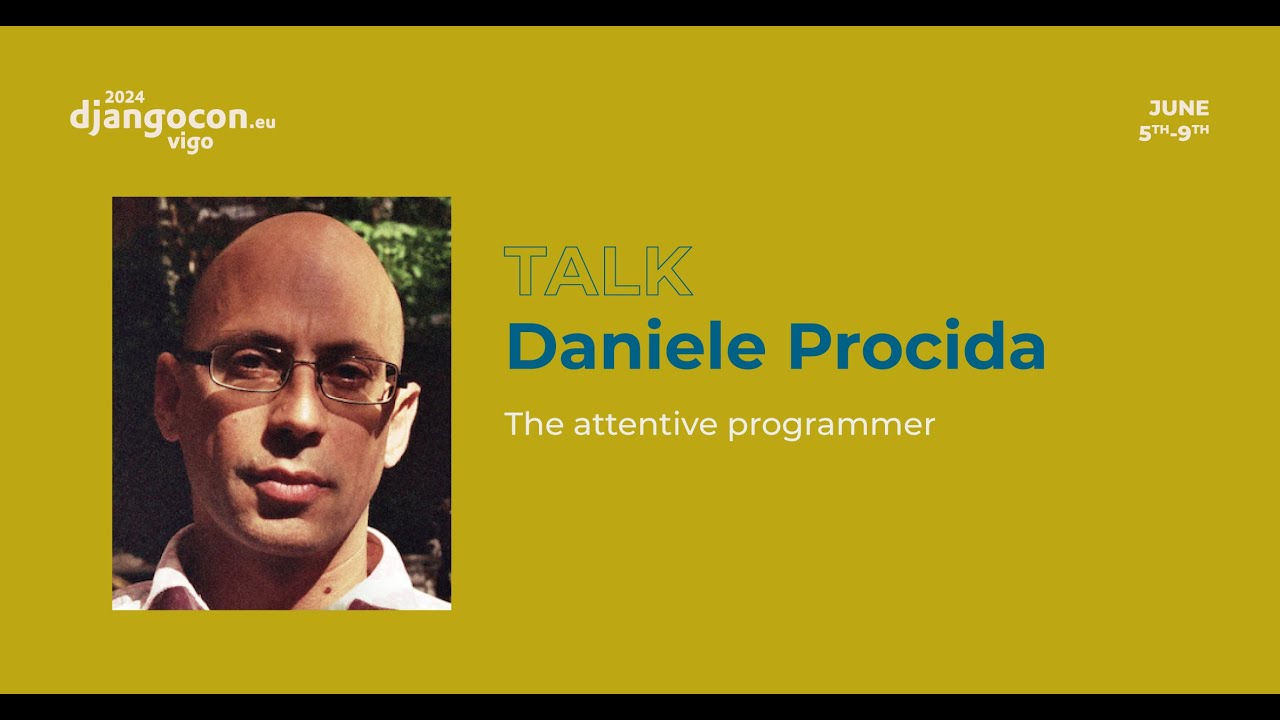
The attentive programmer
Published July 11, 2024
This video features Daniele Procida at DjangoCon US 2023 in Durham, North Carolina, USA.

As creators of software, we're repeatedly told that we're not merely imagining the future of the world, but bringing it into being. Let's suppose that's true. What, exactly, are we imagining?
This talk was presented at: https://2023.djangocon.us/talks/the-programmer-s-imagination/
LINKS:
Follow Daniele Procida 👇
Follow DjangCon US 👇
https://fosstodon.org/@djangocon
https://twitter.com/djangocon
Follow DEFNA 👇
https://www.defna.org/
Video production by the presenter and DjangoCon US 2023 volunteers.
Daniele Procida argues that imagination is never passive or neutral: it shapes how we understand technology, history, intelligence, and our place in the world, then influences what we build and do. Using dinosaur art, visions of the computer future, early creative-computing culture, and ELIZA, he shows how scientific ideas and cultural assumptions—including prejudice—become embedded in images and software. He urges programmers to examine their own assumptions, distinguish the appearance of intelligence from intelligence itself, and recover a humanist view of computing grounded in creativity, pleasure, and joy rather than productivity or the reduction of humans to software.
Summarised automatically from the transcript.
Automatically transcribed, so expect mistakes in names and technical terms.
Um
Speaker 1: hi everyone, um thank you very much. But thank you especially to the organizers, the volunteer organizers of this Django Con. a good feeling to be here and to be in this environment. So really thank you very much. I know how much work they've done, so thank you. So nice. So I'm Daniele. Um I'm a director of engineering at Canonical. That's me. That's what I look like on television. And if you can read it, there's there's some of my life story. But what I will do is um
Speaker 1: give you a QR code so you can just find a page with all that stuff on my website so you don't need it. And um I work at Canonical. By the way, I'm hiring for all kinds of roles, but especially in roles related to things like documentation and developer relations and community. Please come and talk to me about that. I've been involved in Python and Django communities for all the pretty much all the time that I've been in software. I was a Django core developer when that was a thing. I'm been involved in organizing events and especially involved in the African Python
Speaker 1: community, the African Python movement. So I'm one of the organizers of the forthcoming Django Khan Africa that several people have mentioned already, and there are several of the fellow organizers and attendees here in the audience. So I know many people here have also supported that event in different ways. So thank you very much. for um for that. That's going to be in November. Come and talk to us if there's anything you'd like to know about Jangokon Africa because we'll have plenty to say about that I don't think you need to know anything else about me right now. So let's get on with this. So you you've probably seen this. The
Speaker 1: install worked successfully. Um congratulations. So What is it telling us? Well, okay, it's telling us that we've successfully launched Django, but it also tells us that in the world of Django, um success is like a successful rocket launch. And somebody, I don't know who it was, imagine this for some reason. Even if it was a bit of whimsy, it was a Choice that they made. And in this vision, success means to leave the Earth behind. I don't know why, maybe they're explorers going to explore another planet, or maybe they're escaping a dying planet. Or
Speaker 1: maybe there are billionaire space tourists who've got a bit frightened of going on holidays in collapsible submarines for a while. And they're wanting to do something else. And but why why a rocket? You know, maybe Django is more like a clockwork or an orchestra or a city. There are other things that work successfully, not just uh rockets. But the thing is that somebody thought of this and I think thousands or hundreds of thousands of people have seen this and I guess accepted it, and probably some of them think about Django in a certain way because of this, because of this imagination. And um this particular image doesn't maybe matter too much, but I'm interested in what the imagination does to us and for us.
Speaker 1: So dinosaurs lived until about 66 million years ago. But they're alive now in our imaginations. And it's in the imagination that dinosaurs belong to us. And I acquired acquired my dinosaurs when I read that book as a small child. Brontosaurus the best because it seemed very peaceable. And it was quite a striking book for a small child to read. You know, i I don't know if you could read it It says in the beginning nothing lived on the land or in the sea. And it's like you know the the Bible that in the beginning the earth was formless and empty and darkness was over the surface of the deep And you look at that picture, if you can see it, is
Speaker 1: with um the bleak cliffs and the lightning, it's lashed by the sea, there's fire in the sky, and the the whole Uh dinosaurs uh is are a quite a confrontation with ideas for a small child A child is being invited to consider something that was a time long before them or anything they know n existed. And which is now gone. And the dinosaurs, however awesome in every true sense of that word, were, they are also gone. So it's also an intimation of the end of things. That things that seem like they might have lasted forever will come to an end. That their own time will come to an end.
Speaker 1: Um our own civilization, our own species might come to an end. So it's like eschatology for small children And I still now remember the kind of feelings that were provoked in me by encountering that. And the pictures and visions are very vivid to me still. They were formative. They helped form the world that I'm in. And it means that, oh by the way, that's I I live in Wales in the UK. uh Dracoraptor honey ghani it's a Welsh dinosaur. I think it's might be our only Welsh dinosaur. But it's feathered. And that bothers me because in my imagination of the dinosaurs they are not feathered Because I'm old enough that
Speaker 1: I grew up before dinosaurs had feathers, if you understand what I mean. So I'm not really keen on dinosaurs having feathers I I know it's not reasonable, but the imagination is not always reasonable. So dinosaurs forcefully occupy Quite a space in our imagination. Uh con conceptually, because of all the things I mentioned, how big they were, how long ago it was, the fact that they're all gone. because they're such powerful ideas, but also visually because of the paleo art that depicts them. And paleo art is this fascinating encounter between art and science. So dinosaurs, they are creatures of the imagination.
Speaker 1: And they're delivered to us by paleo artists. And there's this cycle of scientific and visual imagination that feed into each other. And artists and scientists Respond to each other in discovery and creation. And paleo art um moves with the scientific times. So in the early days, lizards were the uh inspiration. This is um 1838 you can see Iguanodon down there on on the um uh bank of the river with an incorrect horn. And then in uh this is Samuel Goodrich's Iguana Don, which is now this big lumbering beast and still with the incorrect.
Speaker 1: horn. But later reconstructions put iguanodon on two legs with its heavy tail as a support. And that became the classic image of iguanodon for The a century nearly. And it's acquired its famous thumb spike, it's moved from its nose to its um uh thumb But now, in the 21st century, Iguanodon is agile and alert. It's nimble, it's versatile, it's a creature that can shift from two legs to four at will. And it's looking down on us. We are the ones who are being judged and considered. And the shift of iguanodon is not just about new scientific understanding. It's also about a shift in how we see our own place
Speaker 1: in the universe and our place relative to other things. So paleo art moves with the cultural times as well as with the scientific times. So this is a pretty reasonable way to see things that The visual imagination is moved forwards and onwards by the scientific knowledge and that and then that both of them help to inform the cultural understanding. So that's really reasonable and completely wrong because the reality is more like this, that one feeds into the other and the imagin the work of the imagination informs and influences Everything that's tangled up together because the imagination is never passive and it's never neutral
Speaker 1: So in the 18th and 19th centuries, our idea of when the world started grew more and more distant from a matter of thousands of years. to many thousands of years, to many millions of years. So this wide and frightening gulf opened opened up And naturally the imagination stepped in to fill it, and it filled it with fan, as you can see, with often with fantastical violence. You know, this is animal geological uh violence. The earth itself is exploding. There's always fire in the sky in these, well not always, but there's often fire in the sky in in these images. It's an ancient world full of
Speaker 1: Terrifying chaos and savagery. And the implication is that this is a primordial world, it's before the laws of man, even before the laws of God. And you'll f often find biblical titles On these depictions on these images. This is from the 19th century. This is a classic image and it It's two giants of the ocean battling it out with each other. Now in the nineteenth century, which um politically it was defined by naval battles between warring superpowers of the age um this would have had would have had a lot of resonance. So
Speaker 1: the thoughts and anxieties of the time are always being expressed through this kind of uh or through the paleo art. And sometimes what's imagined is contrary to the culture of the time. So this is from this is Soviet-era paleo art. And in it there's a tendency to the narrative, to the impressionistic, the folkloric, even the individualistic. It's completely at variance with the official socialist realism that was prescribed But because this was art by scientists, it was a allowed liberties that other artists weren't allowed to have.
Speaker 1: I I love this. It looks like a scene from a Western or something like that. You know, no Um artists outside this field would have been able to get away with that kind of thing back then, 19 um 53. And the anxieties of our modern age also show up. So here a couple of um you know scrawny and desperate beasts fighting for survival in a in a dust bowl. In a world that's got no more resources left to offer, that's basically us in a few years' time if we're not careful, or even maybe it's too late, who knows. And it's not just about dinosaurs. So this is in the American Museum of Natural History in New York, and it's supposedly depicting Neanderthals, who are to be understood as
Speaker 1: a kind of pre-human race, a primitive inferior, failed race. And it depicts them deliberately and explicitly using exaggerated racial features. So they're depictions of indigenous peoples, present-day human beings, as stand-ins for pre-humans on the basis of their race. And again and again the scientific imagination delivers to us this vision of evolution, is this progress that moves from low to high, from um uh animal to man, from dark skin to light, and it always finds its highest point in the figure of the white male.
Speaker 1: So paleo art is is not neutral and the imagination is not neutral and it's not passive. And we have to imagine not just the past but our future as well. And um I encountered dinosaurs when I was a smaller child, but some years later um I encountered our imagined um computer world future. Here's a record about it. I don't know if anybody knows this. Craftworks 1981 album Computer World. I I love the cover because it's they got it right. How in the future are we going to see things on a computer screen?
Speaker 1: And the songs on this record um They're in a discourse on this imagined future world. By the way, uh, you know, I'm an old man now, but how many people know this record, are familiar with it? Okay, well I mean good company so we old men should stick together. Um And it's this notion that we were about to enter a new world, a computer world. And it was a really strong Notion and computer world can mean quite different things. It could be referring to the logical world that exists within computers or our world as it's going to be defined by uh computers or how we represent our world in computers
Speaker 1: or computers in our world. These are all four different things that we deal with. And in different ways, the songs on this record are meditations on those themes. And they wonder what this world is going to mean for us. And some of those, some of that wondering is optimistic and some of it is not. A couple of the songs on here, there's Pocket Calculator and It's More Fun to Compute, express a kind of delight in the idea, a delight in technology that I think many programmers share. And at the time, we're talking about the early 1980s, there was also a strong visual imagination of this future. Computer world. So there's a real challenge for the visual imagination to depict what happens inside
Speaker 1: that logical world of the computer. So it's often depicted as a kind of um landscape or three-dimensional space or um Some kind of formalized arrangement. Well, space, I don't have another word for it. And when I'm thinking For example, thinking my way through a program through through code, I represent it to myself often. in those kinds of visual terms. And I don't actually know, I've got no way of knowing whether I do that because of this imagination or That's how it was going to be anyway, and that's what that
Speaker 1: happens to depict. I don't know which way the influence went And oh, it's funny. Oh, it's taking a while to look. There we are. Um sometimes the attempt to depict the logical world inside computers reaches for geometric or mathematical patterns. These are from the US magazine Byte. And here's the world in computers. You can see the world represent uh again, the world the outside world represent represented on a computer screen that's inside. So it's inside the computer but it's also outside. Or on the right hand side the idea that we are in a world somehow defined by
Speaker 1: or made by computers Some of my favorite examples are of computers in the world. There's the computer in front of the church organ, and it's not completely clear to me whether the computer is The instrument or playing the instrument. I think I'm I'm not sure, maybe it's deliberately ambiguous. Or what we will do with computers, I don't know if you can read that clearly. It says the um uh the What is it, the holographic museum of ancient technology? And he's holding a, I think it's a a basic manual or something in his hand. It's um Captain Kirk. Here's a really powerful statement. This is from
Speaker 1: uh 1983. It's a world again uh a world represented on a computer screen and uh the screen is a window into an inner imaginary world and at the same time it's a window to the open world outside. But Look at the title. It's The Joy of Computers. And it's not about finding amusement. It's about obtaining joy, happiness. There is joy in computers and computing And that was one of the promises of the computer world that I found really thrilling all those years, decades ago. And it was this that thrill was sealed by this imagination.
Speaker 1: Now not all the imagination is very charming. And there's bad paleo art and there's also bad art of this kind, you know, technically, imaginatively, scientifically, artistically, and even morally bad. It's you know trite and lazy and devoid of understanding and so on. And the thing is It's easy to look at that and think, oh yeah, this sexism in the 1980s, but that is not the point. Because the point is that Somebody made those choices and it was an act of the imagination and it's not neutral and it's not passive. And It is informed and it informs in the sense that it molds, it presses a shape into us.
Speaker 1: Somehow that got onto shelves in bookshops. But we are doing things right now, and in 40 years' time, people will be looking back, or we will be looking back and thinking. How is it possible that we failed to notice what was right in front of us? And it will, in 40 years' time, we will look at things that look like that. To us uh in some years' time. Um computer magazine covers seem to have ended up Somewhere like this. I can't read the date, but I think that's early 2000s. And it looks as though the imagination, the imagination, the imagining
Speaker 1: simply stopped. Or maybe it went elsewhere. So what we're looking at here is a kind of joyless and lifeless world. The only invitation here is to buy stuff. The cover is a catalogue of stuff you might purchase. There's no future here to be imagined. This is the British magazine Personal Computer World. Oh in in 2005. Yeah. So somewhere along the way something has been lost. Because that's what the same magazine looked like twenty or more years earlier. And whatever the imagination is doing here, whether it's right or wrong. It was alive. It was imagining a computer world where things were going to be happening, where we would be doing those things.
Speaker 1: And two things really shine through in it. One is a genuine affection for this technology, and the other is this sense of excitement. about what we might do with it, that it might be fun to compute, that there might be joy in computers. In the USA there was compute. magazine. And you know, it's compute, it's not just an imperative, but it's an imperative with an exclamation mark If you can read the subtitle, it's the journal for progressive computing, not the magazine of soon-to-be obsolete shit that you can buy. And um this is an even older one, Creative Computing. Um and the title, just the title alone
Speaker 1: tells you everything. Creative Computing. It was founded by David H. Al and his mission in life was to be ki a kind of midwife to other people's creativity with computers or computing and software as the vehicle. Not productivity, not economic value, not even amusement or leisure, but creativity. And I got hold of um um his book, More Basic Computer Games, at some point. And these programs were m mostly written in the 1960s originally or the early 1970s for teletype systems, you know, computers that they didn't even have screens, but you had to type on a keyboard and and everything came out on a roll of paper.
Speaker 1: And if you were going to do anything with that, you were probably also going to have to adapt those games for your own computer or whatever it was, because everyone had a slightly different basic. And when I got hold of that this book, what I got from it was a sense of humanism in computing, that technology was And could be and should be for humans. And that it offered something that no other activity that I'd ever even Imagined could do. I didn't really have the vocabulary of humanism, and I barely understood the concepts, but
Speaker 1: There was something there that affected me and it felt like something of a promise in computing. More of those books apparently were sold than there were computers in the world to use them with. Apparently Basic Computer Games was the first computer book to sell more than a million copies. And it had I love the cartoon illustrations by George Becker. So on there's a kind of Escher, uh MC Escher style. Example on the right hand side of reflection and recursion. And there was this visual imagination at work in there, in these line drawings, and it was depicting a
Speaker 1: A conceptual world. And I think they stand these illustrations as Good examples of the visual imagination, not just trying to capture something, but trying to push something onto us Because they're not neutral, because they're not passive. They had an agenda. And they were, you know, they were formative images for me. You can't read that, but I laughed when I saw it when I was doing the research for this talk because it's a a short basic program to simulate having an argument with your father about whether you're allowed to go out. So I can't actually remember what my teenaged self thought about this at the time, but it wasn't really anything that needed to be simulated, I'm afraid.
Speaker 1: So Um and and many of these games um they had you would type something in and you'd get something back, you'd type something in and get something back. So they had a very narrative form. It gave you a very narrative relationship with software. I used to read this book over and over again, you know, before I had a computer, because there was this sense of something utterly fascinating in it. And the one that above all that caught my imagination was Eliza. And I don't know if you uh were listening to uh Tim's talk um earlier. Um In case you don't know about Eliza
Speaker 1: , it was created in the mid-1960s by Joseph Weisenbaum and an actual artificial intelligence pioneer at MIT. And it was what we'd call now a chat bot or something that took the role of a psychoanalyst and um he created it as part of his argument against the idea that uh computer symbol processing could amount to a genuine intelligence. He wanted to show how clever but ultimately quite simple pattern matching And some clever computation could give a startling appearance of an intelligence at work. And it's an illusion that we fall for really easily. And I was completely fascinated by Eliza, the idea that I could have a
Speaker 1: conversation with my, I might have a conversation with a computer at the same time as being shown the trick behind the magic. Um and that gave me a kind of knife And a conceptual or intellectual knife that I've relied on ever since. It was a knife that allowed me to cut through a kind of com um conflation between the appearance of language usage and genuine intelligence. When I was older I I actually read Computer Power and Human Reason. Which made also a strong impression on me that has lasted. He wanted people to question Kelly's assumptions about computer power.
Speaker 1: He wanted them to understand the nature of human minds before making judgments about whether computers might be um intelligent. So you were completely horrified when people started taking Eliza seriously uh even more horrified when people started suggesting that it might be used as a therapeutic tool. Again, uh you heard some of this earlier from Tim So we're 50 years on from then. And Weisenbaum is dead, but the same claims and ideas are now being made for things like chat GPT and other large language models. And it's Really remarkable how much credulity and how little skepticism and little critical thinking is coming out of our own industry.
Speaker 1: And we are the ones Who are able to peer inside that black box. We are the ones who ought to be understanding what's really going on in there. So I think we need um two things. I think we need to sharpen our intellectual knives to help us cut through these conflations. and to trim away this flabby thinking. And I think we need to pay attention to what the imagination is doing. Because whatever it does, it will continue to do, and we are not good at noticing that it's doing it.
Speaker 1: We are very bad at noticing how the imagination, our imagination, informs and directs our thinking. So I want to leave you with some thoughts that f you know that If you want to understand what we are really doing now, and you want to see what we're doing and where we're going to go with it, which maybe is more important. We have to pay critical attention to the imagination, which is something that we just don't know how to do. to pay attention to what our imagination is doing because its operation
Speaker 1: is hidden from us. This is why we look back at things of 40 years ago and think That's horrible. But we can't see it now because it's the imagination at work. And we can never, it's very hard to see that. And what we imagine and how we express what we mean we imagine is never neutral or passive. It's always filled with intention and meaning. And it's part of action because all this thinking is not doesn't just stay as thinking, it ends up in action and the things that we do. And we can't see the prejudices in our own imagination. We can only see those in others or in other times.
Speaker 1: But you know, if we if right now I think that, okay, well, unlike those people back then I've got it right, then once again I'm the white man at the pinnacle of intellectual evolution this time. And that's a trap we're going to fall into again and again. So if you want to change the way we think and change the trajectory of our actions and the world itself. into uh to a towards a better direction, then we have to start doing that by thinking about our own imagination, which is where all that comes alive, because it's in the imagination Where things really um belong to us. So I would like to see software humanized, but I honestly think that we're in danger of a world where humans are
Speaker 1: Softwareized, where we are reduced and devalued and deracinated. And the thing is, I think that An alternative is not so far away. It was not so far away in in time. Our thinking and imagination about the computer world drew very deeply from a a humanist well. It informed what we did. Um and I want to I would like us to find our way back to that rich source of uh of thinking. And to add our own active voice and our active imagination, the programmer 's imagination ,
Speaker 1: to it, to apply our thinking um to those values. And actually I I I'm I 'm never sure whether I'm pe a pessimist or an optimist I think it's possible that we can. I think that I think it's possible because what could re-ignite this particular vision of computing is human pleasures and joys because I believe that a fundamental aspect of being human is being creative and I think that that creativity is where one of computing's highest values comes from. Because I
Speaker 1: honestly believe that there is a joy in computing. So, you know, in the immortal words of from of Kraftwerk from uh 1981 on a pop music record, it's more fun to compute. And I that it's why I'm here. I know it's why many of you are here because you believe that it's more fun to or you dis find that it's more fun to compute somehow. I think it truly, really Thank you.
Speaker 2: Ex excellent talk. Um any suggestions for what we do with the uh Django success page?
Speaker 1: Oh for the Django I don't know. Who likes I'm not I'm not asking this because I judge it one way or another, but who likes the rocket or would like to think could imagine has imagined something else I mean I quite like rockets, you know, every who d who doesn't like rockets? Although the you know, Elon Musk has spoiled them like he spoiled everything, so
Speaker 3: Uh I've only been thinking about this for about two minutes, but it strikes me that empathy is a form of imagination, but we would tend to think of it as a way To mitigate some of these like internal biases. Do you think that is a useful tool or do you have any others?
Speaker 1: I think it's a step along the way because just imagining somebody else's position isn't Enough. I need to care as well. Because you you might care, but fail to have the imagination, which means that you'd act in the wrong way if you don't if you can't imagine yourself into somebody else's position well enough. But so I think it's Necessary but not sufficient. I think we have to be we have to get things actually right about w other people's conditions. So um you know we we need a systematic understanding of other people's conditions.
Speaker 1: For example, if you're going to understand Why is it difficult for women to enter this industry, just to think of one example? I I I I don't think for example merely eliminating unconscious biases will be enough. I think there are um systematic conditions in the economy and social structures are are also at work. So we have to we have to do real work to understand that. And I'm not saying the imagination is not important there but definitely not enough.
Speaker 4: Yep, ask questions over here.
Speaker 5: Thank you. Excellent talk. You definitely took me down a time warp of when I was younger too in the imagination of seeing and that hope of like where do you think we're going? And I wanted to give you a chance to be use the optimistic side of where do you hope we're going. I I
Speaker 1: In the creativity I I I think with um the small things that people do often actually and and the small things that people do on their own or in groups and you see people's little projects And sometimes you feel a little bit moved a little bit moved by them because something you see something of the of the person has gone into their hobby project or whatever it is And um that's definitely something that we can pull out of people and encourage, especially in children, for example. that the things that children will do with computers is is quite funny and qu quite funny quite fun and uh
Speaker 1: That seems to have a connection to some of these things, you know, the the joy of computing, the joy of making, you know, electric sand do tricks or or whatever it is going on inside a computer. Um at the larger scale, I'm definitely not optimistic. I'm I'm optimistic about some of the social things that happen. For example, there was the talk earlier about the Django North space and and the all the uh serious thinking that's gone into that. And that's r you know, that's really important. Um but I think that we have to do imaginative work as well as that serious work.
Speaker 1: You know, our minds have to, we have to have this free play of the imagination. And I think some computer games go down that route. I mean I don't really I mean modern computer games and I I I've s I don't play them, but I've heard people talking about them. I think How did somebody think of that? And it's not the usual shooting things, it's it's it's something else. Did you have any particular thoughts in mind about where you find this?
Speaker 6: So this one I guess kind of relates to it. This is not actually my question. This comes from a Lacey Williams Henschel from online. She's kind of related, how do you practice using your imagination day to day and then apply that to computing?
Speaker 1: Hello, Lacey. I didn't know. Um I I I think by not working, probably. sometimes by allowing all the gears and wheels of the imagination to turn and to spin against each other and to f for these faculties to play against each other for a bit of knowledge to connect up with an emotion or an idea and something comes out. And and that that's very di easy to say, but you know if if somebody's uh being ground down by their work Then it's quite difficult for them to find it. If they're being ground down by their work on a computer, it's even less likely that they in when they're in interacting with a computer that what they will uh um encounter this.
Speaker 1: In fact, I think what coincided with the um kind of diminish diminution of um the imagination was when computers started appearing in schools as office tools and all of a sudden instead of being allowed into the computer room to Type in short programs in BASIC on an Apple or a whatever it was. They were being made to do really boring lessons learning how to write fake letters on Microsoft Word or pretend to do PowerPoint presentations. And I think that sucked a lot of joy out
Speaker 1: of computing for people. So maybe they should take computers out of schools.
Speaker 4: We got time for one more quick question.
Speaker 7: If we want to bring creativity into the work that we produce. Um unfortunately some of us work in corporations that want to smack it down at every turn. And it's so rare that you see those little playful moments like on a remember Flickr for years had used the word embigan from The Simpsons to enlarge an image. It's like look at that, it's actually says embigan on the website. It was like one delightful spark there. But if any of us try to put playful language or images into an error message or page or you know, any part of an interface, we're probably not going to make it through code review. So how do we, you know, how do we push forward with creativity in that cloud? context.
Speaker 1: That's a really interesting question because I'm I'm I'm actually not entirely convinced that that playful language does add up to creativity. It was still a corporation that was doing it. And it it can be exclusive because some people won't know what it means. You know, when if you have uh playful messages in uh language in an error message, somebody's going to be baffled by it if they haven't seen that particular cartoon. So I think we have to dig deeper than that. And Uh uh but going to yeah, s but going to your your question, uh where can we find this if
Speaker 1: the corporate machine is squashing everything flat. Well, I mean maybe maybe in those cases we should not be looking for joy, but we should be looking for rage. Maybe we should be getting really angry about these things and trying to overturn some of them, whether from the inside or the outside. Because I if if it is squashing us, then if if that's really what we think, then probably we should fight back in order that we will find a place for the imagination and the playfulness. So it it might be that there's work to be done before we can get to the playfulness. Maybe we need to do some serious work as well. I'm not very
Speaker 1: optimistic always, see? Yeah. Maybe we should have a a you know, a programming year of rage against the way things are, the rage against uh The machine or something like that. Yes, we had a we had a talk on rage, didn't we? I understand that. Are we out of time now? Thank you very much, everybody.
Paleo art changes not only with scientific knowledge but also with cultural attitudes and anxieties. Its depictions can express ideas about power, race, progress, and humanity’s place in the universe.
Discussed at 7:20Early computing culture often presented computers as sources of creativity, excitement, and human possibility. Later computer magazines increasingly became catalogs of products, and the sense of joy and imaginative possibility was diminished.
Discussed at 20:50ELIZA showed how simple pattern matching could create the appearance of intelligence, helping distinguish language-like behavior from genuine understanding. Daniele argues that programmers should apply the same skepticism to claims about chatbots and large language models.
Discussed at 26:18Imagination is not passive or neutral: it shapes how we understand technology, ourselves, and the actions we take. Paying critical attention to it can help change the direction of computing and the world it influences.
Discussed at 29:30Empathy is necessary but not sufficient: imagining another person’s position must be combined with genuine care and a systematic understanding of their social and economic conditions. Simply removing unconscious bias will not address structural problems.
Discussed at 35:05Make space away from constant work for ideas, knowledge, and emotions to connect and play with one another. Daniele warns that treating computers only as office tools, especially in schools, can remove the joy and creativity from computing.
Discussed at 39:18The answer may require more than adding playful wording to interfaces, since that can be confusing or merely cosmetic. If corporate systems suppress imagination, developers may need to challenge or fight those systems before there is room for playfulness and creative work.
Discussed at 41:46Note: We understand that names change, people change, and bodies change. We respect each individual's journey and privacy. If you have any concerns about a video or need us to remove content, please don't hesitate to contact us. We will handle your request with care and promptly address any issues.

Published July 15, 2026

Published July 15, 2026

Published July 15, 2026
Published July 15, 2026
Published July 15, 2026
Published July 14, 2026

