
0:41:47
Django Through the Years with Andrew Godwin
Published November 3, 2022
This video features Andrew Godwin, Anna Makarudze, Frank Wiles, Jeff Triplett, Josue Balandrano Coronel, Katherine Michel, Kojo Idrissa, Rachell Calhoun and Simon Willison at DjangoCon US 2018 in San Diego, California, USA.
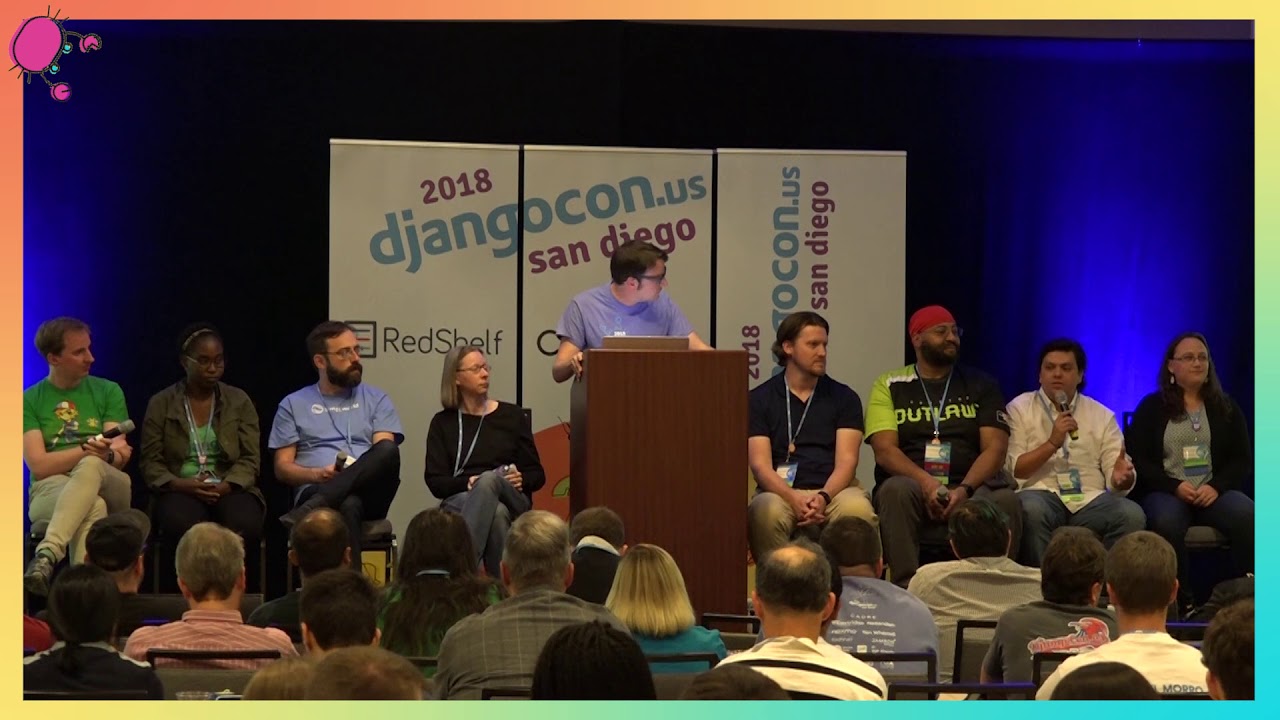
DjangoCon US 2018 - "State of Django" Panel by Simon Willison
Join us for a panel on the State of Django: the state of the Django codebase, but also the state of the Django community as represented by organizations like the Django Software Foundation, Django Girls, and DEFNA.
Moderated by Simon Willison, our panelists will discuss:
how we can continue to grow the Django community and create a welcoming space for beginners
the priorities for the continued development and maturation of Django
ways to improve Django events and bring them to new regions worldwide
success stories from Django communities
concrete steps toward better and more effective diversity and inclusion efforts
and much more. It’s been a long time since we gathered leaders of the Django community on one stage to have an open-ended discussion about Django’s present and future, and we hope you’ll join us for this special event.
Panelists
Andrew Godwin
Anna Makarudze
Frank Wiles
Jeff Triplett
Josue Balandrano Coronel
Katherine Michel
Kojo Idrissa
Rachell Calhoun
This talk was presented at: https://2018.djangocon.us/talk/state-of-django-panel/
LINKS:
Follow Simon Willison (moderator) 👇
On Twitter: https://twitter.com/simonw
Official homepage: https://simonwillison.net
Follow DjangCon US 👇
https://twitter.com/djangocon
Follow DEFNA 👇
https://twitter.com/defnado
https://www.defna.org/
Django’s strength lies in the wider community around the framework: Django Girls has introduced thousands of people to technology, helped grow Python communities internationally, and shown the value of accessible education, mentorship, translations, and local events. The speakers argue for more inclusive and distributed participation, supported by practical resources, actionable codes of conduct, office hours, sponsorship, and paid roles such as Django Fellows. They support making Django’s governance more public and consensus-driven, bringing new people into core work, investing in third-party packages, and evolving the framework toward stronger asynchronous support while funding projects that the community identifies as important.
Summarised automatically from the transcript.
Automatically transcribed, so expect mistakes in names and technical terms.
Speaker 1: So hi. Yeah, this is um so the original idea for this panel was to be a sort of state of Django um talking about the code, and then we realized that the more the Django community is far more interesting than the sort of nuts and bolts of the Django framework itself. So we've assembled a panel of representatives from a whole bunch of exciting projects that help make up that Django ecosystem. And I've actually started thinking about this more in terms of this is a what can the Django project learn from the Django community panel? So in that light, um we've got a fantastic group of panelists. I'll um ask them to introduce themselves briefly and then we'll we'll start the conversation. So uh Andrew, could you introduce yourself to the room?
Speaker 2: One, two, there we go. Hello. Uh thank you, Simon. I am Andrew Godwin. Uh I am a Django uh core developer. I mostly known for my work on things like channels and migrations and South in the past.
Speaker 3: Hello everyone, I'm Anna Makaruzze. I'm a developer from Zimbabwe. I am with Django Girls Foundation, the DSF, as well as the Python community in Zimbabwe and Africa.
Speaker 4: Hi, I'm Frank Wiles. I'm the president and founder of RevSys and president of the Django Software Foundation board.
Speaker 5: I'm Catherine Michael. I also go by Katie. I'm a web developer and community manager for Eldarion. I'm a DEFNA board member, the DjangoCon website chair and a DSF member.
Speaker 6: Hello, I'm Jeff Triplett. I am the DeafNet president and co-founder, uh PSF director, uh DjangoCon U. S. Principal Organizer for the last four years. consult at the repsis.
Speaker 7: Hello, I'm Kojoi Derisa. You've seen way too much of me this week. I am the definite North American ambassador. I am also the orientation lightning talks and sprints chair for DjangoCon US and other things.
Speaker 8: Yeah. Uh hi, my name is Josué Valandrano Coronel. Uh I work for the Texas Advanced Computer Center and and I'm also one of the newest DevNA board members. Great. Hello. My name is Rachel Calhoun. I'm a Django developer, also associated with Django Girls Soul and Django Girls and Pyleades Grand Rapids, Michigan.
Speaker 1: Okay, um let's have another welcoming applause for our panelists. So I wanted to start by talking about Django Girls because honestly I think Django Girls is an e incredibly inspiring project and we're very lucky that it chose to attach itself to Django as a community. I feel like it's one of the most vibrant and um exciting parts of the of the Django ecosystem. So Rachel, could you give us some of the latest highlights on on how on how the Django girls organization is shaping up?
Speaker 8: Yeah, um so I got a little side up. Um so we've we have sixty-nine upcoming events, six hundred and seventy-one past events. And total number of applicants, 43,885. And people that have actually attended the event, 16, past 16,000. And in that's in 94 different countries. So yeah. Um and last year there was the impact report and we sent out surveys to try to see where people are now. Um because we we hadn't been tracking that and from the from the responses we got 21% of uh participants that came to our workshop um they started into tech after that and now they're working in tech
Speaker 8: So
Speaker 1: I I just think that's astonishing. Um so uh Anna, you've um uh could you give us an update on how Django Girls is shaping up in Africa
Speaker 3: Uh we have uh okay, many events happening uh mostly um in Nigeria Uh I think Nigeria has recorded the highest number of events, but we have events happening across Africa, South Africa, Zimbabwe, Namibia, Ghana, and many other countries. So Uh Django Girls has been instrumental not only in impacting women, uh introducing them to technology and coding, but it has also helped us grow our communities because every other country that's developing their Python community. They are starting by organizing Django girls and then they move on to PyCons and other events. So it has really been helpful. uh for us as a continent in developing the Python community and advancing the use of Python in Africa.
Speaker 1: And uh so I understand the DSF um actu uh funds Django Girls events. Um could you talk us through some of how that works?
Speaker 4: Yeah, so um actually it's one of the bigger uses of DSF funds. Uh it kind of goes uh paying for the fellows and then funding Django Girls. girls events and then funding other types of Django events and and specific types of development. Uh but yeah it's been really successful. We we actually have had to move to kind of having it be part of a consent agenda for the DSF board meeting so that we don't end up taking up most of our board meetings saying yes, yes, yes, yes, yes to all these Django Girls events.
Speaker 1: Fantastic. So on that sort of topic, I feel like one of the things that Django Girls brings to the Django community is a fantastic focus on on education and sort of helping people get started with um learning how to achieve their goals in in web development uh with with Django as the sort of substance So open question to the panel. How can we double down on that and become the open source community with the best possible education experience for newcomers?
Speaker 8: I'll um I'll I'll kind of start us off, I guess, uh from because I am a career changer, so um I've kind of experienced both both ways as a participant as an organizer um and as a coach. So of obviously resources. There's a Jangle Works tutorial that's great, but then what next? Right? And I think that's something we could improve on a roadmap, more resources, or just a a way to go after that. Luckily I had people around me to help me with that, but not not everybody Everyone is like that. And that's the next thing is mentorship. It's hard to find them, so if you're a developer, I encourage you to reach out and help junior developers or people that are interested in getting into tech.
Speaker 1: And a sort of follow-on from that, what makes a good mentor? Like
Speaker 7: There we go. I think one of the things that is important as far as mentoring people is the fact that you actually care about that person's advancement. and their improvement as far as uh their skills or whatever it is they're trying to do. So oftentimes mentoring is looked at with regard to how much technical skill the mentor has, but I think the reality is if you actually genuinely care about that person making some sort of progression towards whatever the goal is they're trying to trying to reach. That's one of the more important criteria because if you care about that person's advancement, you'll do what you need to do to help them find the inform. But one, help them figure out what the goal is that they're trying to achieve, and then two, help them them find the resource the resources that they need to reach that goal. So I think that's one of the more important things.
Speaker 8: I um I also want to add that as a mentor, admitting you don't know things um helps people understand that you don't have have to be perfect, you don't have to know everything. For me that was a huge moment when I was learning that my mentor was like, I don't know, let's Google it. And I was like, oh, okay. That's okay to not know something. Um and another thing is resources. Uh something I I got from my mentors was just you know, conferences coming up, scholarship opportunities, um things like that that maybe you're not exposed to and you're not really in the tech field. And if someone can share that with you, that's that's valuable very valuable.
Speaker 4: Yeah, I definitely echo that. I always try if I'm mentoring somebody to tell them some story where I didn't know what I was doing and it took me forever to figure out that thing. It puts people at ease. And then just kind of having that kind of beginner mind. What was what was stuff that tripped me up way back then? And and being able to kind of just do that that empathy of, oh yeah, I've been there too. Uh
Speaker 1: Hoswei, did you have a um uh jank a um uh uh documentation and tutorial project that you were doing one of the efforts that we're doing Devna
Speaker 8: is trying to open a little bit more resources for people that would like to create events. So I mean it does have to do with the with the topic at hand right now, which is uh trying to teach other people, right? about everything that we that we can uh about software programming and Django and all that all of that. So a lot of that actually uh happens in all of these different types of events.
Speaker 7: And all of not not all of those have to be really big events. Events like for instance this one could be smaller events like the ones that uh Django Girls actu uh also do, different uh different type of tutorials and stuff like that. Uh one a really good resource actually
Speaker 8: it comes from Django Girls, which is the handbook that they have to create events, but we're trying to create more resources around that and and just uh different guidebooks on how to to create different types of events.
Speaker 7: So if anybody has any questions uh about
Speaker 3: about how to actually uh start with that, um
Speaker 7: you can you can uh I don't know contact us.
Speaker 5: Um I'd like to add that we'd love to have assistance with with this and it's been a huge boost to have Hostway join the board because he has kind of spearheaded this and we're doing a lot of new outreach, not just you know in local communities but also uh internationally and it's really exciting because we're hoping to Move beyond DjangoCon. It's been a new goal for us in the past year or so to move beyond DjangoCon to also do outreach in local communities.
Speaker 1: So yeah, this is a great opportunity to to talk about events because um certainly Django Girls is a very events-focused organization. DEFNA has been doing an amazing job with with DjangoCon and trying to push into further events. So sort of open questions to the panelists, why why aren't there more Django cons around the world right now?
Speaker 4: That's mostly the DSF boards uh doing. Um so uh we we own the trademark around Django and so we and and DjangoCon and so we We c we are the ones who let you have a Django Con. And the board's position on that has been the same for a long time, that it running a conference is very hard and most people don't realize really how hard it is and how much work goes into it. into it. DEFNA spends most of the year organizing this and it with a group of of you know a dozen or more people working on it throughout the year just to make it happen. And so if you're wanting Django Khan Fridonia in your country, the worst thing you could do would be to have a conference that starts off and goes very badly for whatever reason.
Speaker 4: reason because you'll never end up having Django Confredonia again. You won't be able to get sponsorship and you won't get people people to buy tickets. So it's important that whoever starts one has a lot of event planning experience and can show that they've got kind of lines on sponsorship lined up and and before we would grant one and that's why there's only a couple of them.
Speaker 1: But that applies to the sort of Django Con brand. At the same time
Speaker 4: Yeah absolutely. I mean if you want to have Django weekend or you know Django Day and your city, go for it. You know, and let us know how we can help. But the the larger conferences, we're kind of keeping the Django Khan name close hold.
Speaker 1: So um one thing that I've certainly realized is um this DjangoCon is probably the most diverse technical conference I've ever been to. Which I think speaks poorly to my previous choice of conferences. But I would like to ask the DEFCO members on the panel, how did you pull this off? Because this is not an accident.
Speaker 6: So pretty much um that's that's a hard question actually. Um kind of getting out of the way for a lot of people who want to help, I think we 're If we look back four or five years ago, there was a much smaller group of people running the conference. And so one of the things we wanted this to be is a community-rand conference. And so we tend to err on the side of giving you more access to do things you want to do. And in so far it's worked out pretty well for us. Every year too is an iteration of the previous year and seeing what worked, what didn't work. That's been pretty successful. Honestly, I as somebody who doesn't like to do public speaking, I have no problem not being on stage, which is why Kojo is on stage for hours and hours each day, which is great. So I think that was a big factor. Um we have a really good actionable code of conduct too, so it's easy to keep nice people here because we can ask people
Speaker 6: who aren't nice to leave. So I think that also is a factor as well. And thank you for the compliment too.
Speaker 7: So I would say as the person who's on stage uh all the time, um one of the things and I have said this to to attendees here and And as one of the members of a former definite board member and a Django Khan US organizer of that group, I think I am one of the more extroverted introverts. And so I have said this to people as I interact with them. the entire team has a a very serious focus on trying to make Django Con as inclusive as possible. So not just trying to reach out to people of different groups. but you're try but trying to create a conference environment such that when people from a variety of different groups come to Django Con, you feel comfortable, you feel welcomed because like we really legitimately truly want you to be here. I mean
Speaker 7: want you to have the actual best Django Khan experience you can have. And I'm like the big visual one who's saying it to people and kind of in your face all the time, but there's a whole other group of organizers that you might not see as much who feel the exact same way. And so that's why you get that feeling here because we're all on the same page about that. So
Speaker 5: the organizers are okay, I've never been an organizer or for a different conference, but so I don't know what other experience people have, but the organizers are absolutely constantly trying to find ways to make get more diverse and to bring underrepresented people in and it is such an important part of it. Um I have experienced it myself and It has just drastically improved my own life from um Jeff encouraging me to become the web website share and that it I wouldn't have thought of that for myself and um it was something I wanted to do and it helped me learn and helped
Speaker 5: me mentor other people and they are doing this everyone is doing this in the community as far as I can tell among the organizers.
Speaker 1: Um Kojo, you've been working as the the events ambassador for the for North America. What what are sort of the patterns that you you've uh the the sort of themes that you've noticed in in those conversations you've been having well
Speaker 7: honestly uh one thing that I've noticed it's a thing that uh I think we as the Django Khan US folks need to maybe get a little bit better at marketing wise is that people often think that Django Khan is just for talks about Django. And so uh so some people uh don't necessarily realize that you w I've spoken to people and asked them to submit talks to Django kind of like, oh well I don't do a lot of Django. Um but the reality is Django is an open source web framework written in Python. And so Python talks acceptable. web related talks or about even about other web frameworks or about JavaScript front ends acceptable. It's open source, so it's mostly built by volunteers, so talks that are related to the community. and helping people maintain their volunteer efforts by not burning themselves out or dealing with their mental health issues
Speaker 7: or having a culture that is included. and welcoming to people, all of those are valid DjangoCon talks. And as I've gone to different events uh literally all around North America and also Australia, um Um I think that those sorts of values are represented in the different communities that I've been to.
Speaker 1: So I'm interested in hearing more. I one of the things I find fascinating in Panjango is how international the community So I'd be interested in hearing more about some of the event plans in uh Mexico and Africa from Josue and from Anna. Uh
Speaker 8: yes, well actually there has been some effort also to try and bring all of these different uh type of events to Mexico. Right now the one thing that we have it's it's Python Day in Mexico. And that's gonna happen next next month. But uh the other thing that also is gonna happen but gonna happen until next year and it's kind of uh like a first step is to create a pay la pay latam which is Latin American. So uh that's going to be the first step to actually uh start to have more more events like this one and then eventually probably a Django Khan. Maybe we're gonna start with something like one day or something like that. I don't want to give out too many details because those might change and there's other people also involved in the whole uh organization of the event. But this is also helping us out trying to figure out what
Speaker 8: other resources do we need to give out there or to to make public to for people that would like to start this type of event. events and the whole point of these uh these events that are going to happen in Mexico and in other countries are also to be very international, right? For everybody, I mean whoever can who whoever actually can go to uh to these other countries and all that and also So uh expose a talk or something like that or just contribute in in any other way. Uh
Speaker 3: that's that's the whole idea to make a a more bigger international uh community. Uh uh so far there have been uh new events, uh PyCon events coming up uh with every year. Uh we started our own PyCon Zimbabwe in 2016. Uh Nigeria had their PyCon first PyCon in 2017. This year Ghana had a new PyCon and this uh These events emanated from PyCon, Namibia. The only country that had been running PyCon was South Africa. And this year was their eighth event. So we are happy that there are new PyCons coming up in Africa. But there is an a plan for a Pan African PyCon that will not only cover one country but uh
Speaker 3: as many countries as can be covered which we are planning for twenty twenty And we're also trying to come up with a small Django event possi if possible maybe for twenty nineteen or twenty twenty as well. So those are the plans that we have uh in Africa for PyCon as well, uh as uh Django events to have as something that is continental. And that's something that we are reaching out to the rest of the world if you want to participate uh by helping us uh with uh events. If you have been running uh a continental event, uh we value the experience that you have had. with the issues uh how to handle visas and other administration issues that can come up. Uh any information that you may have uh with regards to budgets, financial aid and stuff like that would also we would appreciate that very much
Speaker 1: Um go ahead.
Speaker 5: I I just wanted to point something out, and that is that um we actually have two people from Mexico who joined our board this year, Joseway. And we're also doing some Spanish language translation. Cacha has translated our website, which will go live soon, and we've done some tweets in Spanish. And I'm also hoping that the documentation that is in the works for local meetups that we might be able to do a translation of that also. Right. Um so
Speaker 8: on that note about like internationalism Um in Korea I I started uh the Jamal Girl Soul and um it took off. It's it was a huge success, but one of the things that made it so successful was all the work going into translations of Jail Girls tutorial. Right now it's translated into 14 different languages and it's being translated by volunteers so please help if you can into many others. So that was my kind of plug on the international scope working.
Speaker 1: So I'd like to move us on to talking about Django Core itself. And so I'm going to call on James Bennett in a minute. moments um as a quick guest uh um actually could we get you out here and we'll we'll we'll hand you a microphone. Um so this was discussed a little bit yesterday but there is a proposal in the works to um to introduce a completely new new uh governance model to Django because right now Django Core I will be honest does not look very much like the um the the the makeup of people in this room. And furthermore, Janga , it's we need to start injecting this vitality and this freshness and these new ideas into the core framework, the way the core framework is So um James is the author of the DEP, the Django enhancement proposal that's um uh outlining this new governance model.
Speaker 1: And I I I I James, if you could if you could give us the the executive summary from the from the author author yourself, that would be fantastic.
Speaker 7: Okay. So the way that historically Django development has worked is there are certain people who have commit rights to the main repository. We call those people Django Core. And they sort of get to make decisions and do what they want. There was for a long time Jacob and Adrian as sort of The proposal is get rid of that, uh shut down the private Django Core mailing list and IRC channel, move all of the governance of Django. Django the framework onto the public Django developers list. You may be wondering, well, if there are no more committers, how does code get into Django? The answer is already a lot of the commits that happen in Django Django are done by Carlton and Tim, who are the Django fellows, who are paid by the DSF to do all sorts of uh management around the Django source code repository.
Speaker 7: Uh the proposal is to formalize a role of a merchant merger. This is not someone who just adds code on their own initiative. It's someone who merges pull requests from other people after discussion and consensus on the public mailing list. This does away with the need to have the sort of multi-tier, you know, some people have special privileges and some people don't. Everybody would be equal on the Django developers list and it would be consensus driven as to what gets into Django. The mergers would simply be a bureaucratic role. There would still be a technical board elected from the Django developers mailing list every so often to act as a final decision making. backstop if we need one. Although I will say I've been on the technical board I think now four release cycles
Speaker 7: and we've had very little work to do. So I would like to see that continue. Because it seems like at least the consensus model seems to be working.
Speaker 1: Great. Um any thoughts from the panel on on this on this as a as a concept for governance? going forward.
Speaker 2: Yeah, and in fact like one of these things um I can talk about it already started happening. So when I launched my big uh sort of proposal for like hey let's take Django and make it all asynchronous um Um I did that directly in public on the Django developers mailing list. So like we we have the private list. The private list is not very busy, but it does still exist. Um and for many years we want to try to get try and get rid of it. So that's okay let's just get rid not do that go straight to public and try and get that discussion and get and like see if there's any objection and like much to my surprise there was no objection like there was a near unanimous um agreement agreement for the community, which is like you know I am occasionally personally a little bit suspicious of um, shall we say, everyone agreeing at once kind of base systems, but it seems to work with Django. We foster this kind of community that works
Speaker 2: works. Um and the technical board, you know, I'm also on it and we've had like one email on the last year, I think. It's like there's not much contentious going on right now. So in in that regard, I think it's a good, maybe not the complete solution, but it's an excellent um move forward for us.
Speaker 1: Anyone else got uh any input they want to make on this?
Speaker 6: So first of all I think it's a great first step. Um my concern is just you know we we do have a problem it's an uncomfortable problem and I'm glad we're addressing it um I've I've seem to notice like there's certain parts of Django we've noticed and even Django girls like when when Django Django hired somebody to be the fellow, the the framework advanced at a pace that we couldn't advance previously. Um with Django Girls too having a couple of ambassadors. Uh we've seen some huge improvements now where You know, you have somebody who's paid to work on the problems and and fix things. So my only concern is that I would love to see us take another step and hire somebody who is, you know, knows what they're doing with diversity and And let's like head on reach and let's you know let 's fix some of the various issues by bringing an expert in. But I I love the step. I think this is good, but I would just love to see a little extra bit.
Speaker 5: Um you know I've gone to the documentation and looked at the lists of people who are on committees and core committers. And it's like for me that's the face of Django and a lot of these people go back to Lawrence Journal journal world or they've been around for a really long time and it's like they know the history of Django. and have a lot of tribal knowledge. And for me, that was a psychological barrier of entry. And just having the message that Carlton gave of welcome and saying that you're needed. Um for me that makes me much more likely to contribute. And I think that we are very often surfacing the accomplishment of these same people and that we need to make the face of Django
Speaker 5: more about the diverse community we are becoming and start surfacing new people and new opportunities. And this is a really good first step.
Speaker 1: So a few people have mentioned the Django Fellows now. For anyone who's not familiar with that program, uh there are two Django fellows who are actually employed by the Django Software Families. Foundation essentially to do the bug triage and help manage releases and the stuff which um the the the stuff the I don't want to say the tedious stuff, but some of the the sort of ongoing work that needs to be done to keep the community healthy I it's quite a rare model in open source actually and I think it's been extremely successful. I'm really impressed with with with the impact that's had. So my question for the uh panel is um do you feel like the Django Fellows program is working well as it is? kind of loaded the question there. But also um do you see um how do you see that program expanding maybe with new responsibilities or or Other things that might help it work even better.
Speaker 4: In short, yes, it's working really well. Um we we've seen uh a steady pace of releases, um security issues that come into the security mailing lists are dealt with and triage super quickly sometimes in less than a couple of hours. Um where with community resources that might have been a day or two and if it was a busy holiday holiday weekend, maybe several days. Um so you know those parts of it work really well. I think one area where we could one, we could have more fellows if if we raised more money uh so Django could move faster and and and and more or you had money to put behind projects like moving to async or like with the Mozilla grant for channels. If we had if we had some piles of money like that, then we could, you know employ people to work on those problems specifically, but I also think that we need to uh
Speaker 4: focus some energy around maintaining the third-party app ecosystem. things like Django debug toolbar and all the things that the Jazz Band group takes care of. How can we support them? Um the I I know personally almost every Django project I work on uses some number of third party apps that aren't that aren't mine and aren't anybody as part of Django Core, how can we help them? Um could we have a fellow who focused on those issues, looking for pull requests and small bug fixes and and be added as a maintainer across a lot of those projects. And I I think that's something that we should explore.
Speaker 2: Yeah, I totally agree with that. Like Django stands on the shoulders of its third party apps in many cases. And like we we claim to be batteries included, but Some of the batteries come in the form of those th third party apps and having having like a better cause like, you know, if it's bad enough for the Django core, like those third party maintainers burn out even more easily than we do. Right. Like it's often a story that like those apps come and like they get popular, then as I know from personal personal experience, you get a deluge of feature and issue requests and you sort of just go, oh, I decided somebody has to walk away. And so it would be really nice to see like not just maybe in front of like Django itself helping out a bit more actively in things that really help build our community. that sense as well.
Speaker 1: So on that theme of um so fellows is a is a concept we think other open source projects should should steal from us. What are some of the ideas from other open source communities that we should be adopting?
Speaker 5: Something that I've uh come across recently is that I've seen other communities do kind of like a dir diversity audit or an open source project health audit. And we are making a lot of progress naturally But I feel that if we could look at where we think we should be and where we are and find problem areas and maybe create Create a a strategy that we might make more progress.
Speaker 4: Yeah. Um I I think one of the the great open source communities out there that we 're going to do. we could learn a little bit from is the Postgres community. There is a uh a huge amount of large commercial enterprises. that contribute whole people and money and resources uh to the Postgres project and that's part of I think part of its success and the fact that it is not tied around one particular company. Um means it's very resilient if a company falls away or becomes a bad actor, that doesn't harm the project as a whole. I'd really love to see companies who are using Django Django contribute more of their own staff's time or uh funds in general and and have some of these you know this we
Speaker 4: Django's being used by lots and lots of people. If if there was a little more contribution back from some of these companies, I think that would whiff the whole project.
Speaker 7: I also think the idea of uh sort of expanding the concept of office hours might be useful. So My first open source contributions were ever to Drupal, which is the PCP project project, and I literally learned how to use Git for the first time. sitting on my former sister-in-law's couch in Japan during uh Drupal's office hours, Drupal core office hours. So they had a set of office hours and I think they still continue to do it with there's a certain period of time once per week, I believe, where there are people in the RRC channels available to help you learn how to learn how to make contributions to the core. And I know that somebody, I think I believe Marietta holds office hours. as far as Python core goes. So there are some of those things that are being done, but sort of expanding efforts like that where a dedicated amount of time is going to be set aside
Speaker 7: for the purpose of helping people become more informed. involved in the project in various ways.
Speaker 1: So um we've talked a lot about the Django community. Let's spend a little bit of time talking about the Django Django framework itself. So I'm interested in what are the big ideas for Django? What are some ambitious projects that Django should take on next? And I'm going to pick a speaker completely at random and point it out. Andrew to to see if he has any thoughts on on what the the next big evolution of Django should look like.
Speaker 2: thoughts uh too much even for a full hour panel I think. Um so yeah this is one of the things like um if you've seen any of my talks over the past couple of years the end is often um what is Django, right? Like my position is like Django has kind of achieved what its initial goal was, which was to become this sort of good framework that was designed for like from a newsroom. environment initially. But like, you know, we had to work out what it is in future. And like my personal like pet project these days is asynchronous stuff. If you've not seen my blog post, the plan is to take progressively more and more of Django to be async capable. So starting with the request path, ending with the RM being fully async capable. And there's a lot of enhanced There as well. There's other small things too. We were just talking this morning, Simon, about MySQL now has great geospatial support.
Speaker 2: And so there's a there's a huge opportunity there for adding good Geo Django support to the MySQL. backend. And there's all sorts of good ideas like this that we need to just go and find. One of the kind of problems is that many of us on the uh currently Extant core team are a little bit sort of old like long on the tooth, should we say. Like we've been around like we sort of settled in our ways. And I think
Speaker 1: we got dogs.
Speaker 2: Um I got I got too many hobbies. But the point is that we need that injection of uh fresh talent as well to help bring those new ideas, right? Um but certainly in the short term I think like if we want to be competitive on, to use a phrase, the world stage of frameworks, I think looking at what everyone else is doing and like the what people are turning towards, things like Node especially. go and like having a great fluid easy to use asynchronous story is for me one of those big ones like can we position Django as oh no we're we're not only with the experienced like well learned framework, but also we have all the shiny new things as well. That'd be really powerful.
Speaker 1: This reflects back to a sort of earlier earlier topic. How do we make our how do we take the lesson from our events world in in inclusivity and making lowering the barrier to entry for new developers, how do we apply those to Django Core itself? And that's an open question for
Speaker 4: So uh one way that we opened some stuff up uh in the last year or so that I don't think has maybe gotten as much news as as maybe I've got should have tried to push for it. But who here is a member of the Django Software Foundation? Did you know that the rest of you can be too? Uh all you have to do is go fill out a web form and you can become a member and then you can vote on who gets to be in the board and participate in the discussion. It is not a high traffic mailing list. Uh no one will come and beat you if you don't vote. Uh but so you know please come and and and join uh and and and start participating. You we can f If we're all kind of on the same mailing list, we can throw around ideas and communicate a little better as a community.
Speaker 1: Any further thoughts on um on lowering that barrier to entry?
Speaker 8: Um well I liked what Carlton said earlier in his talk, um in and just his approach to it and and and trying to take away that pressure but like mentorship we had touched on earlier but just um for myself too I I wouldn't feel comfortable and I know if people with 10 years experience or whatever experience they might not feel comfortable so just like um if you know somebody that would like to be interested or mention it or or nudge right sometimes we just needed a little nudge in the right direction um and then if if if there is interest kind of help them and and pull them up right to where you are or if you're in you know a place where you can help somebody. I think that would definitely be helpful. Or if there was something more official that you know a program that would be even better. But yeah.
Speaker 7: Actually, yeah, I want to steal a phrase from Rachel from earlier today with regard to helping people meet their goals. So if you're gonna have people making contributions to Django, again, let's be realistic. The people who are going to make contributions to Django are going to be people who use Django. The people who use Django are going to be people who find that Django helps them do the things that they're wanting to do. whether that is become professional software engineers or to just build web applications that you know that are for their Boy Scout trooper for their Overwatch League team or for whatever. No bias there. Um but uh the people who are going to actually contribute to Django are going to be the people who actually use Django. And so in your local communities, your local Python and Django user group. if you can sort of make an effort to try to help draw more people in by showing them how Django can be useful to them, it can be beneficial to them, even if they're not planning to become professional software engineers.
Speaker 7: If Django is useful to them, those people become part of the community, and that large that widens the pool of the community. And so the volunteers, the contributors are going to come from that community who actually find use in Django. Django. So I think that would be very helpful.
Speaker 1: Let's talk about money. So the Django Jang so the oak to the question basically is who has money and who needs needs money. And uh Frank, I'd I'd love it if you could fill us in on how the Django funding ecosystem works at the moment.
Speaker 4: So um I think by terms of who has the largest bank account I think the DSF wins out by a little bit. And we we get our money mostly from corporate sponsorships and individual sponsorships. And then the current PyCharm type promotion that's going. going on right now is a is a big source of our revenue each year. I'm very confident that if we had some big projects to spend on we could go find the money. Um but right now we don't have a lot of asks and we don't have a lot to go spend it on. Um that makes sense to us. And so if we had a reason, I think we could go find the money. And I think that if you know, but depending on the reason reason, I think uh we would know who to go target. Um so if it was something async, who would benefit from that as companies?
Speaker 4: Let's go reach out to them, get $5,000 from 10 companies and we're off to the races. Um so I I think that that's you know and then we use that money for the fellows, we use the money for sponsoring events, um, and and we can use that money for other things. the that the community dreams up.
Speaker 1: Anyone on the panel want to say that they need the money? Or or or or
Speaker 3: Uh all right, I'll answer uh on behalf uh first on behalf of uh Django Girls is the fundraising coordinator. Uh Django Girls needs the money. We need to uh support our infrastructure that enables us to uh give the resources uh our volunteers are using uh to organize their events uh support our online tutorials and stuff like that. So Django Girls does need the money. Then as well as uh a DSF director representing Africa. We also need the money for our events in Africa. So would really appreciate uh sponsorship for our events. Uh so yeah we need the money as younger girls as well as uh Africa needs your money. Thank you.
Speaker 7: from uh from more slightly more self-serving perspective that uh DEFNA as a former DEFNA board member DEFNA could use the money because one of the things in addition to putting on DjangoCon, which hopefully you all are enjoying, DEFNA is also working to promote Django related educational events throughout North America. And one of the ways that DEFNIN does that is by providing grants to people who and to groups who are doing those sorts of events. And so the more money that that there is that is available to DEFNA, the more more grants that DEFNI is able to give or the larger those grants can become. And that also makes it a little more viable for people to start thinking about having their own Django related events.
Speaker 1: So I'd like to finish up by um inviting the board to to put out some calls to action. Like what are things that we as members of the Django community, what are actual action points we can be taking to address some of the issues that we've been discovering today? And I'll do this in a in whatever order you like.
Speaker 2: I'll I'll start then over here. So my call to action is uh somewhat predictable. Um but it is about um having ideas, right? Like right now we are on the precipice of opening up the Django what what what what will become the former Django core. to everyone else here. And a lot of you use Django, a lot of you use Django more than I do in my job these days. You have the ideas, you have the knowledge, and the next decade of Django is going to be defined by the big idea. Like we need to know like what should we work on? What what what high point should we aim for? Even if we do part of it or just sort of a smaller version of it. We need that kind of input. So like please come to sign up Django Developers. Come and suggest big ideas.
Speaker 2: Let us discuss them. Let's renew some of the energy and think about what those next that next decade holds for us. F
Speaker 3: uh for me I would appreciate if we could get um members from uh the American community uh in all over the world joining our mailing list. Uh Python Africa so that you can meet other developers uh from Africa, mentor them, help them grow and if not only we don't appreciate just uh the mind, we do appreciate the mind, but we also appreciate the knowledge transfer that can uh happen if there's an interaction between uh Africa and the rest of the world. So we really appreciate uh learning from you and if there's any way you can reach out to Africa and try and share the knowledge that you have. that would go a long way in also ensuring that um even the contributors to the Django project itself uh
Speaker 3: uh is diverse. So we cannot just expect uh to say we are opening it up to everyone and ex already accept accept uh expect that uh uh the contributors will be diverse if you are not willing to help other people who need to learn and grow and then be able to contribute to the Django framework. So I think we need to be able to offer our time as mentors for knowledge transfer to OK so that we have a diverse group of people contributing to Django.
Speaker 4: I I think that joining the DSF membership and getting involved in the community um at in any way, shape, or form, it doesn't have to be code. Most of my contributions to Django are not in the form of code. And uh yours don't have to be either. It can be, like people have said, mentoring, j answering questions on mailing lists, fixing typos in docs, adding docs that can that you know, docs that confused you changing how they're written. so that they're less confusing. There's lots of ways to get involved. You can volunteer at conferences to be a chair runner and session runner. There's lots of ways to get involved and just help get involved.
Speaker 5: If you see a person in our community, especially an underrepresented person who could take on a leadership role and maybe, for instance, they don't think of themselves as being able to do
Speaker 6: So mine is more like generic, I guess, for the framework. Um a couple years ago there was this joke that was kind of going around and Basically was the idea of calling the framework boring. Please stop doing that. Um essentially we have like thousands of attendees go through Django Girls every year and they're really excited because they just learned something that's new and it's exciting. and they're learning how to code. And so I get that sometimes we've some of us have been here for a while, we've been doing Django and to us it's it it you know if there's the joke of it's boring. It's really dismissive to people. Like I think probably a third of our audience every year are people who are new to Django. It it is exciting. You're learning something new. So I think you know setting that tone, letting people know they're welcome.
Speaker 7: Alright, so as the North American ambassador, I have specific assignments literally. The idea is to start trying to build bridges. A lot of things that happen in Django are centered maybe in the US or in Europe, and so we need to expand upon that. So I'm gonna look at Mariata and point to her as an example of how was being done right. So Pi Cascades, a local conference that moves between Vancouver, Seattle, and hopefully Portland. So then you've got Canada and the U. S. interacting with each other. Uh I don't know if Ernest is here, but say Chicago, Detroit, Cleveland, you all are responsible for Toronto. And so I need I need Bridges to be both between Toronto and Ontario. So wherever you're from, uh I'm in Texas, uh in Houston, Houston, Dallas, Austin.
Speaker 7: We're responsible for Mexico Mexico City, Guadalajara, San Diego, you're responsible for Tijuana. So wherever you live, go to Google Maps and just look at look at say what's a f four to six hour drive from you and structure to if it's international then structure try to make connections there. But even if it's not international, so for instance, Pi Ohio and Columbus Pi, Tennessee, and Nashville, you all are responsible for Appalachia and making sure that there's more activity in those regions. And then Pi, Ohio, since PiCon is in Cleveland. this year and next year, start making those connections, using their connections with Toronto and Ontario to spread some of that information from Toronto and Ontario into to Appalachia and then when people from Texas come to Pie Ohio and Pi Tennessee, we can share that with the folks in Mexico City and Guadalajara.
Speaker 7: So and people on the east and west coasts, West Coast you're responsible for Asia, East Coast you're responsible for Europe. So
Speaker 1: nice.
Speaker 7: So so y g get to it. Caribbean Caribbean. Also the Caribbean. Al also the Caribbean. So Florida. Actually I'm I'm gonna say most of the Gulf Coast We're responsible for the Caribbean, but also if pod Caribbean January and February, if you live in the northern part of North America, you want to go to the Caribbean in February. So keep that in mind. Good call, Kenneth. Well along those those same lines, uh also
Speaker 8: the whole thing about creating events uh local to wherever it is that you that you leave, uh that's a really good idea. But also if you don't have any idea on how to start or maybe you just Not sure if you want to do it or not, you can come and talk to us. That's also something that we do at DevNA. And that's something that we want to do even more, which is give you more information. uh more details and guide you on how to do these things because we know that it's not easy. Uh but so the only thing is that we also need your feedback. to see what is it, what what's the information that's missing that it should be out there and it is and it's not there. All right. I'm going to speak um on behalf of like Django Girls and what you can do to help Help us with that community, uh, money
Speaker 8: for your local events. Check um it we're in ninety-four different countries and a ton of cities, so check what there is. If you don't have money, money or you don't want to give money give your time organize events be a coach you can do it we have uh organizers manual online to follow so it's basically copy paste and also help maintaining the tutorial and keep it up to date or translate it as I said earlier. Need you.
Speaker 1: Awesome. Well, uh, we're out of time, so thank you very much to our panel.
Django Girls had 671 past events, 69 upcoming events, more than 16,000 attendees across 94 countries, and survey responses indicated that 21% of participants went on to work in tech.
Discussed at 3:14Funding Django Girls events is one of the DSF’s major uses of its funds, alongside supporting fellows, other Django events, and specific development work.
Discussed at 5:07A good mentor genuinely cares about the learner’s progress, helps clarify their goals, and finds resources to help them reach those goals. It also helps to admit what you do not know and empathize with the difficulties of being a beginner.
Discussed at 6:57DEFNA is developing resources and guidebooks for different kinds of events, building on the Django Girls handbook for event organizers. These events do not have to be large conferences; local meetups and smaller workshops are encouraged.
Discussed at 8:44The DSF controls the DjangoCon trademark and is cautious because running a large conference is difficult and a badly run event can damage future sponsorship and attendance. Organizers need substantial event-planning experience and credible sponsorship plans before a DjangoCon is approved, although smaller Django Days or weekends are welcome.
Discussed at 10:42The organizers deliberately made it a community-run conference, gave more people opportunities to participate, iterated on improvements each year, and used an actionable code of conduct. They also consistently focus on making attendees from different backgrounds feel genuinely welcome.
Discussed at 12:37DjangoCon accepts more than talks specifically about Django: Python, web development, other frameworks, JavaScript front ends, open source community practices, inclusion, and volunteer sustainability are all relevant topics.
Discussed at 16:02Mexico was planning Python Day and a Latin American PyCon as steps toward more regional events, while African communities were expanding national PyCons, planning a Pan-African PyCon, and considering a continental Django event.
Discussed at 17:25The proposal would retire the private core mailing list and IRC channel, move governance to the public Django Developers list, and make decisions through public discussion and consensus. Dedicated “mergers” would merge agreed pull requests, while an elected technical board would remain as a final decision-making backstop.
Discussed at 22:15The fellows program has accelerated releases and security-response triage. The panel suggested adding more fellows when funding permits and supporting the third-party app ecosystem by helping maintain widely used packages.
Discussed at 27:51Suggestions included conducting diversity or project-health audits, encouraging companies that use Django to contribute staff time and money, and expanding regular office hours where newcomers can get help making contributions.
Discussed at 30:12A major priority is making Django progressively more asynchronous, from the request path through a fully async ORM. Other opportunities mentioned include better GeoDjango support for MySQL and bringing newer contributors and ideas into core development.
Discussed at 33:01The DSF’s money mainly comes from corporate and individual sponsorships plus promotional campaigns. It uses those funds for Django Fellows, event sponsorships, and other projects, and could raise targeted funding from companies that would benefit from work such as async support.
Discussed at 38:02Note: We understand that names change, people change, and bodies change. We respect each individual's journey and privacy. If you have any concerns about a video or need us to remove content, please don't hesitate to contact us. We will handle your request with care and promptly address any issues.
Published November 3, 2022

Published September 30, 2020

Published October 25, 2019

Published July 10, 2024

Published October 20, 2021

Published June 27, 2021

Published December 6, 2024
Published November 3, 2017

Published September 7, 2017
Published April 28, 2026
Published October 21, 2025

Published July 27, 2021

Published October 21, 2021

Published October 20, 2021

Published November 8, 2018

Published October 20, 2021

Published October 20, 2021

Published April 12, 2021

Published October 23, 2025

Published December 6, 2024

Published November 22, 2023

Published October 23, 2025

Published November 22, 2023

Published December 6, 2024

Published November 3, 2022

Published November 8, 2018

Published July 15, 2026

Published July 15, 2026

Published July 15, 2026
Published July 15, 2026
Published July 15, 2026
Published July 14, 2026